 Nerve Blocks App
 Anesthesia Assistant App
 US Pain Management App
 Pain Medicine Assistant App
 POCUS App
 IV Access App
 MSK Knee App
 VetRA App
 Nerve Block Manual
 Regional Anesthesia Updates
 Anesthesiology Manual
 Anesthesiology Review
 Anesthesia Updates 2025
 Anesthesia Updates 2026
 Pediatric Anesthesia Updates
 Airway Management Updates
 US Interventional Pain Manual
 Pain Medicine Updates
 Mastering Difficult IV Access
 PACU Nursing Manual
 RA Veterinary Manual
 Books
Books About
About

Learning objectives
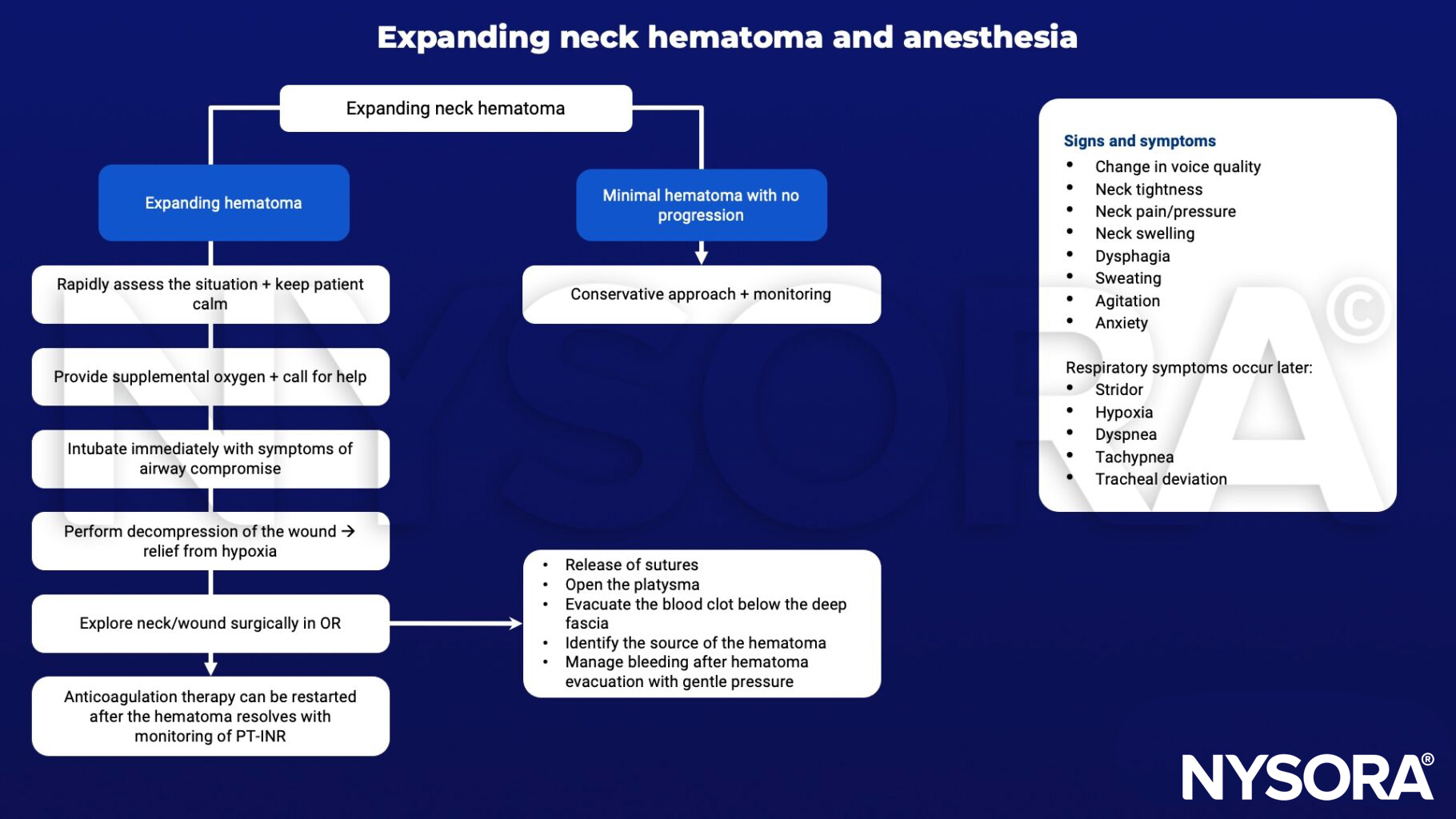
- Recognize an expanding neck hematoma
- Management of an expanding neck hematoma
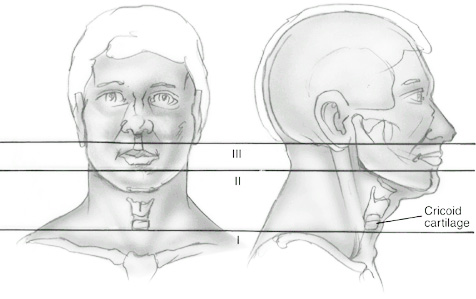
Definition and mechanism
- Hematoma is caused by blunt neck trauma leading to the dissection of a major blood vessel or bleeding from a soft tissue injury
- May result from recent surgery or spontaneous as with a ruptured thyroidal cyst, thyroidal vessel, or parathyroid adenoma
- Affects the pharynx, larynx, esophagus, and trachea and results in airway compromise
- Theoretical potential for hemodynamic instability due to compression of the carotid sinus with resulting bradycardia/hypotension
Causes
- Injuries to the internal and/or external carotid arteries, external carotid artery deep branches, or internal jugular veins
- Injuries to the cervical fascial layers (barriers of deep spaces) that facilitate the pooling of blood and hematoma
Management
Keep in mind
- Intubation may be difficult and should be performed by an experienced anesthesiologist
- In case of inability to intubate, a surgical airway should be performed early
Suggested reading
- Alfraidy, D, Helmi, H, Alamodi Alghamdi, M, Bokhari, A, Alsaif, A. Rare cause of acute neck hematoma. Clin Case Rep. 2019; 7: 1378– 1381.
- Shuker ST. Expanding Hematoma’s Life-Threatening Neck and Face Emergency Management of Ballistic Injuries. J Craniofac Surg. 2 016;27(5):1282-1285.
- Shakespeare WA, Lanier WL, Perkins WJ, Pasternak JJ. Airway management in patients who develop neck hematomas after carotid endarterectomy. Anesth Analg. 2010;110(2):588-593.
- Barash PG, Cahalan MK, Cullen BF, Stock C, Stoelting RK, Ortega R, Sharar SR, Holt H. Clinical anesthesia. 2017. Eight edition. Wolters Kluwer.