Industry News - NYSORA

Explore NYSORA knowledge base for free:

IndustryWire
Industry News

Industry Spotlight at NYSORA Events: EpiFaith Smart Syringe Brings Modern Innovation to Epidural Placement

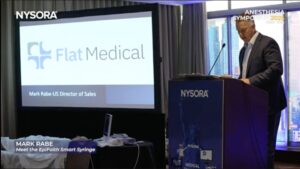
At NYSORA events, the lecture hall and the industry spotlights work hand-in-hand, with the latter offering concise sessions where innovators share practical tools and emerging solutions for clinical use. During the event,  Mark Rabe of Flat Medical, introduced the EpiFaith Smart Syringe – a simple yet transformative upgrade to a technique clinicians have used the same way for nearly a century. Why EpiFaith Matters: A Modern Solution for a Long-Standing Challenge Epidural techniques have been foundational in anesthesia for decades, yet the tools have hardly changed. Glass syringe? 1894. Plastic syringe? 1956. Loss-of-resistance technique? 1933. Very few aspects of medicine still rely on tools from the early 20th century – except this one. EpiFaith has already been honored with: Premier Innovation Award 2025 Vizient Disruptive Technology Award AAPM Innovation Challenge Award Contracts with the VA Health System and Department of Defense For a technology this new, the momentum is exceptional. What the EpiFaith Smart Syringe Does The Smart Syringe adds a visual confirmation to the traditional tactile “loss of resistance” technique. It doesn’t change the procedure – it simply makes it clearer, more consistent, and easier to teach. How it works As the needle advances, clinicians watch a yellow piston indicator. When the epidural space is reached, the piston pops. Advancement stops immediately. Confirmation is instant and objective. This gives clinicians two sensory inputs instead of one: – Tactile feedback – Visual confirmation The benefits become especially clear during training. Residents and fellows can finally see the moment the space is entered – a major step forward in teaching accuracy and confidence. Why Clinicians Are Paying Attention During his talk, Mark Rabe framed change in a simple way: People change for two reasons – to avoid pain, or to gain something better. EpiFaith aims to do both. Potential clinical and […]

View December 9, 2025

Industry Spotlight at NYSORA Events: An Opportunity to Showcase Innovation

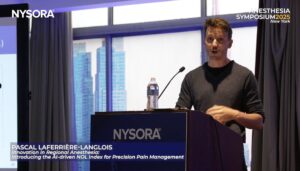
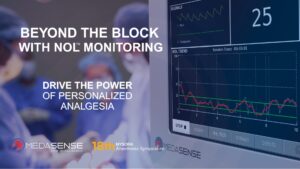
Across NYSORA’s global events one theme consistently emerges: clinicians want to see real innovation. They want to understand not just the science, but the tools and technologies reshaping regional anesthesia, pain management, and perioperative care. That’s why NYSORA continues to support non-CME lunch break presentations for industry partners. These short sessions give companies a high-visibility moment to showcase new technologies, tools, and ideas directly to an audience that’s hungry for practical solutions. This initiative aligns with a long-standing NYSORA vision: to bring clinicians and innovators into the same room, spark meaningful dialogue, and showcase the adoption of safer evidence-based technologies. A Proven Example: Medasense & the NOL Index One of the most impactful industry spotlights at our events has been the presentation by MedaSense Biometrics, the company behind the AI-driven Nociception Level (NOL) Index®. Traditionally, assessing nociception during anesthesia has been subjective and inconsistent. Medasense’s NOL technology introduces a new level of precision. It uses a combination of physiological signals-photoplethysmography (PPG), galvanic skin response, peripheral temperature changes, and motion – to generate a single, personalized NOL value. In practice, this gives clinicians: A clearer, continuous picture of a patient’s nociception level Better insight into block effectiveness A data-driven way to titrate analgesics Reduced risk of both under- and over-treating pain More consistent, predictable outcomes The PMD-200™ monitor, built around the NOL Index, has been recognized as one of the first tools to bring true objectivity into intraoperative nociception monitoring. Its ability to guide analgesia with precision aligns perfectly with the growing focus on individualized anesthesia care, opioid optimization, and safety. At our recent New York event, Pascal Laferriere-Langlois delivered a compelling lunch-time session titled: “Innovation in Regional Anesthesia: Introducing the AI-driven NOL Index for Precision Pain Management.” His session demonstrated exactly what these lunch break presentations are meant to achieve: […]

View December 2, 2025

NOL – Nociception Level Index®: A New Era in Regional Anesthesia Monitoring

September 7th, 2025 Author: Medasense Biometrics Delivering safe and effective anesthesia requires precise control of hypnosis, analgesia, and, when needed, muscle relaxation. Under general anesthesia, conscious pain is blocked, but the body continues to display unconscious physiologic responses known as nociception. While non-invasive monitors for hypnosis and muscle relaxation are common, there has been no dedicated solution for objective analgesia monitoring. Clinicians have relied on surrogate signs, such as heart rate (HR) and mean arterial pressure (MAP), which are neither sensitive nor specific to nociception. This makes it challenging to evaluate the success of a regional block and to decide whether and when to supplement with additional analgesics. The PMD-200™ Monitor The PMD-200 monitor, powered by the AI-driven NOL-Nociception Level Index® technology, is the first and only FDA-authorized monitor indicated for nociception monitoring in adult patients under general anesthesia in the United States. The system consists of a proprietary monitoring unit with a reusable non-invasive finger probe and a single-use sensor. It captures four physiological signals: Photoplethysmograph (PPG) Galvanic Skin Response (GSR) Peripheral Temperature (Temp) Accelerometer (ACC) Figure 1-PMD-200 Sensing Platform How the NOL Index Works From the PPG and GSR signals, the NOL algorithm extracts and analyzes nociception-related features – including heart rate, heart rate variability, PPG amplitude, and skin conductance level – along with derivatives associated with the autonomic nervous system. Temp and ACC serve as guardrails to ensure signal quality. Figure 2 – PMD-200 Bedside Monitor After a 30-second calibration, the monitor displays a NOL index value (0–100). This value is continuously personalized: initially normalized to large-scale population data, and progressively adapted to the patient’s own physiological responses as more data is gathered. 0 represents no nociceptive response. 100 represents an extreme nociceptive response. Clinical Guidelines Evidence suggests that during general anesthesia: NOL values above 25 for […]

View September 25, 2025

Experience live demonstrations and practical techniques at the Anesthesia Symposium in Sydney, March 2026.

X

Expert anesthesia updates - join us in Key West, Florida for the 2026 Anesthesia Review Conference.

X