Learning objectives
- Prevent infective endocarditis
Definition
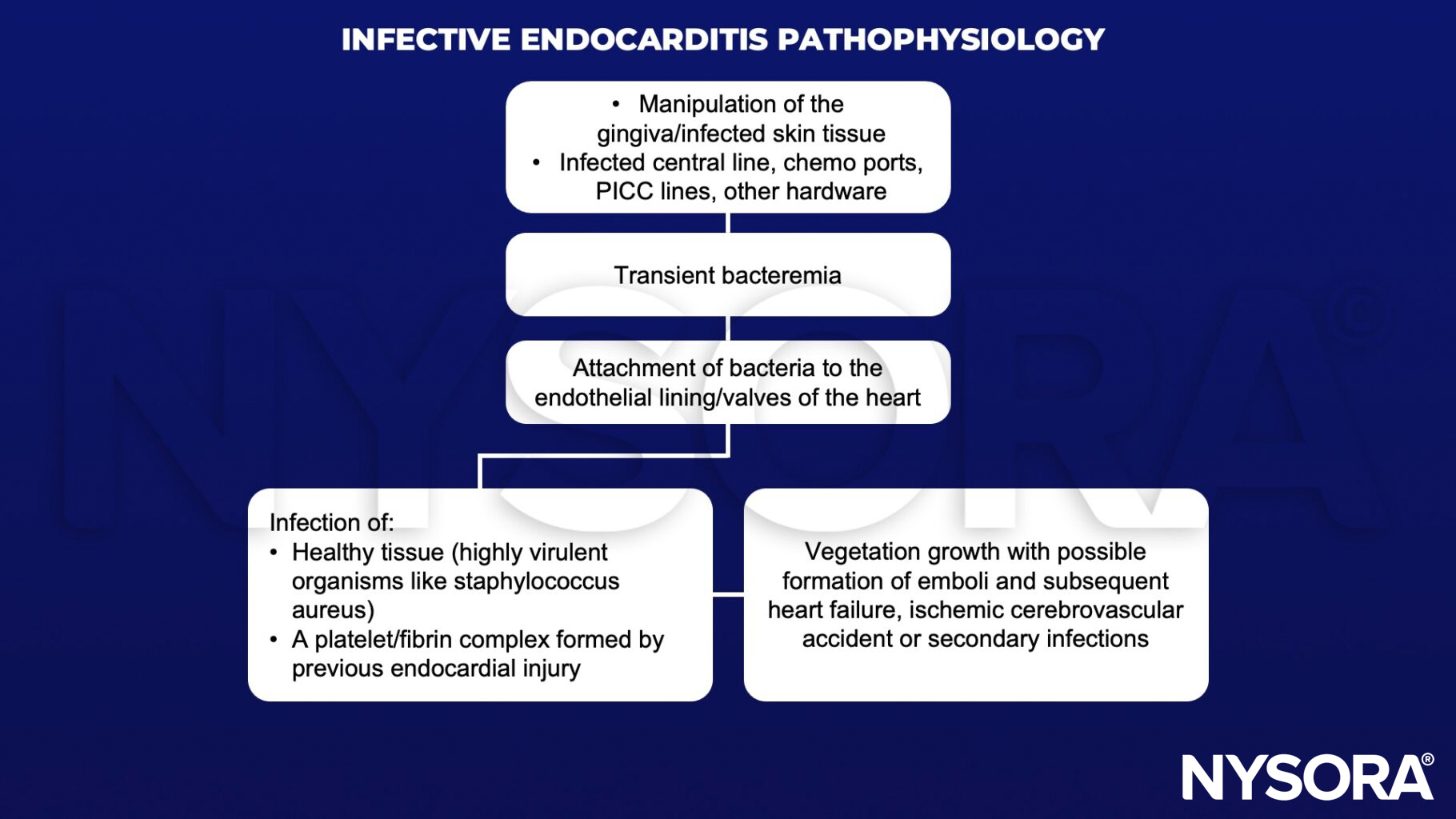
- Infective endocarditis (IE) is a life-threatening infection of the endothelial lining of the heart’s chambers and heart valves
Pathophysiology
Risk factors
| High-risk patients | Any prosthetic heart valve |
| History of IE | |
| Congenital heart disease (CHD): - Any cyanotic type of CHD - Any CHD repaired with prosthetic material, up to 6 months after the procedure or lifelong if persistent |
|
| the procedure or lifelong if persistent High | Incision of infected skin tissue |
| Dental or surgical procedures with manipulation of the gingiva | |
| Root canal treatments | |
| Root extractions |
Prophylaxis
- The absolute risk for IE is very low, and while antibiotics given at the right indication lower the incidence of IE they do not prevent all cases of IE
- Antibiotic use poses the risk of anaphylaxis or bacterial resistance
- Consider the pros and cons when giving IE prophylaxis, only use antibiotics for high-risk patients undergoing high-risk procedures
| Infected skin tissue | Dental procedures | |
|---|---|---|
| No allergy to penicillin or ampicillin | Flucloxacilline: 2 g oral, 30-60 min before procedure Child: 50 mg/kg (max. 1.5 g) | Amoxicillin: 2 g oral, 30-60 min before procedure Child: 50 mg/kg (max. 2 g) |
| Penicillin or ampicillin allergy or treatment with penicillin <7 days ago | Clindamycin: 600 mg oral, 30-60 min before procedure Child: 20 mg/kg (max. 600 mg) | Clindamycin: 600 mg oral, 30-60 min before procedure Child: 20 mg/kg (max. 600 mg) |
- Use oral antibiotics as the first choice
- Alternatively, use cephalexin 2 g (50 mg/kg IV for children), cefazolin, or ceftriaxone 1 g IV (50 mg/kg IV for children)
Suggested reading
- Habib G, Lancellotti P, Antunes MJ, et al. 2015 ESC Guidelines for the management of infective endocarditis: The Task Force for the Management of Infective Endocarditis of the European Society of Cardiology (ESC). Endorsed by: European Association for Cardio-Thoracic Surgery (EACTS), the European Association of Nuclear Medicine (EANM). Eur Heart J. 2015;36(44):3075-3128.
Clinical updates
Hermanns et al. (Anesthesiology, 2022) emphasize that infective endocarditis (IE) carries high perioperative morbidity and mortality (≈20% in-hospital, 30% at 1 year), with increasing incidence and a growing proportion of prosthetic valve and healthcare-associated cases. They highlight the need for early diagnosis using modified Duke criteria and prompt bactericidal IV antibiotics, with about 50% of patients requiring urgent or early surgery for heart failure, uncontrolled infection, or embolic risk. The review advocates a structured multidisciplinary “endocarditis team,” including anesthesiologists, to optimize perioperative management, anticoagulation strategies, and organ support in this high-risk population.