 Nerve Blocks App
 Anesthesia Assistant App
 Ultrasound Pain App
 Pain Medicine Assistant App
 POCUS App
 IV Access App
 MSK Knee App
 VetRA App
 Nerve Block Manual
 Regional Anesthesia Updates
 Anesthesiology Manual
 Anesthesiology Review
 Anesthesia Updates 2025
 Anesthesia Updates 2026
 Pediatric Anesthesia Updates
 Airway Management Updates
 US Interventional Pain Manual
 Pain Medicine Updates
 Mastering Difficult IV Access
 PACU Nursing Manual
 RA Veterinary Manual
 Books
Books About
About
 Back to News
 5 min read

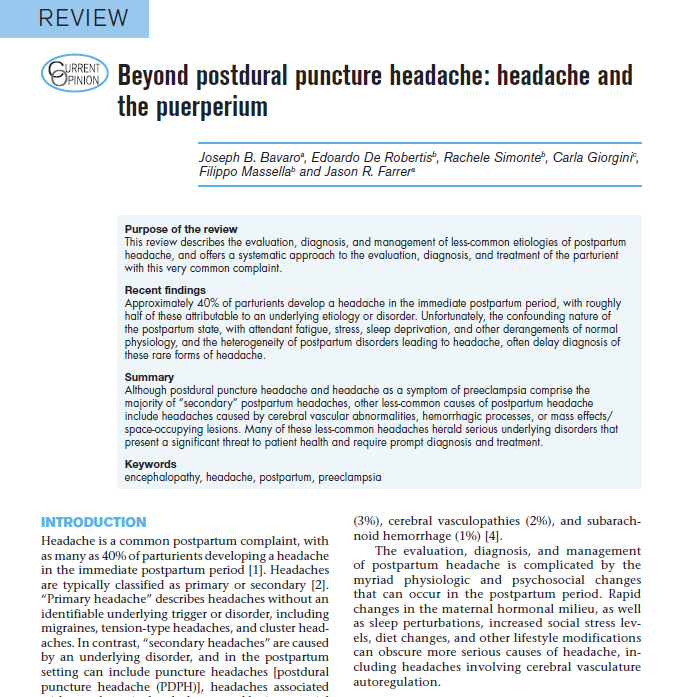
Postpartum headache is one of the most common neurologic complaints after childbirth. Nearly 40% of postpartum patients develop headaches in the early puerperium. While many are benign primary headaches, such as migraine or tension-type headache, a substantial proportion are secondary headaches caused by potentially life-threatening conditions.
A new review published in Current Opinion in Anesthesiology highlights the importance of recognizing uncommon but dangerous postpartum headache syndromes that may mimic postdural puncture headache (PDPH) or preeclampsia.
These rare conditions include:
- Cerebral venous sinus thrombosis (CVST)
- Posterior reversible encephalopathy syndrome (PRES)
- Reversible cerebral vasoconstrictive syndrome (RCVS)
- Pituitary apoplexy
- Subdural hematoma
- Subarachnoid hemorrhage
- Intracranial tumors
- Lymphocytic hypophysitis
The review emphasizes that delayed diagnosis remains common because postpartum fatigue, hormonal fluctuations, sleep deprivation, and stress can obscure warning signs.
Cerebral venous sinus thrombosis (CVST)
What is CVST?
CVST is a form of stroke caused by thrombosis within the cerebral venous sinuses. The obstruction impairs venous drainage from the brain, increasing intracranial venous pressure.
Pregnancy and the puerperium significantly increase risk because of the prothrombotic state associated with childbirth. Approximately 20% of CVST cases occur during pregnancy or postpartum.
Symptoms
Patients may develop:
- Severe headache
- Focal neurologic deficits
- Seizures
- Altered mental status
- Visual symptoms
An important distinguishing feature is positional behavior opposite to PDPH:
- CVST headache often worsens while supine
- PDPH typically worsens upright
Diagnosis
Preferred imaging includes:
- Magnetic resonance venography (MRV)
- CT venography in selected cases
Treatment
Management usually involves:
- Systemic anticoagulation
- Neurologic monitoring
- Occasionally, thrombectomy or thrombolysis
Early recognition substantially improves outcomes.
Posterior reversible encephalopathy syndrome (PRES)
Understanding PRES
PRES is characterized by vasogenic cerebral edema, particularly affecting posterior brain regions.
The condition is strongly linked to:
- Severe hypertension
- Preeclampsia
- Eclampsia
- HELLP syndrome
Studies suggest nearly all patients with eclamptic seizures demonstrate radiographic evidence of PRES.
Clinical features
Common manifestations include:
- Headache
- Visual disturbances
- Seizures
- Weakness
- Nausea
- Altered consciousness
Imaging findings
MRI typically demonstrates:
- Parietal edema
- Occipital edema
Treatment
Management focuses on:
- Blood pressure control
- Magnesium sulfate therapy
- Seizure prevention
- Treating underlying obstetric pathology
Prompt intervention usually leads to complete neurologic recovery.
Reversible cerebral vasoconstrictive syndrome (RCVS)
What makes RCVS unique?
RCVS is characterized by diffuse cerebral arterial vasoconstriction and severe thunderclap headaches.
Although termed “reversible,” the syndrome may produce devastating complications, including:
- Ischemic stroke
- Intracerebral hemorrhage
- Subarachnoid hemorrhage
Typical presentation
Symptoms include:
- Sudden thunderclap headache
- Recurrent severe headaches
- Neurologic deficits
- Seizures
Diagnostic hallmark
Cerebral angiography often reveals the classic:
“Sausages on a string” appearance
This reflects alternating arterial constriction and dilation.
Therapy
Common treatment strategies include:
- Calcium channel blockers
- Magnesium
- Supportive care
- Blood pressure management
Pituitary apoplexy
A rare endocrine emergency
Pituitary apoplexy involves sudden hemorrhage or infarction of the pituitary gland.
Although uncommon, it may initially resemble PDPH.
Symptoms
Clinical findings may include:
- Thunderclap headache
- Diplopia
- Bradycardia
- Visual changes
- Ophthalmoplegia
- Hypopituitarism
Why are postpartum patients vulnerable?
The enlarged pituitary gland during pregnancy is more susceptible to ischemia and hemorrhage.
Severe postpartum hemorrhage can precipitate:
- Sheehan syndrome
- Pituitary necrosis
Management
Treatment may require:
- High-dose corticosteroids
- Neurosurgical decompression
- Hormone replacement therapy
Postpartum subdural hematoma
How does it occur?
Subdural hematoma after delivery is most commonly associated with:
- Neuraxial anesthesia
- Dural puncture
- Intracranial hypotension
CSF leakage causes traction on fragile bridging veins, leading to hemorrhage.
Important warning sign
Initially, symptoms mimic PDPH.
However, the headache later becomes:
- Persistent
- Nonpostural
- Progressive
Risk factors
Risk factors include:
- Multiple dural punctures
- Coagulopathy
- Anticoagulation
- Preeclampsia
- HELLP syndrome
Diagnostic imaging
Urgent noncontrast CT is the preferred initial test.
Treatment
Management depends on severity:
- Conservative monitoring
- Neurosurgical evacuation
- Intensive neurologic care
Postpartum subarachnoid hemorrhage
A neurologic catastrophe
Postpartum subarachnoid hemorrhage (pSAH) is rare but highly dangerous.
Most cases result from ruptured intracranial aneurysms.
Clinical presentation
Patients often develop:
- Sudden thunderclap headache
- Vomiting
- Neck stiffness
- Altered mental status
- Focal deficits
Diagnostic approach
Recommended evaluation includes:
- Emergent noncontrast head CT
- Lumbar puncture if CT is negative
- MRI or angiography when needed
Why diagnosis may be delayed
The review notes that pSAH may initially be mistaken for:
- PDPH
- Migraine
- Hypertensive headache
Intracranial tumors in the postpartum period
Pregnancy can unmask tumors
Hormonal and hemodynamic changes during pregnancy may accelerate tumor growth or edema.
Tumors most commonly identified include:
- Meningiomas
- Prolactinomas
Symptoms
Tumor-associated headaches are often:
- Progressive
- Focal
- Worse in the morning
- Associated with nausea or visual symptoms
Why is diagnosis challenging?
Symptoms overlap extensively with common postpartum complaints:
- Fatigue
- Dizziness
- Nausea
- Sleep deprivation
As a result, diagnosis may be delayed for weeks.
Lymphocytic hypophysitis
Autoimmune inflammation of the pituitary
Lymphocytic hypophysitis is an autoimmune inflammatory disorder affecting the pituitary gland.
Remarkably, 80% of cases occur during late pregnancy or postpartum.
Symptoms
Patients may experience:
- Severe headache
- Visual changes
- Fatigue
- Hypoglycemia
- Hypothermia
- Pituitary hormone deficiencies
Associated autoimmune disease
Many affected patients also have:
- Graves disease
- Addison disease
- Other autoimmune conditions
Treatment
Management may include:
- Hormone replacement
- Corticosteroids
- Immunosuppressive therapy
- Surgical decompression in severe cases
Red flags clinicians should never ignore
The review strongly emphasizes the identification of “red flag” features that mandate urgent imaging and neurologic evaluation.
Dangerous warning signs
These include:
- Thunderclap headache
- Sudden severe onset
- Focal neurologic deficits
- Altered consciousness
- Fever
- Hypertension
- Seizures
- Persistent nonpostural headache
- Visual changes
- Laboratory abnormalities
Any postpartum patient with these findings requires immediate evaluation.
Key clinical takeaway
The postpartum period creates a uniquely vulnerable neurologic state. Although many headaches are benign, clinicians must remain vigilant for dangerous secondary causes that can rapidly progress to stroke, hemorrhage, permanent neurologic injury, or death.
The authors conclude that a structured diagnostic strategy combining careful history-taking, neurologic examination, and targeted imaging is essential for reducing maternal morbidity and mortality.
Reference: Bavaro JB et al. Beyond postdural puncture headache: headache and the puerperium. Curr Opin Anaesthesiol. 2026;39:217-223.
Read more about postpartum headache and postdural puncture headache in NYSORA’s Anesthesiology Manual. The essential guide to evidence-based clinical practice, perioperative medicine, and practical case management in anesthesiology.