 Nerve Blocks App
 Anesthesia Assistant App
 Ultrasound Pain App
 Pain Medicine Assistant App
 POCUS App
 IV Access App
 MSK Knee App
 VetRA App
 Nerve Block Manual
 Regional Anesthesia Updates
 Anesthesiology Manual
 Anesthesiology Review
 Anesthesia Updates 2025
 Anesthesia Updates 2026
 Pediatric Anesthesia Updates
 Airway Management Updates
 US Interventional Pain Manual
 Pain Medicine Updates
 Mastering Difficult IV Access
 PACU Nursing Manual
 RA Veterinary Manual
 Books
Books About
About
 Back to News
 7 min read
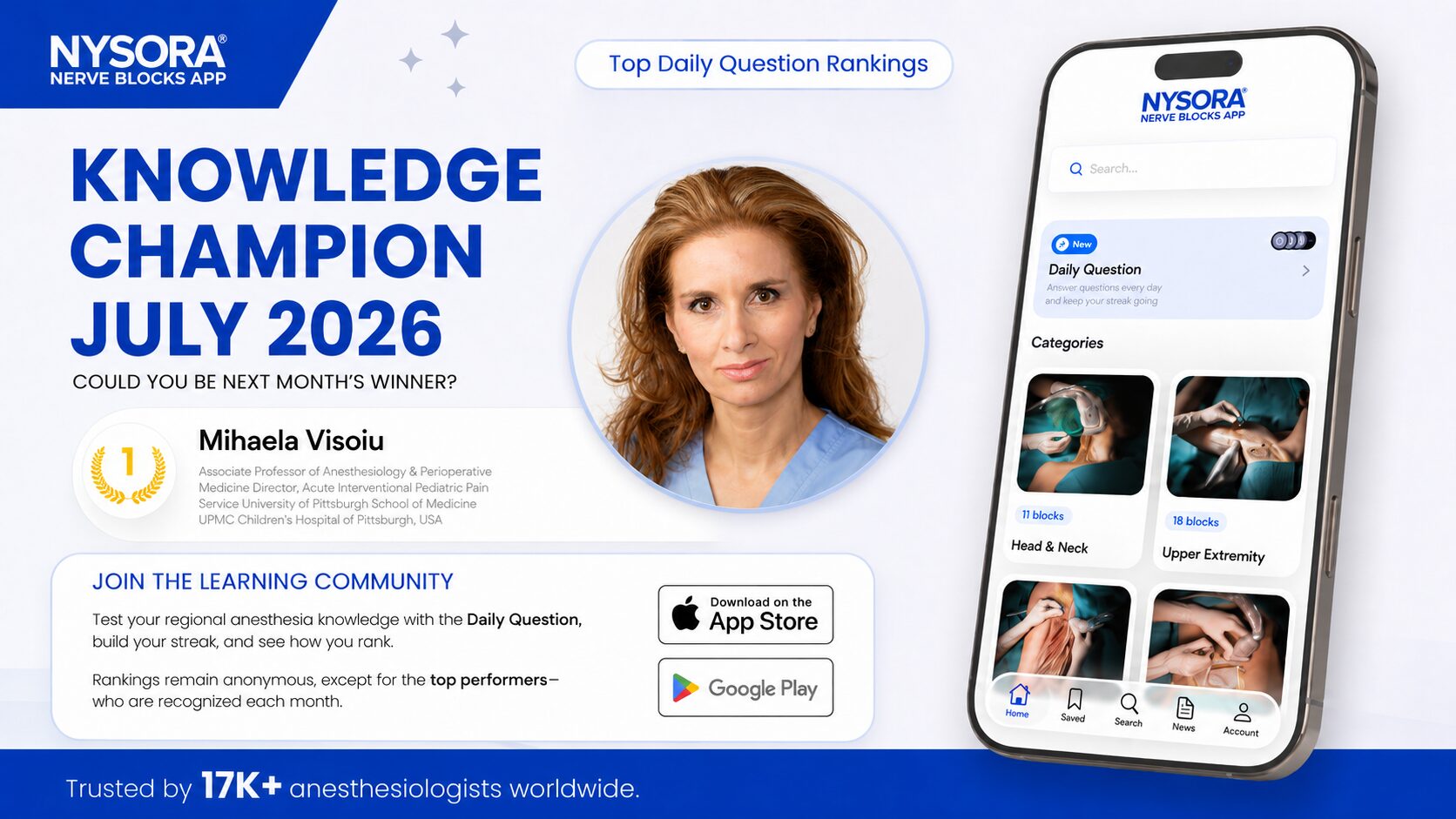
For this pediatric anesthesiologist, reaching the top of the Daily Question rankings in the NYSORA Nerve Blocks App was not simply about knowing the right answers. It was part of a much larger habit: continually learning, reviewing, and bringing new ideas into clinical practice.
When the July Daily Question rankings closed, one name stood at the top: Mihaela Visoiu.
Naturally, we wanted to meet the clinician behind the result.
Who was answering these questions each day? What kept her coming back? And, perhaps more importantly, how did this brief daily activity fit into the much more demanding reality of clinical practice?
Mihaela’s answers revealed that her place at the top of the rankings was not the result of competition alone. It reflected the way she approaches regional anesthesia: with curiosity, consistency, and a willingness to keep revisiting even familiar techniques.
A career centered on pediatric regional anesthesia
Mihaela is a pediatric anesthesiologist at UPMC Children’s Hospital of Pittsburgh in Pennsylvania, where her work extends across the operating room, perioperative pain management, and education.
Her clinical responsibilities include providing general and regional anesthesia, managing perioperative pain, rounding on hospitalized patients, and teaching student nurse anesthetists, residents, and fellows.
Her particular interest is pediatric regional anesthesia – especially ultrasound-guided nerve blocks in neonates, infants, and children.
Even with years of experience, Mihaela does not view learning as something that ends once a technique becomes familiar.
“I want to learn additional techniques for performing these blocks and better understand how they compare with established approaches to perioperative pediatric pain management.”
That mindset – looking beyond the technique she already knows – is central to how she uses the NYSORA Nerve Blocks App.
From a NYSORA conference to a clinical reference
Mihaela first discovered the app after attending a NYSORA conference in New York several years ago. She had signed up to receive the latest updates in anesthesiology and later received an email introducing the app.
Since then, it has become part of how she reviews regional anesthesia and prepares for clinical practice.
Although she is already highly familiar with many pediatric regional anesthesia techniques, she uses the app to study alternative approaches, review ultrasound anatomy, and reinforce her understanding of the muscles, fascial planes, and other anatomical structures that act as important sonographic landmarks.
There are also moments when she returns to the app after performing a block.
“Even with blocks I perform regularly, there are occasions when they are technically challenging. In those situations, I find it helpful to review the app’s videos and explanations after performing the procedure.”
This is not learning separated from clinical work. It is learning shaped by what happened in the operating room that day.
A difficult image, an unexpected needle trajectory, or a block that required more adjustment than usual can all become reasons to return to the anatomy and reconsider the technique.
Mihaela also values the practical guidance shared by clinicians in the app.
“I especially value the practical tips shared by experts in regional anesthesia and often incorporate them into my clinical practice.”
Learning a technique before bringing it into practice
One example Mihaela shared was the iPACK block.
Before performing the block independently, she used the app’s step-by-step videos to understand the sequence of the procedure and make the technique easier to remember.
“After reviewing this content, I felt prepared to perform the block safely and effectively when the appropriate clinical opportunity arose.”
The important part of that experience was not simply seeing where to place the transducer or advance the needle. It was being able to review the procedure at her own pace, understand the relevant anatomy, and return to the material before using it in a real patient.
Not every technique she studies will immediately become part of her routine practice. Some may be relevant only for selected pediatric patients. Others may be considered when the standard approach is not ideal.
For Mihaela, that does not make learning them less valuable.
It gives her a broader clinical vocabulary – and more options when the right patient or situation appears.
Anatomy as the foundation
When asked which parts of the app she finds most useful, Mihaela highlighted three features: Reverse Ultrasound Anatomy™, the step-by-step guidance for each block, and the “Let’s Review” section at the end of the technique.
But one combination stood out in particular.
“The feature I value most is the combination of cadaveric dissection videos with 3D functional anatomy.”
For Mihaela, this connection between anatomical dissection, three-dimensional relationships, and the ultrasound image is essential.
“In my experience, a thorough understanding of anatomy is the foundation of safe and effective regional anesthesia.”
Ultrasound provides a live image, but interpreting that image requires a deeper mental model of what lies beneath the probe. Seeing the anatomy from several perspectives helps turn individual structures on the screen into a coherent anatomical picture.
That understanding also strengthens confidence – not only when everything appears exactly as expected, but when the anatomy is less clear or the procedure becomes technically difficult.
The Daily Question as a clinical learning habit
When the Daily Question feature became available, Mihaela began using it to strengthen her knowledge of regional anesthesia.
Her own practice is largely focused on pediatric patients, which means she may have limited exposure to techniques commonly used in obstetric anesthesia, adult joint replacement surgery, elderly patients, or other areas of regional anesthesia.
The Daily Question gave her a practical way to keep those areas within reach.
“It helps reinforce concepts that I can apply in my daily practice, such as selecting the most appropriate nerve block for a specific surgical procedure or patient and recognizing strategies to reduce the risk of complications.”
That is what makes a daily question useful. It is small enough to fit into a busy day, but focused enough to prompt a genuine clinical decision.
Which block provides the required coverage? What structure is most at risk? Which approach is appropriate for this patient? What could explain an incomplete result?
Over time, those individual decisions accumulate.
Mihaela’s position at the top of the July rankings was a visible result of that consistency. But the ranking itself was not the main purpose. The real value was maintaining contact with regional anesthesia concepts outside the boundaries of her usual case mix.
Learning, reviewing, and teaching
The app has also become a teaching resource in Mihaela’s department.
She uses it to review ultrasound anatomy and procedural techniques before performing a block and to discuss technical challenges and possible improvements afterward.
That cycle – prepare, perform, reflect, and teach – captures the larger story behind July’s Knowledge Champion.
Mihaela did not reach the top because she had finished learning regional anesthesia. She reached it because she continues to learn despite already having substantial clinical experience.
Her story is a reminder that professional growth rarely comes from one long study session or a single course. More often, it comes from small, repeated actions: reviewing a difficult technique, questioning an assumption, studying an unfamiliar approach, or answering one carefully chosen clinical question each day.
The July rankings introduced us to a Knowledge Champion.
The conversation introduced us to the learning habits behind the title.
Could You Be the Next Knowledge Champion?
Make continual learning part of your clinical routine. Open the NYSORA Nerve Blocks App, answer the Daily Question, review step-by-step techniques, and strengthen your understanding of regional anesthesia – one clinical decision at a time.