 Nerve Blocks App
 Anesthesia Assistant App
 Ultrasound Pain App
 Pain Medicine Assistant App
 POCUS App
 IV Access App
 MSK Knee App
 VetRA App
 Nerve Block Manual
 Regional Anesthesia Updates
 Anesthesiology Manual
 Anesthesiology Review
 Anesthesia Updates 2025
 Anesthesia Updates 2026
 Pediatric Anesthesia Updates
 Airway Management Updates
 US Interventional Pain Manual
 Pain Medicine Updates
 Mastering Difficult IV Access
 PACU Nursing Manual
 RA Veterinary Manual
 Books
Books About
About
 Back to News
 6 min read
A new step toward precision blood pressure management in the operating room
Maintaining adequate blood pressure during surgery is one of the most important responsibilities of the anesthesia team. Even brief episodes of intraoperative hypotension have been associated with postoperative complications involving the kidneys, heart, and brain. Consequently, vasopressor therapy, particularly norepinephrine, is routinely used to restore arterial pressure.
Despite its widespread use, surprisingly little evidence has been available regarding the precise relationship between norepinephrine dose and blood pressure during general anesthesia.
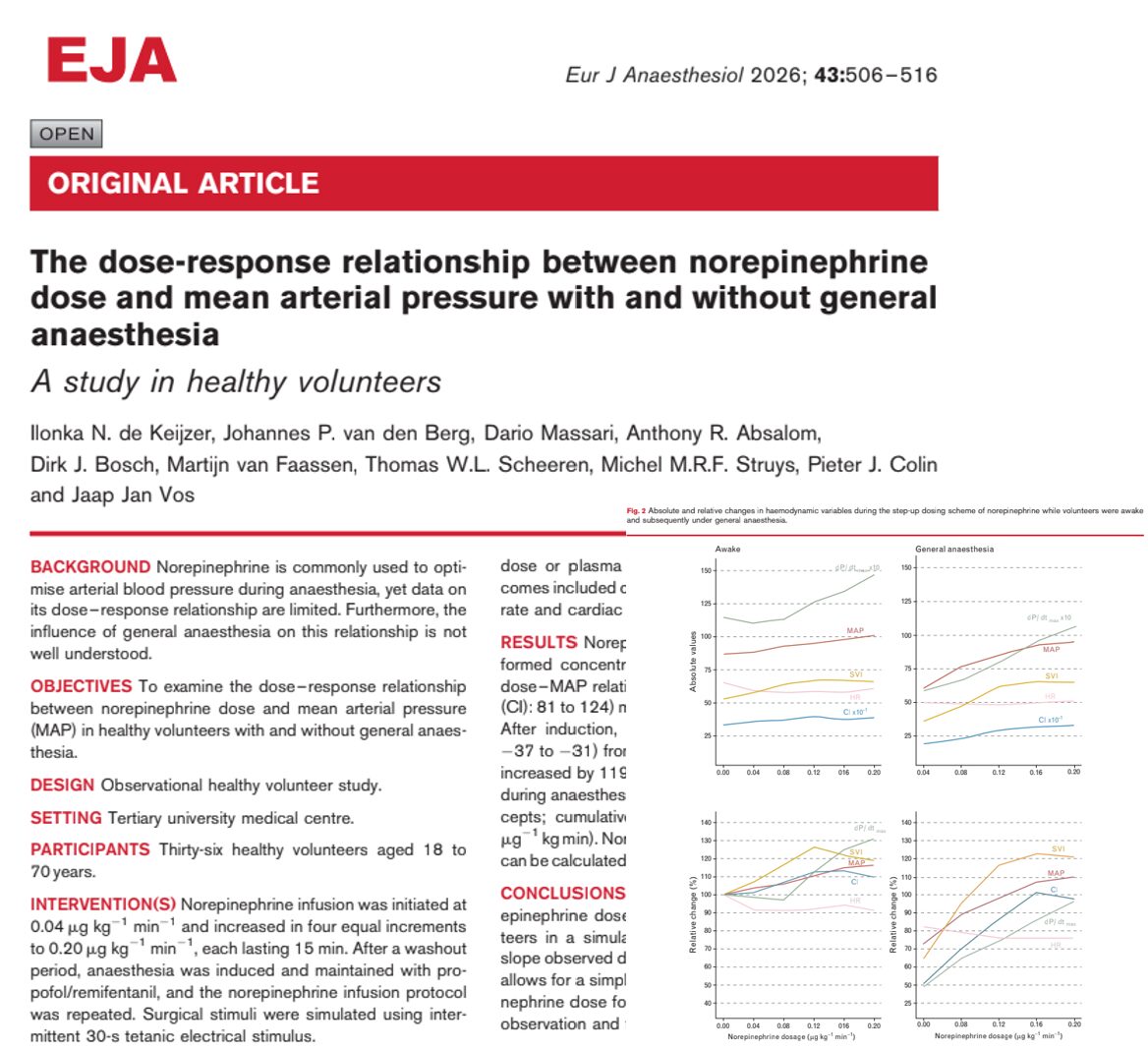
A new study published in the European Journal of Anaesthesiology addresses this important knowledge gap. Investigators examined the dose-response relationship between norepinephrine infusion and mean arterial pressure (MAP) in healthy volunteers before and during propofol-remifentanil general anesthesia.
Their findings demonstrate that norepinephrine exhibits a highly predictable, linear dose-response relationship, allowing the researchers to develop a simple equation that estimates the infusion rate required to achieve a desired blood pressure during anesthesia. Importantly, the authors emphasize that this equation should complement, not replace, continuous clinical assessment and individualized titration.
Why blood pressure matters during surgery
General anesthesia commonly causes vasodilation and myocardial depression, resulting in reductions in systemic vascular resistance and arterial pressure.
Persistent hypotension has been associated with:
- Acute kidney injury
- Myocardial injury
- Cerebral hypoperfusion
- Increased postoperative complications
- Longer hospital stays
Norepinephrine has become the preferred vasopressor in many operating rooms because it primarily stimulates α1-adrenergic receptors, increasing vascular tone while also exerting modest β1-adrenergic effects that support cardiac function.
However, clinicians have traditionally titrated norepinephrine empirically because robust pharmacodynamic data during general anesthesia have been lacking.
Study overview
The investigators designed a carefully controlled physiological study involving 36 healthy volunteers between 18 and 70 years of age.
Study design
Each volunteer underwent two experimental phases:
- Awake phase
- Incremental norepinephrine infusion
- Continuous hemodynamic monitoring
- General anesthesia phase
- Propofol and remifentanil target-controlled infusion
- Repeated norepinephrine dosing protocol
- Simulated surgical stimulation using intermittent electrical tetanic stimuli
Norepinephrine infusion rates increased from:
- 0.04 µg/kg/min
- 0.08 µg/kg/min
- 0.12 µg/kg/min
- 0.16 µg/kg/min
- 0.20 µg/kg/min
Each infusion level was maintained for 15 minutes, allowing hemodynamic equilibrium before measurements were obtained.
What did the researchers measure?
The primary outcome was the relationship between:
- Norepinephrine dose
- Mean arterial pressure (MAP)
Additional measurements included:
- Heart rate
- Stroke volume index
- Cardiac index
- Arterial dP/dtmax (an indicator of cardiac contractility)
- Mean systemic filling pressure analogue (Parm)
- Plasma norepinephrine concentrations
This comprehensive assessment allowed investigators to evaluate not only blood pressure but also broader cardiovascular physiology.
Key finding: the relationship is remarkably linear
Perhaps the most clinically relevant discovery was that norepinephrine dose predicted blood pressure more accurately than plasma norepinephrine concentration.
The investigators found:
- A linear dose-response relationship
- Excellent model performance
- Greater responsiveness during general anesthesia
During the awake phase:
- Every 0.01 µg/kg/min increase in norepinephrine increased MAP by approximately 1 mmHg.
During general anesthesia:
- The same dose increase produced an additional increase of approximately 1.2 mmHg.
Overall, patients under anesthesia became substantially more responsive to norepinephrine.
Anesthesia changes the body’s response
Following induction of anesthesia:
- MAP decreased by approximately 34 mmHg
- Baseline blood pressure fell from roughly 88 mmHg to 54 mmHg
- The slope of the norepinephrine dose-response curve became significantly steeper
This means relatively small increases in norepinephrine produced larger increases in blood pressure after induction than when volunteers were awake.
This finding challenges the assumption that anesthesia simply suppresses cardiovascular responsiveness.
A practical equation for clinicians
One of the most interesting outcomes of the study is the proposed mathematical equation for estimating norepinephrine infusion rates during general anesthesia.
The authors derived the following relationship:
Norepinephrine requirement (µg/kg/min) = (Target MAP − 54) ÷ 222
For example:
- Target MAP = 65 mmHg
- Estimated infusion ≈ 0.05 µg/kg/min
Although individual patients will vary considerably, this provides clinicians with an evidence-based starting point rather than relying solely on trial-and-error titration.
More than just blood pressure
The study also demonstrated several important physiological effects of norepinephrine.
Improved cardiac performance
As norepinephrine doses increased:
- Cardiac index improved
- Stroke volume increased
- Cardiac contractility increased
Interestingly, these improvements were even more pronounced during general anesthesia.
Venous circulation also plays a role
The investigators observed increases in mean systemic filling pressure analogue (Parm), suggesting that norepinephrine recruits blood from the unstressed venous reservoir into the stressed volume.
This increases:
- Venous return
- Cardiac preload
- Cardiac output
These findings reinforce the modern understanding that norepinephrine influences both the arterial and venous circulation, not simply arterial vasoconstriction.
Clinical implications
The study provides several important messages for anesthesiologists.
Potential benefits
- More predictable norepinephrine dosing
- Earlier treatment of hypotension
- Improved hemodynamic stability
- Better understanding of norepinephrine pharmacodynamics
- Foundation for future decision-support software
Rather than waiting for hypotension to develop, clinicians may eventually use predictive dosing strategies based on validated pharmacodynamic models.
Why individualized titration remains essential
Despite the promising findings, the researchers stress that their equation should not replace clinical judgement.
Individual responses vary because of factors such as:
- Age-related physiology
- Cardiovascular disease
- Sepsis
- Blood loss
- Surgical stimulation
- Concurrent medications
- Fluid status
Continuous blood pressure monitoring and dose adjustment remain essential.
What could this mean for the future?
One particularly exciting possibility discussed by the authors is the development of adaptive drug advisory systems.
Such systems could potentially:
- Continuously monitor arterial pressure.
- Predict hemodynamic trends.
- Estimate individualized norepinephrine requirements.
- Recommend dose adjustments in real time.
- Assist clinicians while preserving physician oversight.
Artificial intelligence combined with validated pharmacodynamic models could represent the next evolution in precision hemodynamic management.
Key takeaways
- Norepinephrine demonstrated a predictable linear dose-response relationship with MAP.
- Patients under general anesthesia were more responsive to norepinephrine than when awake.
- A simple mathematical equation estimated the infusion rate required to achieve a target MAP.
- Norepinephrine improved multiple hemodynamic parameters beyond arterial pressure alone.
- Clinical judgement and individualized titration remain indispensable despite the predictive model.
- The findings may help support future precision-guided hemodynamic management and intelligent dosing systems.
Reference: de Keijzer IN et al. The dose-response relationship between norepinephrine dose and mean arterial pressure with and without general anaesthesia: A study in healthy volunteers. Eur J Anaesthesiol. 2026;43:506-516.
Read more about recent evidence like this in NYSORA’s Anesthesia Assistant app. Simulate cases, check dosages and search through NYSORA’s knowledge database!