 Nerve Blocks App
 Anesthesia Assistant App
 Ultrasound Pain App
 Pain Medicine Assistant App
 POCUS App
 IV Access App
 MSK Knee App
 VetRA App
 Nerve Block Manual
 Regional Anesthesia Updates
 Anesthesiology Manual
 Anesthesiology Review
 Anesthesia Updates 2025
 Anesthesia Updates 2026
 Pediatric Anesthesia Updates
 Airway Management Updates
 US Interventional Pain Manual
 Pain Medicine Updates
 Mastering Difficult IV Access
 PACU Nursing Manual
 RA Veterinary Manual
 Books
Books About
About
 Back to News
 6 min read
New clinical trial examines whether checking blood pressure every 2.5 minutes is better than every 5 minutes
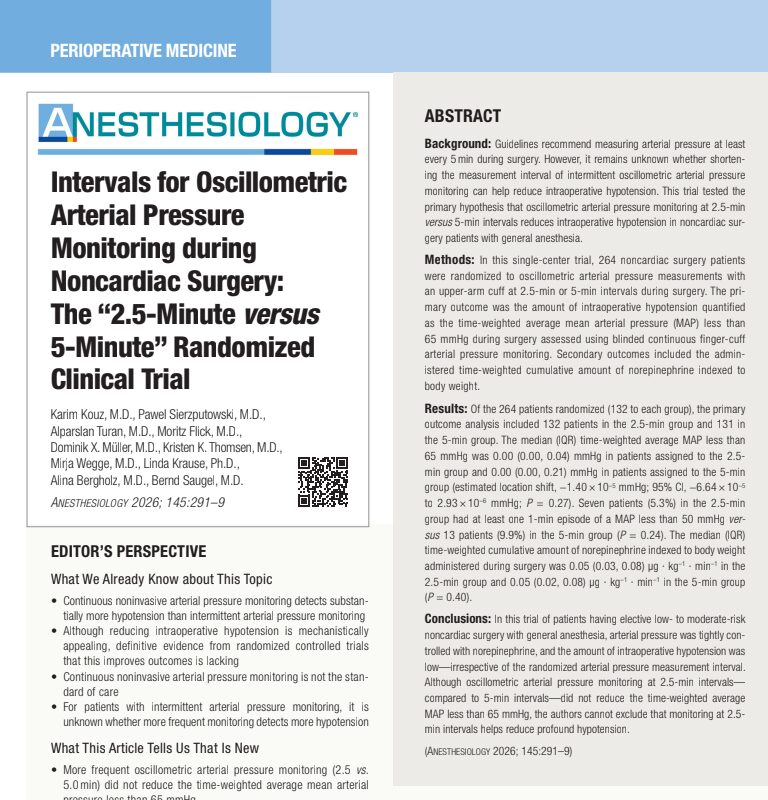
A new randomized clinical trial published in Anesthesiology investigated a practical question that affects millions of surgical patients every year: Should anesthesiologists measure blood pressure every 2.5 minutes instead of every 5 minutes during noncardiac surgery?
Current international guidelines recommend measuring arterial blood pressure at least every five minutes during general anesthesia when invasive arterial monitoring is not required. Although continuous blood pressure monitoring has been shown to detect more episodes of hypotension than intermittent cuff measurements, it remains uncertain whether simply shortening the interval between oscillometric cuff measurements improves patient care.
The investigators found that doubling the frequency of intermittent blood pressure measurements did not significantly reduce the overall burden of intraoperative hypotension. However, the study also suggested that more frequent measurements may help reduce episodes of profound hypotension, an observation that deserves further investigation.
Why intraoperative hypotension matters
Maintaining adequate arterial blood pressure during surgery is one of the most important responsibilities of the anesthesia team.
Even relatively short periods of hypotension have been associated with increased risks of:
- Acute kidney injury
- Myocardial injury
- Cardiovascular complications
- Increased postoperative morbidity
- Increased mortality in selected patient populations
For this reason, clinicians continuously assess blood pressure and intervene promptly with intravenous fluids, vasopressors, or adjustments in anesthetic depth whenever necessary.
Previous studies have demonstrated that continuous noninvasive blood pressure monitoring detects hypotension earlier than intermittent cuff measurements. However, continuous monitoring is not yet the standard of care for most patients undergoing elective noncardiac surgery. Consequently, intermittent oscillometric cuff monitoring remains the most widely used technique worldwide.
Study design
Researchers from the University Medical Center Hamburg-Eppendorf conducted a single-center randomized clinical trial comparing two different monitoring intervals.
Participants
The study enrolled:
- 264 adults
- Age ≥ 45 years
- Elective noncardiac surgery
- General anesthesia
- American Society of Anesthesiologists (ASA) Physical Status II or greater
Patients requiring invasive arterial catheter monitoring were excluded.
Participants were randomly assigned to:
- Blood pressure measurements every 2.5 minutes
- Blood pressure measurements every 5 minutes
Importantly, all patients also underwent blinded continuous finger-cuff arterial pressure monitoring, which was used solely for outcome assessment and not for clinical decision-making. This allowed investigators to accurately quantify hypotension regardless of the assigned cuff interval.
Primary outcome
The investigators evaluated the time-weighted average mean arterial pressure (MAP) below 65 mmHg.
Unlike simply counting episodes of hypotension, this metric combines:
- Severity
- Duration
- Overall hypotensive burden
It is considered a clinically meaningful measure because both the depth and length of hypotension contribute to postoperative organ injury.
Main findings
No significant reduction in overall hypotension
The study demonstrated:
- Median time-weighted average MAP < 65 mmHg:
- 2.5-minute group: 0.00 mmHg
- 5-minute group: 0.00 mmHg
The difference between groups was not statistically significant (P = 0.27).
Overall, shortening the monitoring interval failed to reduce the primary outcome.
Severe hypotension occurred less frequently
Although not statistically significant, fewer patients experienced severe hypotension:
- 2.5-minute interval: 5.3%
- 5-minute interval: 9.9%
Specifically, these patients experienced at least one one-minute episode with a MAP below 50 mmHg.
Because the study was not powered to detect this difference, researchers concluded that they cannot exclude the possibility that more frequent measurements help prevent profound hypotension.
Vasopressor use was nearly identical
One notable finding was the extensive use of norepinephrine.
Approximately 98% of patients received norepinephrine during surgery.
Median norepinephrine administration was essentially identical between groups.
This aggressive blood pressure management likely contributed to the remarkably low burden of hypotension observed throughout the study.
Why were the results negative?
The authors suggest several explanations.
Excellent blood pressure management
The participating institution routinely targets:
- MAP above 65 mmHg
- Early vasopressor administration
- Close hemodynamic management
Because clinicians successfully maintained blood pressure in nearly all patients, there was relatively little hypotension left to prevent.
Low-risk surgical population
Patients underwent:
- Elective surgery
- Low- to moderate-risk procedures
- Relatively short operations
Median surgical duration was approximately 77 minutes, reducing the opportunity for prolonged hypotension.
Continuous monitoring was used only for research
Although continuous finger-cuff monitoring identified hypotensive episodes with great precision, clinicians were treating patients according only to the assigned intermittent cuff measurements.
This design allowed an unbiased comparison between the two monitoring strategies.
Safety outcomes
The study also evaluated safety.
Upper-arm complications were uncommon.
Peripheral nerve injury occurred in:
- One patient in the 2.5-minute group
- One patient in the 5-minute group
These findings support previous evidence suggesting that nerve injury from oscillometric blood pressure cuffs is extremely rare.
Exploratory postoperative outcomes
Researchers explored several postoperative complications during the first seven days after surgery.
Interestingly:
- Acute kidney injury occurred in:
- 0 patients in the 2.5-minute group
- 6 patients in the 5-minute group
However, because these outcomes were exploratory and the trial was not powered for clinical endpoints, the authors caution against drawing definitive conclusions.
No patients experienced:
- Myocardial infarction
- Cardiac arrest
- Death
during the seven-day follow-up.
Clinical implications
The study supports current anesthesia guidelines recommending blood pressure measurements at least every five minutes during routine noncardiac surgery.
For most elective patients without indications for invasive monitoring, reducing the interval to every 2.5 minutes does not appear to provide a meaningful reduction in overall hypotension.
Nevertheless, clinicians should recognize situations where blood pressure can change rapidly, including:
- Induction of anesthesia
- Patient repositioning
- Major blood loss
- Hemodynamic instability
In these settings, more frequent measurements, or preferably continuous monitoring, may still be advantageous.
Key takeaways
- A randomized trial involving 264 patients compared blood pressure measurements every 2.5 minutes versus 5 minutes during elective noncardiac surgery.
- More frequent oscillometric monitoring did not significantly reduce the overall burden of intraoperative hypotension.
- Episodes of profound hypotension were numerically lower with 2.5-minute monitoring, although the difference was not statistically significant.
- Nearly all patients received norepinephrine, resulting in excellent blood pressure control throughout surgery.
- Current recommendations to measure blood pressure at least every five minutes remain appropriate for most patients, while higher-risk situations may still warrant more intensive monitoring.
Reference: Kouz K et al. Intervals for Oscillometric Arterial Pressure Monitoring during Noncardiac Surgery: The “2.5-Minute versus 5-Minute” Randomized Clinical Trial. Anesthesiology. 2026;145:291-299.
Read more about recent evidence like this in NYSORA’s Anesthesia Assistant app. Simulate case, check dosages and search through NYSORA knowledge database!