 Nerve Blocks App
 Anesthesia Assistant App
 Ultrasound Pain App
 Pain Medicine Assistant App
 POCUS App
 IV Access App
 MSK Knee App
 VetRA App
 Nerve Block Manual
 Regional Anesthesia Updates
 Anesthesiology Manual
 Anesthesiology Review
 Anesthesia Updates 2025
 Anesthesia Updates 2026
 Pediatric Anesthesia Updates
 Airway Management Updates
 US Interventional Pain Manual
 Pain Medicine Updates
 Mastering Difficult IV Access
 PACU Nursing Manual
 RA Veterinary Manual
 Books
Books About
About
 Back to News
 6 min read

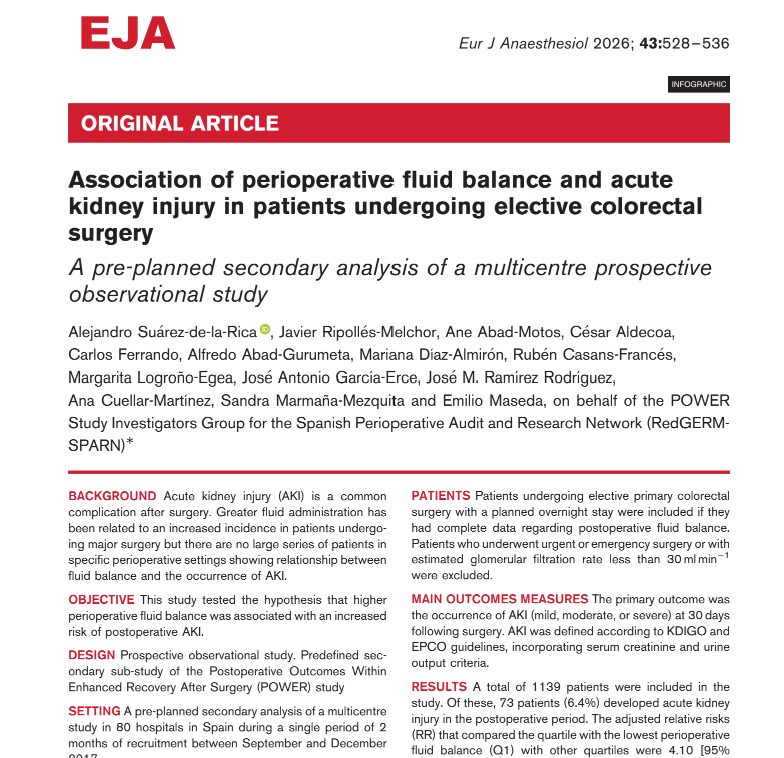
A new analysis published in the European Journal of Anaesthesiology has identified a significant association between higher positive perioperative fluid balance and the development of postoperative acute kidney injury (AKI) in patients undergoing elective colorectal surgery. The findings add to growing evidence that excessive fluid accumulation during the perioperative period may contribute to adverse postoperative outcomes and highlight the importance of individualized fluid management strategies.
Acute kidney injury remains a major surgical complication
Acute kidney injury is one of the most common postoperative complications and is associated with:
- Increased morbidity
- Longer hospital stays
- Higher healthcare costs
- Increased mortality risk
- Greater likelihood of long-term renal dysfunction
Previous studies have shown that AKI occurs in approximately 13% of patients undergoing major abdominal surgery and is associated with substantially increased mortality. Despite this, optimal perioperative fluid management remains an area of ongoing debate.
Study overview
Researchers conducted a pre-planned secondary analysis of the multicentre POWER study, which evaluated outcomes in patients undergoing elective colorectal surgery across 80 hospitals in Spain.
Study design
- Prospective observational cohort study
- 80 participating hospitals
- Recruitment period of two months
- 1,139 patients included
- Follow-up period of 30 days after surgery
The primary objective was to examine whether perioperative fluid balance during the first 24 hours after surgery was associated with the risk of developing postoperative AKI.
Key findings
AKI occurred in 6.4% of patients
Among the 1,139 patients included:
- 73 patients developed postoperative AKI
- Overall incidence was 6.4%
- Mild AKI occurred in 2.7%
- Moderate AKI occurred in 2.7%
- Severe AKI occurred in 1.0%
Higher fluid balance increased risk
Patients who developed AKI had a significantly greater positive fluid balance during the first 24 postoperative hours.
Average 24-hour fluid balance:
- AKI patients: 1,780 mL
- Non-AKI patients: 1,038 mL
The relationship persisted even after adjustment for important confounding factors.
Fluid balance quartiles and AKI risk
Researchers categorized patients according to perioperative fluid balance.
Quartile definitions
- Q1: Less than 380 mL
- Q2: 380–1,000 mL
- Q3: Greater than 1,000–1,800 mL
- Q4: Greater than 1,800 mL
Relative risk of AKI
Compared with patients in the lowest fluid balance group:
- Q2: Relative risk 2.09
- Q3: Relative risk 4.10
- Q4: Relative risk 4.81
These findings suggest that fluid accumulation exceeding approximately 1 litre may substantially increase the likelihood of postoperative kidney injury.
Which patients were at greatest risk?
Patients who developed AKI tended to have more complex clinical profiles.
Risk factors included:
- Older age
- Male sex
- Higher ASA classification
- Congestive heart failure
- Coronary artery disease
- Chronic obstructive pulmonary disease
- Hypertension
- Lower baseline renal function
- Greater intraoperative blood loss
- Longer operations
- Open surgical procedures rather than laparoscopic surgery
Multivariable analysis identified several independent predictors:
- Male sex
- ASA III–IV status
- Lower adherence to Enhanced Recovery After Surgery (ERAS) protocols
- Greater intraoperative bleeding
Why might excessive fluid administration harm the kidneys?
Traditionally, generous fluid administration was believed to protect the kidneys by improving perfusion and preventing hypovolemia.
However, modern evidence suggests that excessive fluid accumulation can create its own complications.
Potential mechanisms
Fluid overload may lead to:
- Tissue oedema
- Increased interstitial pressure
- Impaired capillary blood flow
- Reduced oxygen delivery
- Impaired lymphatic drainage
- Organ congestion
- Reduced renal perfusion efficiency
The kidneys may be particularly vulnerable because they are enclosed organs where increased tissue pressure can significantly impair blood flow.
The importance of ERAS protocols
One of the notable findings was the protective effect associated with Enhanced Recovery After Surgery programs.
Benefits of ERAS adherence
Higher ERAS compliance was associated with:
- Lower AKI risk
- Improved postoperative outcomes
- Better overall recovery
ERAS pathways typically include:
- Goal-directed fluid therapy
- Early mobilisation
- Optimized nutrition
- Opioid-sparing analgesia
- Minimally invasive surgical techniques
These measures may collectively reduce postoperative complications, including kidney injury.
Moderate-to-severe AKI analysis
Researchers also performed a sensitivity analysis focusing on moderate-to-severe AKI.
Additional risk factors identified
Independent predictors included:
- Male sex
- Coronary artery disease
- Chronic obstructive pulmonary disease
Patients with the highest fluid balance (>1,800 mL) had more than three times the risk of moderate-to-severe AKI compared with those in the lowest quartile.
Clinical implications
The findings do not prove that excessive fluid administration directly causes AKI.
However, they strongly suggest that avoiding unnecessary positive fluid balance may represent a modifiable risk factor.
Practical considerations
Clinicians may need to:
- Monitor fluid balance more closely
- Avoid excessive postoperative fluid administration
- Individualize fluid therapy
- Consider patient comorbidities
- Optimize ERAS adherence
- Identify high-risk patients preoperatively
The authors specifically suggest future studies should evaluate strategies targeting a net fluid balance below 1,000 mL during the perioperative period.
How do these findings compare with previous research?
The results align with several previous studies.
Prior investigations have demonstrated:
- Greater perioperative fluid administration increases AKI risk
- Positive fluid balance predicts worse renal outcomes
- Excessive postoperative fluid accumulation is associated with progression of kidney injury
Interestingly, this study found that negative fluid balance was not associated with increased AKI risk, challenging concerns that modest fluid restriction necessarily compromises renal function.
Limitations of the study
The investigators acknowledge several limitations.
Important considerations
- Observational design cannot establish causality
- Some potentially important variables were not recorded
- Urine output data were not directly documented
- Postoperative fluid balance beyond 24 hours was unavailable
- Nephrotoxic medication exposure was not assessed
- A substantial proportion of patients lacked complete fluid balance data and were excluded
The authors also note the possibility of reverse causation.
In some patients, early kidney injury could have reduced urine output, leading to a more positive fluid balance rather than fluid balance causing kidney injury.
Conclusion
This multicentre analysis provides important evidence that higher positive perioperative fluid balance is associated with an increased risk of postoperative acute kidney injury following elective colorectal surgery. Patients with fluid balances exceeding approximately 1,000–1,800 mL experienced substantially higher rates of AKI, while excessive fluid accumulation beyond 1,800 mL was associated with the greatest risk.
As perioperative medicine continues to evolve toward personalized and evidence-based care, these findings reinforce the importance of careful fluid stewardship, adherence to ERAS principles, and ongoing research to determine the optimal balance between avoiding hypovolemia and preventing harmful fluid overload.
Reference: Suárez-de-la-Rica A et al. Association of perioperative fluid balance and acute kidney injury in patients undergoing elective colorectal surgery: A pre-planned secondary analysis of a multicentre prospective observational study. Eur J Anaesthesiol. 2026;43:528-536.
For more information on acute kidney injury, check out the Anesthesiology Manual of NYSORA!