 Nerve Blocks App
 Anesthesia Assistant App
 Ultrasound Pain App
 Pain Medicine Assistant App
 POCUS App
 IV Access App
 MSK Knee App
 VetRA App
 Nerve Block Manual
 Regional Anesthesia Updates
 Anesthesiology Manual
 Anesthesiology Review
 Anesthesia Updates 2025
 Anesthesia Updates 2026
 Pediatric Anesthesia Updates
 Airway Management Updates
 US Interventional Pain Manual
 Pain Medicine Updates
 Mastering Difficult IV Access
 PACU Nursing Manual
 RA Veterinary Manual
 Books
Books About
About

Learning objectives
- Manage patients with chronic obstructive pulmonary disease (COPD) in the pre-, and perioperative period
Definition
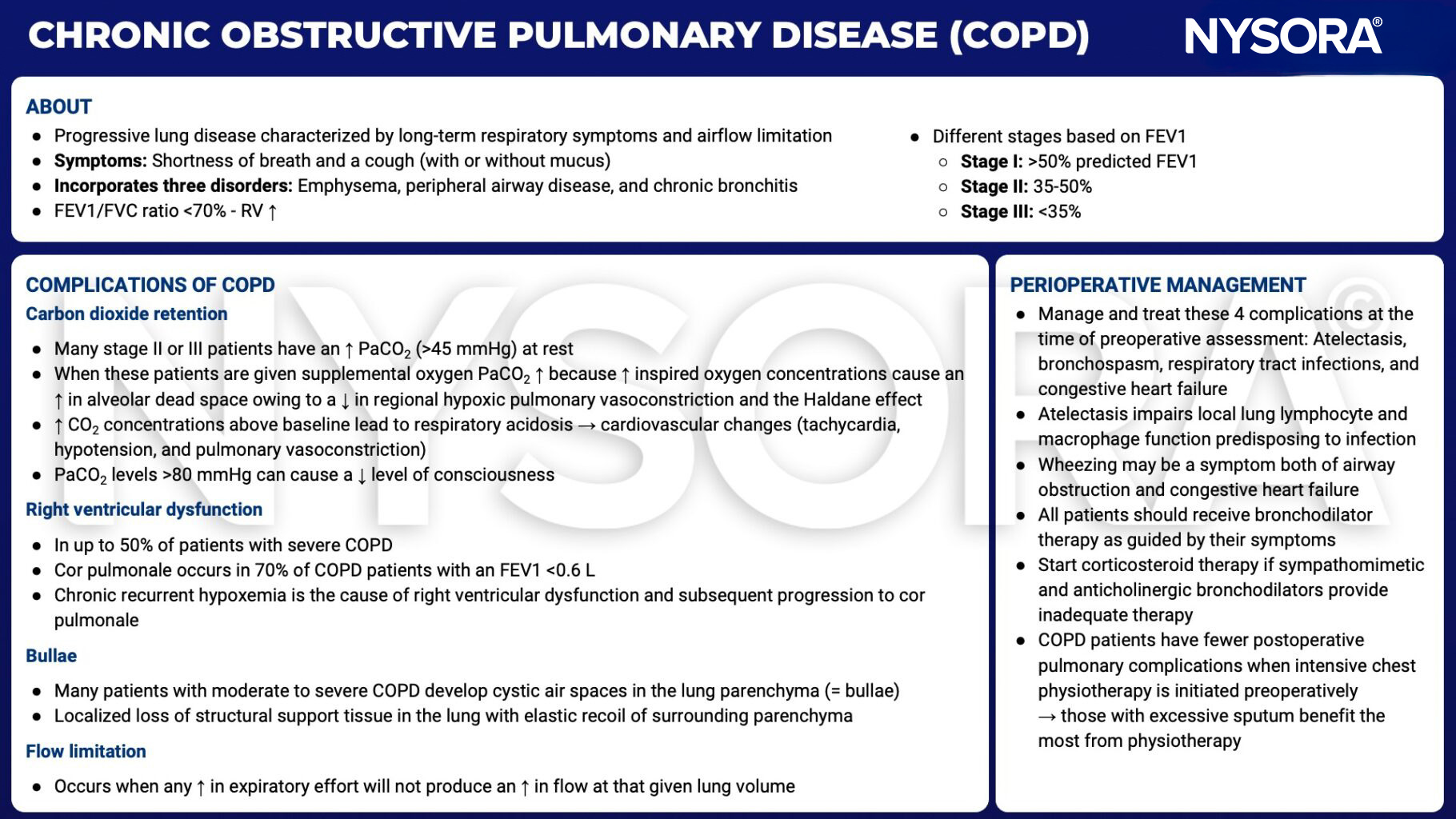
- COPD is an inflammatory lung disease characterized by abnormalities of the airways (bronchitis, bronchiolitis) and alveoli (emphysema), causing chronic dyspnea, cough, excessive sputum production, and progressive airway obstruction
Background information
- In 2017, 300 million people worldwide were living with COPD
Risk factors
COPD is caused by a complicated interaction between chronic exposure to noxious stimuli, individual risk factors, and socioeconomic risk factors
Noxious stimuli
- Tobacco smoke
- Air pollution caused by burning carbon-based fuels or biomass
- Occupational exposure such as chemical fumes or other fine particulate matter
Individual risk factors
- History of previous lung infections, including tuberculosis
- Genetics
- Maternal and prenatal exposure
- Asthma
- Premature birth
Socio-economic risk factors
- Access to healthcare
- Diet
Pathophysiology
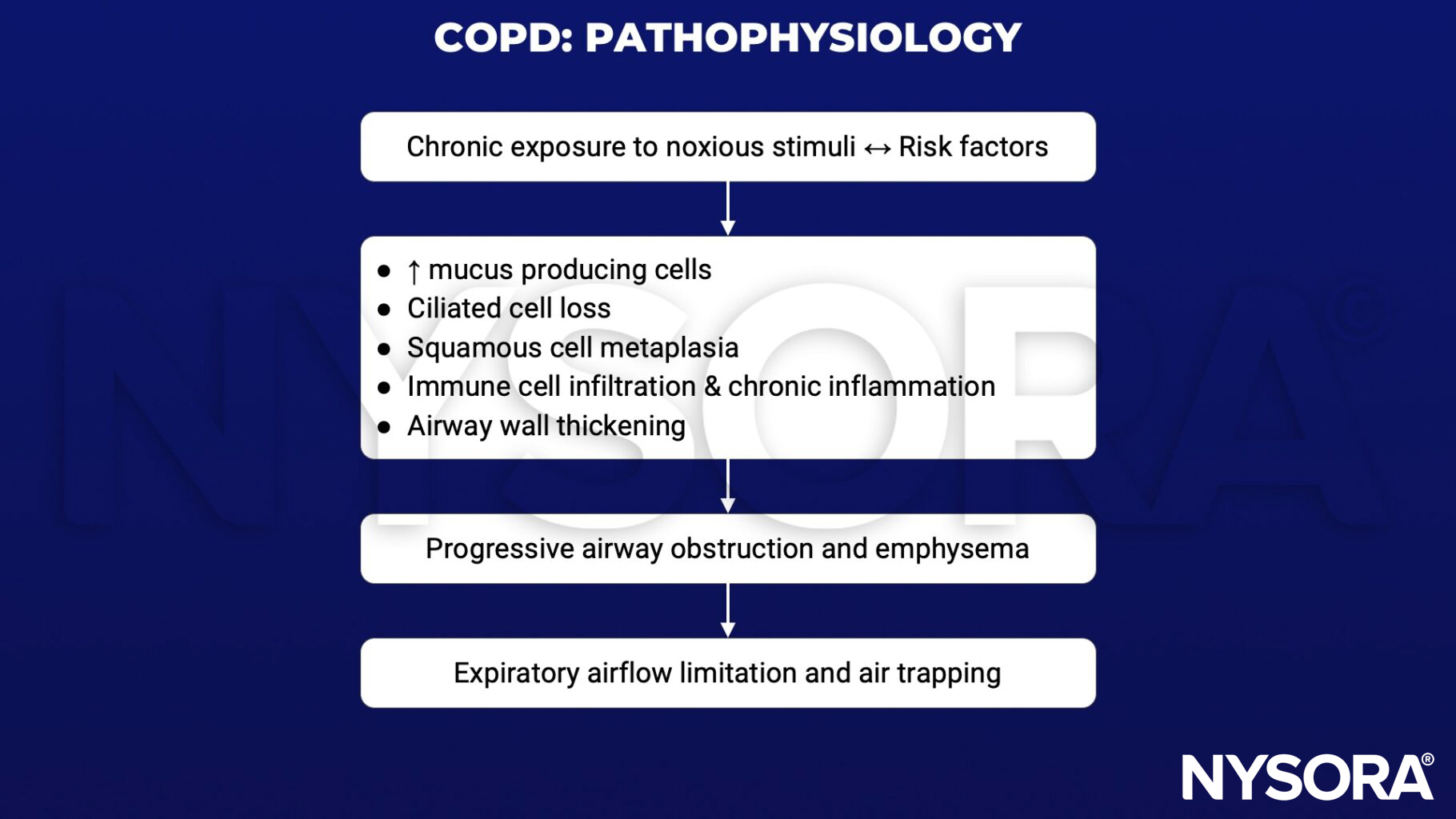
Exacerbation treatment
1. Assess severity
Use ABCDE approach – take arterial blood gas, perform chest X-ray, apply full ASA-monitoring
2. Treat symptoms
- Give supplemental O2 – titrate to achieve SaO2 of 88-92%
- Bronchodilators
- ↑ dose and/or frequency of short-acting bronchodilators
- Combine short-acting beta-2-agonists and anticholinergics
- Give long-acting beta-2-agonists when stable
- Give corticosteroids
- Give antibiotics if signs of bacterial infection
- If necessary, start noninvasive ventilation (NIV)
3. Identify and treat associated conditions
e.g., Heart failure, pulmonary embolism, arrhythmia
Anesthetic implications
Preoperative assessment
- Assess maximal level of exertion attainable
- Perform
- Routine preoperative blood tests
- Electrocardiogram – to exclude concomitant heart disease
- Chest X-ray – if evidence of current infection or recent worsening of symptoms
- Spirometry – to confirm the diagnosis and to assess the severity of COPD
- Treat symptoms aggressively
- If signs of active respiratory infection, postpone non-emergency surgery
- Strict smoking cessation
- Preoperative physiotherapy may help reduce the incidence of intraoperative bronchial plugging or pneumonitis
- Optimize nutritional status
- Obesity and underweight both increase perioperative risk
- Serum albumin level <35 mg/L is a strong predictor of postoperative pulmonary complications, give preoperative nutritional supplementation
Anesthetic regimen
- Regional anesthesia (RA) decreases postoperative pulmonary complications
- Light sedation, flexible positioning, or NIV might comfort patients who find it uncomfortable lying supine
- General anesthesia in COPD carries higher risk for laryngospasm, bronchospasm, cardiovascular instability, barotraumas, and hypoxemia
- To reduce the harmful effects of air trapping when mechanically ventilating
- Reduce the respiratory rate or the I:E ratio (to 1:3–1:5) to lengthen expiration
- Give PEEP to help keep small airways open during late exhalation
- Promptly treat bronchospasm
- Fully reverse the neuromuscular blocking agent before extubation
- Consider peri-extubation bronchodilator treatment
- NIV post-extubation reduces the work of breathing and air trapping and has been shown to reduce the need for reintubation in the postoperative period after major surgery
Suggested reading
- Christenson SA, Smith BM, Bafadhel M, Putcha N. Chronic obstructive pulmonary disease. Lancet. 2022;399(10342):2227-2242.
- National Institute for Health and Care Excellence. (2018) Chronic Obstructive Pulmonary Disease in over 16s: diagnosis and management (NICE guideline 115) available at https://www.nice.org.uk/guidance/ng115.
- Lumb AB, Biercamp C. Chronic obstructive pulmonary disease and anaesthesia. Continuing Education in Anaesthesia, Critical Care & Pain. 2014;14:1-5.
Clinical updates
Cohen E (Current Opinion in Anesthesiology, 2025) outlines emerging regenerative strategies for end-stage COPD, highlighting that alveolar epithelial progenitor (AEP) cells and AECII stem-cell–mediated regeneration may restore damaged alveolar–capillary units rather than merely slow decline. The review details advances in 3D lung organoids and whole-lung bioengineering using decellularized scaffolds repopulated with autologous or induced pluripotent stem cells within bioreactors to recreate functional gas-exchange surfaces. Although currently limited to preclinical models, these technologies aim to provide immunocompatible, transplantable lung tissue, potentially offering a future alternative to donor-dependent lung transplantation for advanced COPD.