
Learning objectives
- Recognize anesthetic complications associated with cardiac arrest
- Recognize cardiac arrest
- Treat cardiac arrest associated with anesthesia
Definition
- Advanced life support is a set of life-saving protocols and skills that extend basic life support to further support the circulation and provide an open airway and adequate ventilation (breathing)
- Is used to provide urgent treatment for cardiac emergencies such as cardiac arrest, stroke, myocardial infarction, and other conditions
- Should only be performed by paramedics and healthcare providers who have undergone more extensive training
Signs of cardiac arrest
- ECG with pulseless rhythm
- Ventricular tachycardia
- Ventricular fibrillation
- Severe bradycardia
- Asystole
- Loss of:
- Carotid pulse > 10 seconds
- End-tidal CO2 on capnograph
- Arterial line tracing
- Pulse oximeter signal
Anesthetic complications associated with perioperative cardiac arrest
- Intravenous anesthetic overdose
- Inhalation anesthetic overdose
- Neuraxial block with high-level sympathectomy
- Local anesthetic systemic toxicity
- Malignant hyperthermia
- Drug administration errors
Management of cardiac arrest associated with anesthesia
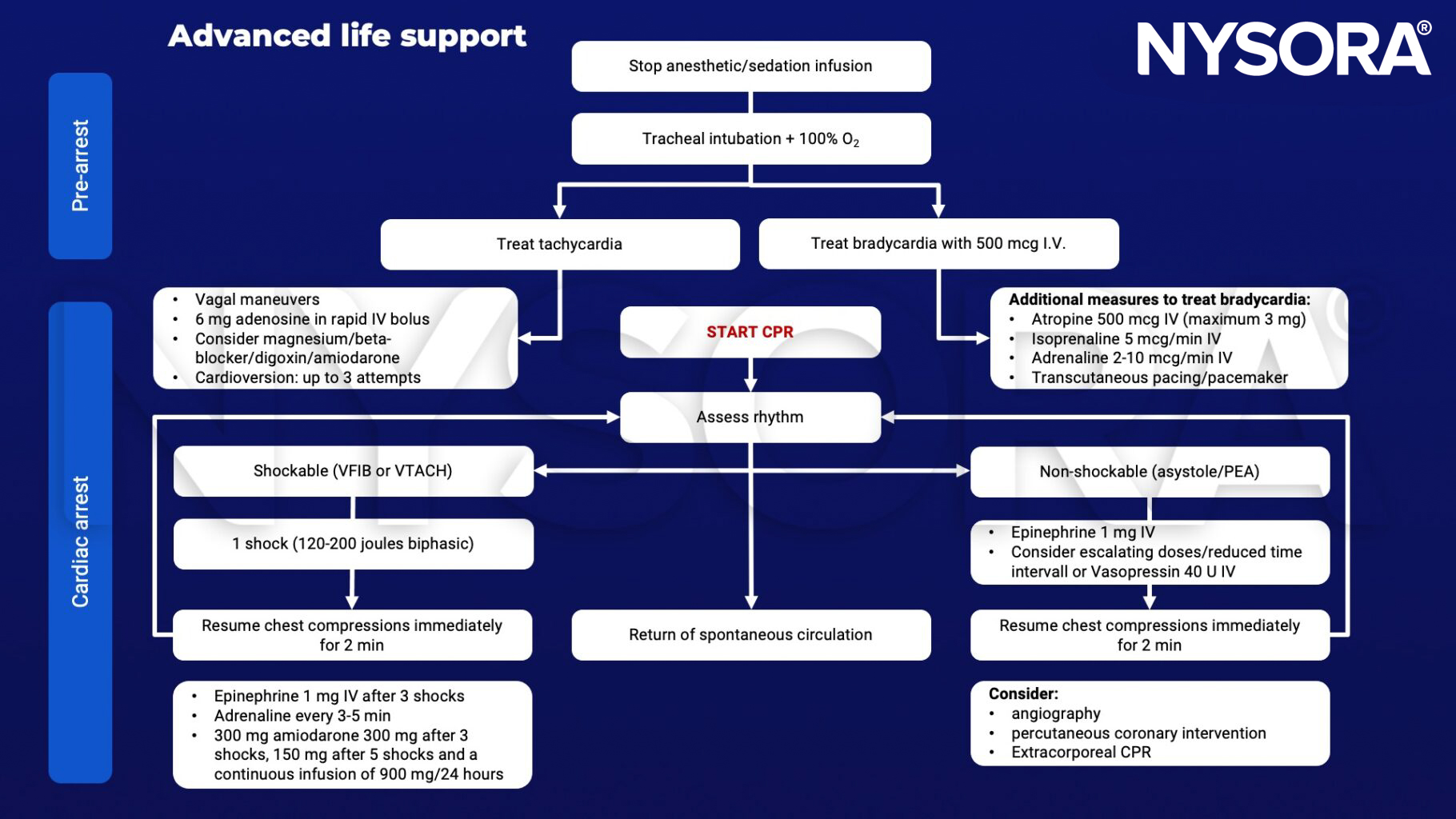
Post resuscitation care
- Apply invasive monitoring
- Finalize surgical plan and transport patient to ICU
- Perform a full history and examination
- Consider therapeutic hypothermia
Keep in mind
- Defibrillation is only possible if shockable rhythm (VFIB, VTACH) occurs
- Bradycardia and hypotension under general anesthesia are relatively common
- Cardiac arrest in the peri-operative setting is relatively rare and knowing when to initiate CPR can be difficult
- CPR should be established immediately and treatment will depend on the rhythm seen by EKG monitoring
Suggested reading
- Soar J, Böttiger BW, Carli P, et al. European Resuscitation Council Guidelines 2021: Adult advanced life support [published correction appears in Resuscitation. 2021 Oct;167:105-106]. Resuscitation. 2021;161:115-151.
- Moitra VK, Einav S, Thies KC, et al. Cardiac Arrest in the Operating Room: Resuscitation and Management for the Anesthesiologist: Part 1. Anesth Analg. 2018;126(3):876-888.
- Pollard BJ, Kitchen, G. Handbook of Clinical Anaesthesia. Fourth Edition. CRC Press. 2018. 978-1-4987-6289-2.
- McEvoy MD, Thies KC, Einav S, et al. Cardiac Arrest in the Operating Room: Part 2-Special Situations in the Perioperative Period [published correction appears in Anesth Analg. 2018 May;126(5):1797]. Anesth Analg. 2018;126(3):889-903.
- Moitra VK, Gabrielli A, Maccioli GA, O’Connor MF. Anesthesia advanced circulatory life support. Can J Anaesth. 2012 Jun;59(6):586-603. doi: 10.1007/s12630-012-9699-3.
Clinical updates
Moitra et al. (Anesthesiology, 2025) introduce the third iteration of Perioperative Resuscitation and Life Support (PeRLS), reframing advanced life support for perioperative cardiac arrest as a diagnosis-driven, context-specific approach rather than a uniform ACLS algorithm. Key updates include targeted ventilation (10–12 breaths/min to avoid hyperventilation), physiology-guided fluid and shock management (e.g., PPV use, LV vs RV shock differentiation), and condition-specific treatments for anaphylaxis, malignant hyperthermia, LAST, and prone-position arrest.
- Read more about these recommendations HERE.
Gu et al. (A&A, 2025) report in a meta-analysis of 17,766 ECMO patients that arterial hyperoxia during extracorporeal membrane oxygenation is consistently associated with increased mortality, with Pao₂ ≥ 200–300 mmHg linked to 43–56% higher odds of death, especially in VA-ECMO and extracorporeal CPR (ECPR) populations. These findings suggest that in advanced life support settings, oxygen therapy should be carefully titrated to avoid supraphysiological levels, reinforcing the principle that both hypoxia and hyperoxia can worsen outcomes.
- Read more about this study HERE.