 Nerve Blocks App
 Anesthesia Assistant App
 Ultrasound Pain App
 Pain Medicine Assistant App
 POCUS App
 IV Access App
 MSK Knee App
 VetRA App
 Nerve Block Manual
 Regional Anesthesia Updates
 Anesthesiology Manual
 Anesthesiology Review
 Anesthesia Updates 2025
 Anesthesia Updates 2026
 Pediatric Anesthesia Updates
 Airway Management Updates
 US Interventional Pain Manual
 Pain Medicine Updates
 Mastering Difficult IV Access
 PACU Nursing Manual
 RA Veterinary Manual
 Books
Books About
About
 Back to News
 3 min read

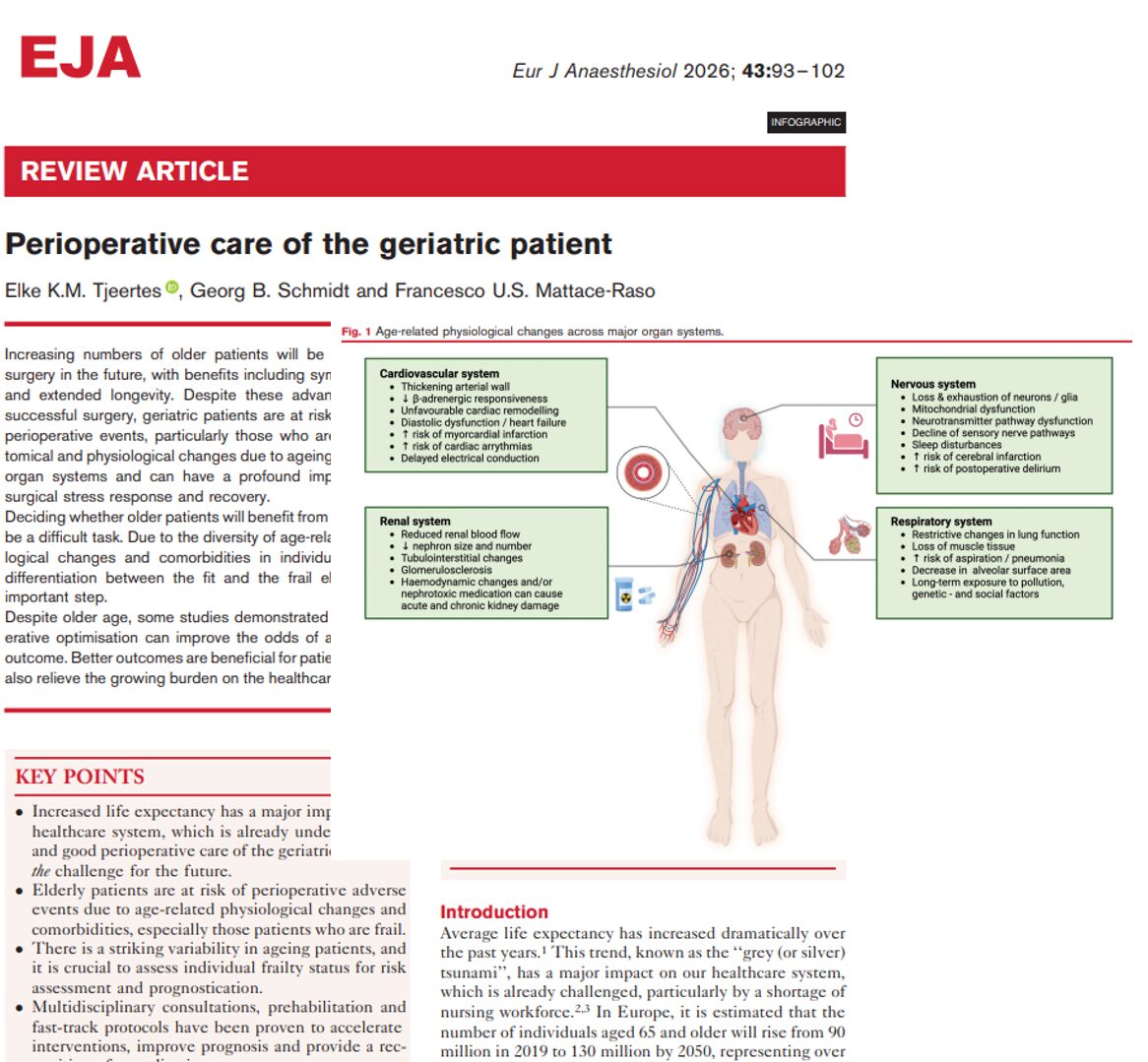
As life expectancy continues to rise, the healthcare system faces a critical challenge: safely managing the growing number of elderly patients undergoing surgery. In their comprehensive 2026 review, Tjeertes et al. present key updates on perioperative care for geriatric patients, with a strong focus on frailty assessment, shared decision-making, and outcome optimization.
The challenge of aging and surgery
Why are older adults more vulnerable?
Geriatric patients experience:
- Multiple comorbidities such as cardiovascular disease, diabetes, and dementia
- Reduced physiological reserve across all organ systems
- Increased susceptibility to postoperative complications such as delirium, infection, and functional decline
By 2050, more than 30% of Europe’s population will be over 65. The need for age-adapted perioperative strategies is more pressing than ever.
Understanding physiological changes with age
- Cardiovascular: increased arterial stiffness, impaired diastolic filling, heightened risk of arrhythmia
- Respiratory: reduced lung compliance, weakened cough reflex, aspiration risk
- Renal: decreased glomerular filtration, increased risk of drug toxicity
- Neurological: cognitive decline, vulnerability to delirium, reduced sensory perception
Frailty: a better predictor than age
Chronological age alone isn’t enough. Frailty, defined as reduced physiological reserve across multiple systems, is a stronger predictor of surgical risk.
Tools for frailty assessment:
- Clinical Frailty Scale (CFS): 9-point visual tool (see page 5) ranging from 1 (very fit) to 9 (terminally ill)
- Comprehensive Geriatric Assessment (CGA): gold standard, but resource-intensive
Frailty affects 23–53% of elderly surgical patients, depending on surgery type. It must be integrated into preoperative risk evaluation.
Step-by-step: how to optimize care for older surgical patients
-
Preoperative screening
- Assess cognitive function, nutrition, cardiopulmonary reserve, and polypharmacy
- Use frailty scales (CFS or CGA)
- Evaluate goals of care and resuscitation preferences
-
Prehabilitation programs
- Include physical training, anemia correction, and nutritional support
- Shows promise in reducing complications, even in frail patients
-
Multidisciplinary consultation
- Collaboration between anesthesiologists, surgeons, and geriatricians
- Improves outcomes and helps tailor risk-benefit analysis
-
Risk-adjusted surgical decision-making
- Consider both patient- and surgery-specific risks
- Balance potential benefits with the likelihood of functional recovery
Postoperative concerns in the elderly
Common complications:
- Delirium – highly prevalent and linked to worse outcomes
- Pneumonia and hypotension
- Renal insufficiency
- Functional loss and prolonged recovery
Enhanced Recovery After Surgery (ERAS) protocols are effective in reducing these risks and should be adapted to geriatric needs.
Advance care planning: reframing surgical intent
Surgery can be a gateway to important conversations about:
- End-of-life care
- Preferences on resuscitation and ventilation
- Quality of life versus survival
For frail patients with limited life expectancy, comfort and dignity may outweigh aggressive intervention. In carefully selected cases, nonoperative management offers humane, high-satisfaction outcomes.
Conclusion: redefining perioperative success
As the population ages, perioperative care for geriatric patients must evolve:
- Move beyond chronological age to assess frailty
- Employ multidisciplinary collaboration
- Integrate advanced care planning
- Customize prehabilitation and recovery protocols
Ultimately, success in geriatric surgery means more than survival; it means preserving dignity, function, and quality of life.
Reference: Tjeertes EKM et al. Perioperative care of the geriatric patient. Eur J Anaesthesiol. 2026;43:93-102.
Read more about geriatric patients in our Anesthesiology Module on NYSORA 360—an essential learning resource for residents with up-to-date, practical guidance across perioperative care.