Back to News
 4 min read
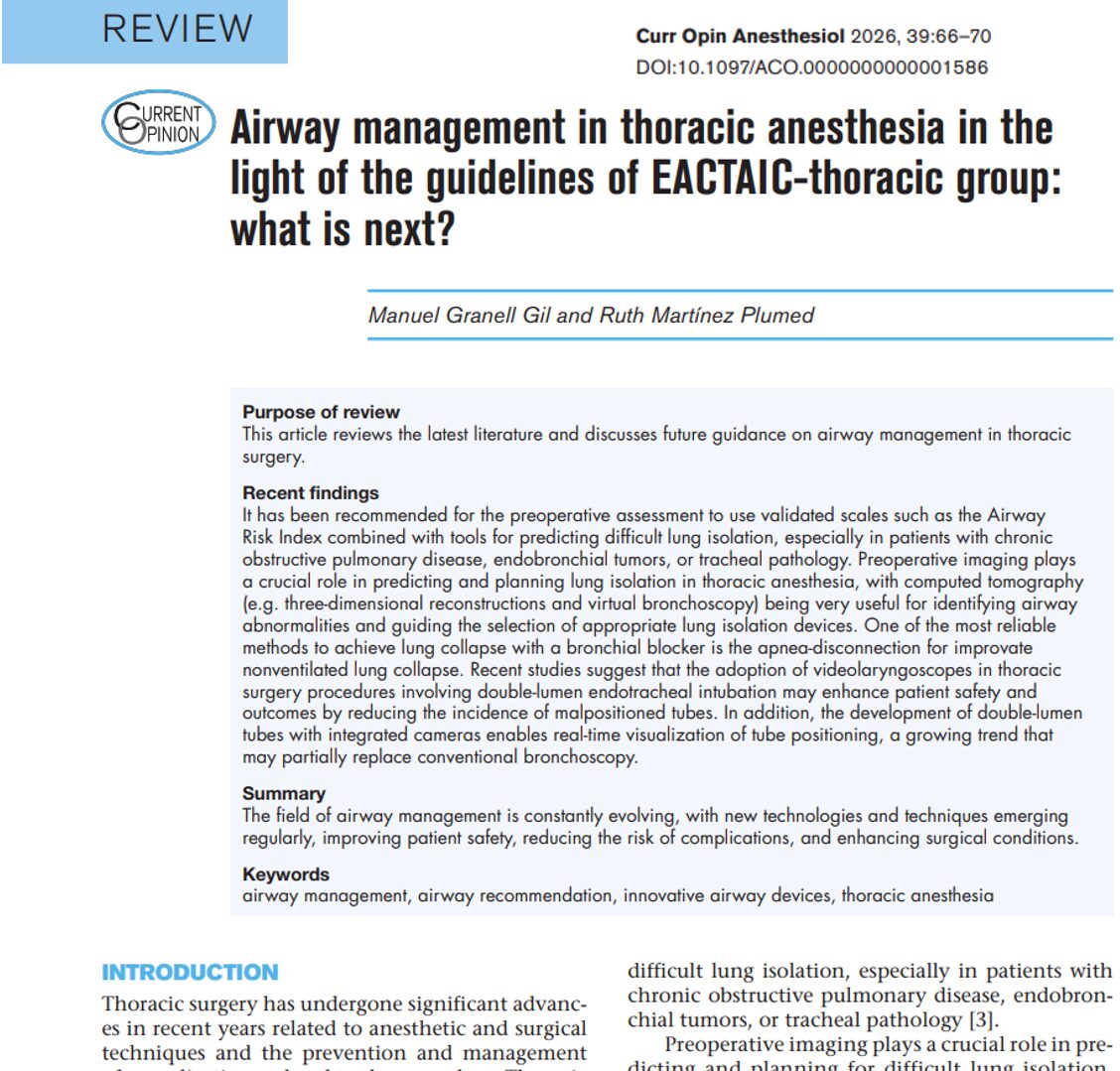
Airway management in thoracic surgery has seen a transformative evolution, shaped by technological breakthroughs, procedural refinements, and evidence-based recommendations. The European Association of Cardiothoracic Anaesthesiology and Intensive Care (EACTAIC) thoracic group recently released comprehensive guidelines aiming to standardize and elevate the safety and precision of airway techniques in thoracic anesthesia.
The evolving challenges of thoracic anesthesia
Thoracic procedures, such as lobectomy, esophagectomy, and lung transplantation, often require lung isolation and controlled one-lung ventilation (OLV), presenting significant airway challenges for anesthesiologists. Conditions like chronic obstructive pulmonary disease (COPD), endobronchial tumors, and tracheal anomalies further complicate airway access and device placement.
Preoperative assessment: laying the groundwork
Accurate airway management starts with a meticulous preoperative evaluation. Key strategies include:
- Use of validated scales, such as the Airway Risk Index, to predict difficult intubation or isolation scenarios.
- Computed tomography (CT) with 3D reconstructions and virtual bronchoscopy for visualizing airway structures.
- Flexible bronchoscopy to assess anomalies like tracheal bronchus or distorted bronchial anatomy.
These imaging modalities help determine the appropriate lung isolation technique and device, allowing anesthesiologists to tailor their approach to each patient’s anatomy.
Videolaryngoscopy: redefining intubation safety
A major advancement endorsed by the guidelines is the routine use of videolaryngoscopes (VLs) in thoracic anesthesia.
Benefits include:
- Higher success rates of first-attempt intubation
- Lower rates of tube malposition
- Improved visualization in difficult airways
Devices like the GlideScope and C-MAC are now recommended as standard of care during double-lumen tube (DLT) placement, especially in complex cases.
The rise of camera-integrated double-lumen tubes
Next-generation DLTs now include built-in cameras, enabling real-time visualization during tube advancement and placement.
Advantages include:
- Near-complete elimination of the need for a flexible bronchoscope (FOB)
- Continuous monitoring of bronchial cuff positioning
- Reduced mucosal trauma
- Enhanced ability to aspirate secretions or detect foreign bodies
These camera-equipped DLTs promise cost savings, improved patient safety, and more precise lung isolation, particularly useful in teaching environments or low-resource settings.
Bronchial blockers vs double-lumen tubes: choosing the right tool
Thoracic anesthesia depends on either DLTs or bronchial blockers (BBs) for lung separation or isolation.
When to choose a DLT:
- Absolute need for complete lung separation (e.g., massive hemorrhage, lung abscess, bronchopleural fistula)
- Procedures requiring rapid lung collapse and re-expansion
- Ease of suction and application of CPAP to the non-ventilated lung
When to choose a bronchial blocker:
- Anticipated difficult airway
- Tracheostomy or altered tracheobronchial anatomy
- Pediatric patients (especially <145 cm tall)
- Postoperative mechanical ventilation requirement
- Need for selective lobar blockade
Popular BB devices include:
- Arndt: FOB-guided placement using a loop
- Cohen: Rotatable tip with a directional wheel
- Uniblocker: Curved tip that rotates proximally
- EZ-Blocker: Dual-balloon tips for bilateral control
Apnea-disconnection technique: enhancing lung collapse
An effective method for lung collapse in VATS (video-assisted thoracoscopic surgery) using a bronchial blocker is the apnea-disconnection technique.
Steps:
- Preoxygenate with FiO₂ 1.0 for 3 minutes.
- Before pleural incision, disconnect the ETT from the ventilator for 30–60 seconds to allow lung deflation.
- Reinflate the blocker cuff under FOB visualization to confirm position.
- Reconnect and ventilate, potentially using a recruitment maneuver.
This technique yields similar lung collapse quality and speed to that achieved using a DLT.
Managing the difficult airway: recommendations from EACTAIC
Thoracic anesthesia poses a high risk of difficult intubation. The EACTAIC guidelines suggest:
- Preoperative planning using clinical history, imaging, and airway scores
- For predicted difficulty: perform awake FOB-guided BB insertion
- For unexpected difficulty: initiate with videolaryngoscopy, relax with rocuronium/sugammadex, and use back-up intubation strategies
- For extubation: follow Difficult Airway Society protocols, and use extubation guides or airway exchangers when reintubation risk exists
Simulation and training: preparing for complexity
Proper placement of DLTs or BBs under bronchoscopic guidance requires advanced technical skill. The field is moving toward:
- High-fidelity simulators for hands-on practice
- AI-powered modules for personalized procedure planning
- Integration of real-time guidance systems
These training modalities enhance skill retention, improve outcomes, and foster safety in high-stakes procedures.
Conclusion
Airway management in thoracic anesthesia is transitioning into a new era, one where advanced imaging, smart devices, and data-driven strategies guide decision-making. The latest EACTAIC guidelines emphasize the importance of individualized care, robust preoperative assessment, and integration of new technologies to enhance safety and surgical conditions.
As anesthesiologists and thoracic teams adapt to these advancements, ongoing training and interprofessional collaboration will be vital to unlocking the full potential of next-generation airway management.
Reference: Granell Gil M et al. Airway management in thoracic anesthesia in the light of the guidelines of EACTAIC-thoracic group: what is next?. Curr Opin Anaesthesiol. 2026;39:66-70.
Read more about these new guidelines in NYSORA’s Anesthesia Assistant App.