 Nerve Blocks App
 Anesthesia Assistant App
 Ultrasound Pain App
 Pain Medicine Assistant App
 POCUS App
 IV Access App
 MSK Knee App
 VetRA App
 Nerve Block Manual
 Regional Anesthesia Updates
 Anesthesiology Manual
 Anesthesiology Review
 Anesthesia Updates 2025
 Anesthesia Updates 2026
 Pediatric Anesthesia Updates
 Airway Management Updates
 US Interventional Pain Manual
 Pain Medicine Updates
 Mastering Difficult IV Access
 PACU Nursing Manual
 RA Veterinary Manual
 Books
Books About
About
 Back to News
 4 min read

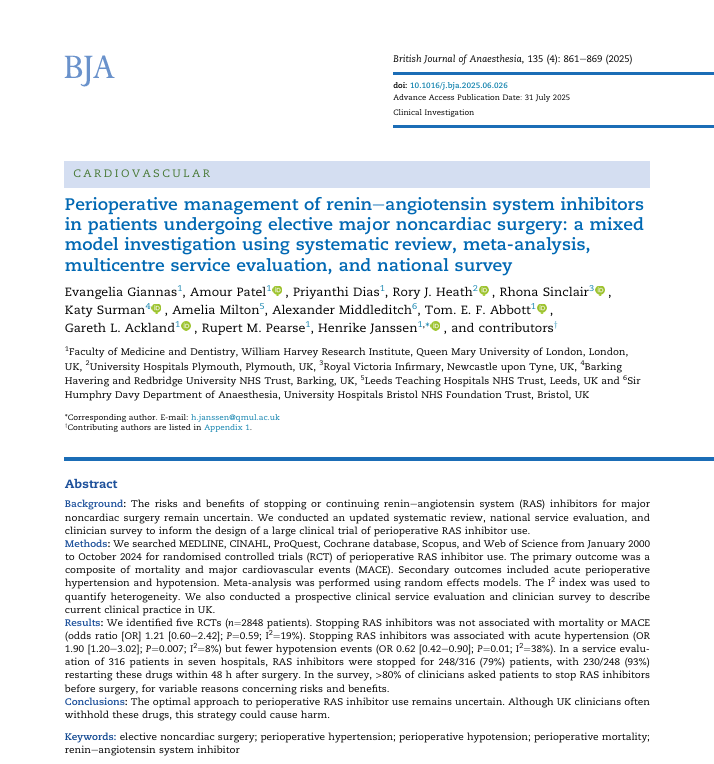
The perioperative use of renin–angiotensin system (RAS) inhibitors, including angiotensin-converting enzyme (ACE) inhibitors and angiotensin receptor blockers (ARBs), remains a contentious topic in noncardiac surgery. While these medications are cornerstones in managing hypertension, heart failure, and other cardiovascular conditions, their continuation around the time of surgery is debated due to potential complications like hypotension or hypertension.
A new mixed-methods study published in the British Journal of Anaesthesia (Giannas et al., 2025) sheds critical light on this issue, combining a systematic review, meta-analysis, a prospective national service evaluation, and a clinician survey to examine the impact and current practices of perioperative RAS inhibitor management.
Why this matters
More than 70% of patients undergoing major noncardiac surgery are prescribed RAS inhibitors. Clinical guidelines vary, and practices are inconsistent. Understanding whether to continue or withhold these drugs before surgery has significant implications for:
- Cardiovascular outcomes
- Blood pressure control
- Postoperative complications
- Clinical decision-making
Key findings at a glance
- No significant difference in mortality or major adverse cardiovascular events (MACE) between patients who stopped vs continued RAS inhibitors.
- Stopping RAS inhibitors reduced hypotension but increased the risk of acute hypertension.
- UK clinicians commonly stop RAS inhibitors preoperatively, often due to concerns about intraoperative hypotension.
- Most patients resume RAS inhibitors within 48 hours post-surgery, indicating clinicians aim for a temporary hold.
Detailed study results
1. Systematic review and meta-analysis
The study analyzed five randomized controlled trials (RCTs) with 2848 patients.
Primary outcome
- MACE or all-cause mortality: No significant difference
Secondary outcomes
- Hypotension: Reduced when RAS inhibitors were stopped
- Hypertension: Increased when RAS inhibitors were stopped
Importantly, hypotensive episodes were only marginally longer when RAS inhibitors were continued (e.g., 7 vs 2 minutes), questioning their clinical relevance.
2. National service evaluation
A prospective evaluation across seven UK hospitals included 316 patients.
Findings:
- RAS inhibitors were stopped in 78.5% of patients.
- Restarted within 48 hours post-op in 91.2%, mostly within 24 hours.
- Practices were consistent across specialties and comorbidities.
3. Clinician survey
247 clinicians (mostly anesthetists) responded.
- Over 80% advised stopping RAS inhibitors before surgery.
- Avoiding hypotension was cited as the main reason.
- Only 24% reported no local guideline for RAS management.
Interpreting the evidence
Pros of stopping RAS inhibitors:
- Reduces risk of intraoperative hypotension
- Aligns with current practice and clinician comfort
Cons of stopping:
- Increases perioperative hypertension
- Potentially worsens outcomes in high-risk groups (e.g., heart failure)
- Rebound BP spikes may cause myocardial injury
Recent data suggest that patients with low NT-proBNP levels (a marker of lower cardiovascular risk) may experience more myocardial injury if RAS inhibitors are withheld.
At-risk populations: heart failure and beyond
Patients with undiagnosed or underdiagnosed heart failure may be particularly vulnerable. Despite guidelines suggesting continuation in stable heart failure, 64.5% of such patients in the service evaluation were still advised to stop RAS inhibitors.
No trial has focused exclusively on patients with heart failure, a glaring evidence gap.
Best practices: what should clinicians do?
Recommendations based on current data:
- Assess cardiovascular risk preoperatively (e.g., using NT-proBNP)
- Consider continuing RAS inhibitors in heart failure patients
- Pause only temporarily—reinitiate within 24–48 hours post-op if possible
- Use individualized decision-making rather than blanket policies
Conclusion
The study by Giannas et al. provides critical clarity in a long-standing clinical dilemma. Although the data do not support a clear “always stop” or “always continue” policy, they do highlight the need for risk stratification, clinical judgment, and patient-specific planning.
Reference: Giannas E et al. Perioperative management of renin-angiotensin system inhibitors in patients undergoing elective major noncardiac surgery: a mixed model investigation using systematic review, meta-analysis, multicentre service evaluation, and national survey. Br J Anaesth. 2025;135:861-869.
Read more about this topic in the Anesthesia Updates section of the Anesthesia Assistant App. Prefer a physical copy? Get the latest literature and guidelines in book format. For an interactive digital experience, check out the Anesthesia Updates Module on NYSORA360!