 Nerve Blocks App
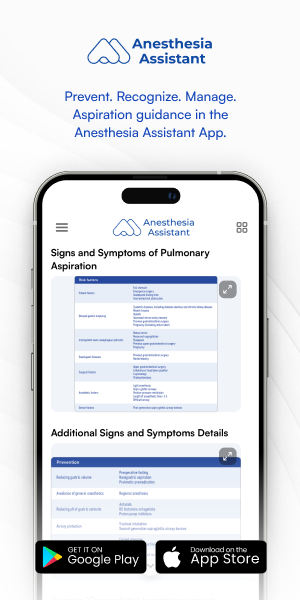
 Anesthesia Assistant App
 Ultrasound Pain App
 Pain Medicine Assistant App
 POCUS App
 IV Access App
 MSK Knee App
 VetRA App
 Nerve Block Manual
 Regional Anesthesia Updates
 Anesthesiology Manual
 Anesthesiology Review
 Anesthesia Updates 2025
 Anesthesia Updates 2026
 Pediatric Anesthesia Updates
 Airway Management Updates
 US Interventional Pain Manual
 Pain Medicine Updates
 Mastering Difficult IV Access
 PACU Nursing Manual
 RA Veterinary Manual
 Books
Books About
About
Learning objectives
- Identification of patients at risk for pulmonary aspiration
- Reducing the risk of pulmonary aspiration
- Management of pulmonary aspiration
Definition
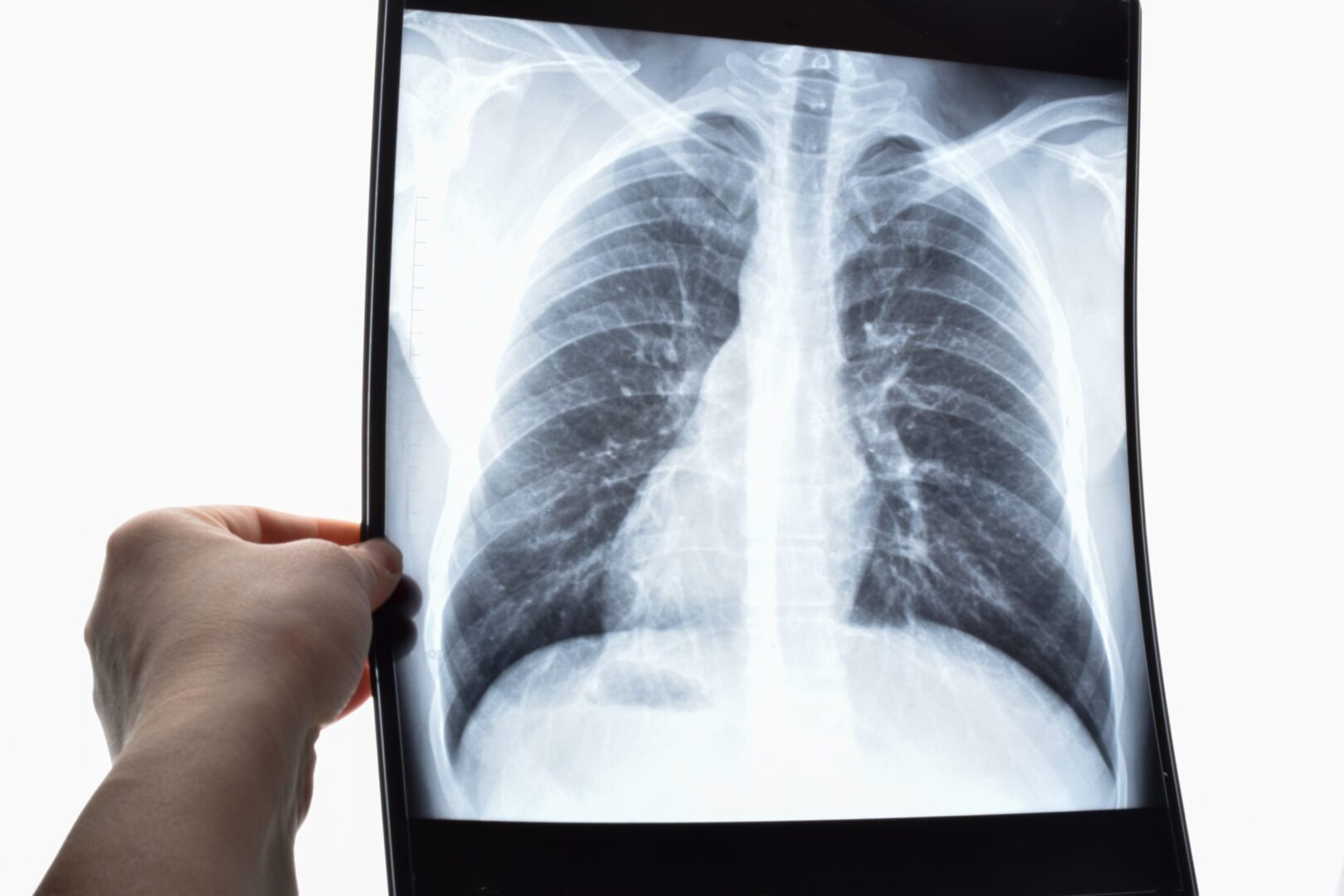
- The inhalation of oropharyngeal or gastric contents into the larynx and the respiratory tract
- Aspiration accounts for more deaths than failure to intubate or ventilate
- May lead to chemical pneumonitis, bacterial pneumonia, or acute respiratory distress syndrome
Signs and symptoms
- Symptoms can range from none to respiratory failure and subsequent cardiac arrest in a massive aspiration event
Risk Factors
| Patient factors | Full stomach |
| Emergency surgery | |
| Inadequate fasting time | |
| Gastrointestinal obstruction | |
| Delayed gastric emptying | Systemic diseases, including diabetes mellitus and Chronic kidney disease |
| Recent Trauma | |
| Opioids | |
| Increased intracranial pressure | |
| Previous gastrointestinal surgery | |
| Pregnancy (including active labor) |
|
| Incompetent lower oesophageal sphincter | Hiatus hernia |
| Recurrent regurgitation | |
| Dyspepsia | |
| Previous upper gastrointestinal surgery | |
| Pregnancy | |
| Esophageal diseases | Previous gastrointestinal surgery |
| Morbid Obesity | |
| Surgical factors | Upper gastrointestinal surgery |
| Lithotomy or head down position |
|
| Laparoscopy | |
| Cholecystectomy | |
| Anesthetic factors | Light anesthesia |
| Supra-glottic airways | |
| Positive pressure ventilation | |
| Length of surgery > 2 h | |
| Difficult airway | |
| Device factors | First-generation supra-glottic airway devices |
Prevention
| Reducing gastric volume | Preoperative fasting |
| Nasogastric aspiration | |
| Prokinetic premedication | |
| Avoidance of general anesthetics | Regional anesthesia |
| Reducing pH of gastric contents | Antacids |
| H2 histamine antagonists | |
| Proton pump inhibitors | |
| Airway protection | Tracheal intubation |
| Second-generation supraglottic airway devices | |
| Prevent regurgitation | Cricoid pressure |
| Rapid sequence induction | |
| Extubation | Awake after return of airway reflexes |
| Position (lateral, head down or upright) |
Management
- Anesthesiologists should have a low index of suspicion for aspiration
- Emergency anesthesia on its own is an important risk factor for aspiration
- Management is supportive
- The trachea should be suctioned after securing a safe airway, ideally before positive pressure ventilation to prevent the distal displacement of aspirated material
- Antibiotics should only be used if pneumonia develops, early antibiotics may lead to the selection of virulent bacteria including pseudomonas
- There is no evidence that using steroids either reduces mortality or improves outcome
Suggested reading
- Michael Robinson, MB ChB FRCA, Andrew Davidson, MA MBBS FRCA FFICM, Aspiration under anaesthesia: risk assessment and decision-making, Continuing Education in Anaesthesia Critical Care & Pain, Volume 14, Issue 4, August 2014, Pages 171–175.
- Asai T. Editorial II: Who is at increased risk of pulmonary aspiration?. Br J Anaesth. 2004;93(4):497-500.
Clinical updates
Paggers et al. (European Journal of Anaesthesiology, 2025) review the perioperative implications of GLP-1 receptor agonists and conclude that although these drugs delay gastric emptying and may increase residual gastric content, a direct causal link to increased pulmonary aspiration during anesthesia has not been definitively established. The authors highlight the importance of individualized risk assessment, consideration of temporary preoperative withholding, and the use of point-of-care gastric ultrasound to better stratify aspiration risk.
- Read more about this study HERE.
Huang et al. (British Journal of Anaesthesia, 2025) identified a strong association between GLP-1 receptor agonists and impaired gastric emptying, with semaglutide showing the highest reporting odds ratio. Among 982 GLP-1RA-related impaired gastric emptying cases, 13 resulted in pulmonary aspiration, including one death and several life-threatening events. The risk was highest early after drug initiation, underscoring the need for careful perioperative assessment and consideration of temporarily withholding GLP-1RAs before elective anesthesia to mitigate aspiration risk.
- Read more about this study HERE.