Indications
- Radial artery cannulation is used for invasive monitoring of the blood pressure and arterial blood sampling.
- The radial artery is the best site for arterial cannulation.
Tip
Other cannulation sites (i.e., brachial, ulnar, axillary, dorsalis pedis, tibialis posterior, and temporal artery) should not be considered first-line for insertion due to their higher complication rate.
Functional anatomy
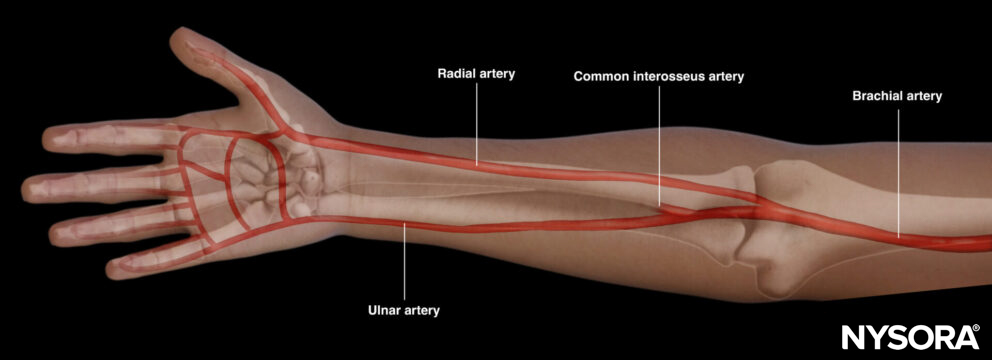
Anatomy of the radial artery.
Preparation
- Hand hygiene
- Disinfect the area of interest (2% chlorhexidine in 70% isopropyl alcohol)
- Use a sterile drape
- Wear sterile gloves during the procedure
- Use a sleeve or Tegaderm to cover the transducer
- Use sterile gel
- 20G needle with a long cannula
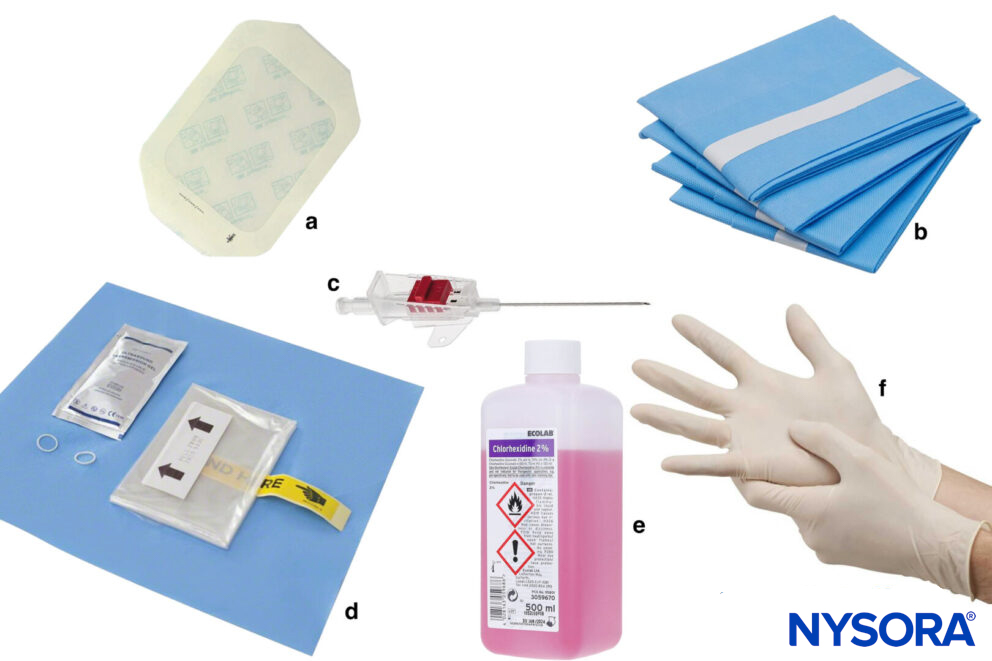
a, Tegaderm; b, Sterile draping; c, Cannula; d, Sterile ultrasound sleeve; e, Antiseptic; f, Sterile gloves.
Patient position
- Radial artery cannulation is performed in the supine position.
- Expose the extremity of interest.
- Position yourself at a 90-degree angle toward the structure.
- A padding that extends the wrist can help to optimize the position for an arterial radial puncture by lifting the wrist from the underlying surface.
Technique
The transducer is placed on the lateral side of the arm and approximately 3-4 cm proximal to the wrist crease.
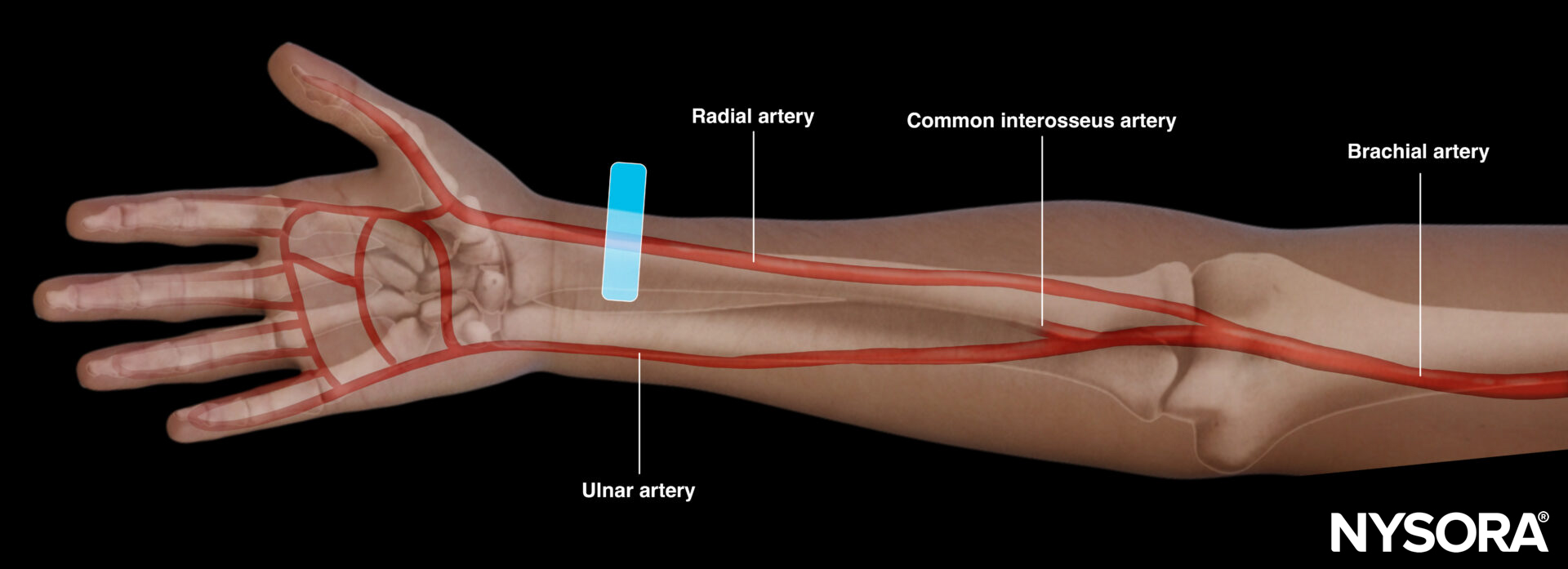
Transducer position for radial artery cannulation.
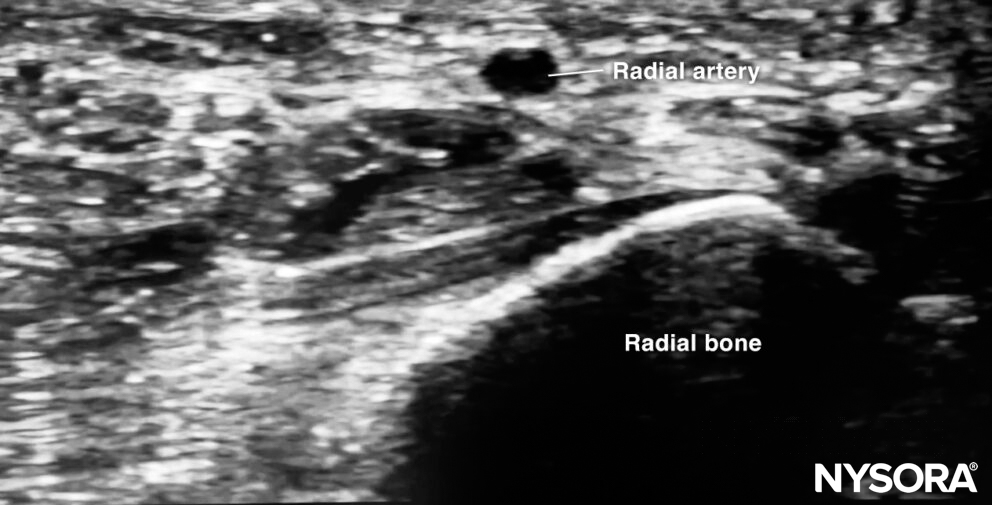
Sonoanatomy for radial artery cannulation.
The out-of-plane technique is the most commonly used technique for arterial vascular access. Before the actual puncture, scan dynamically to get an idea about the direction of the artery. Use the creep technique to follow the needle tip at all times.
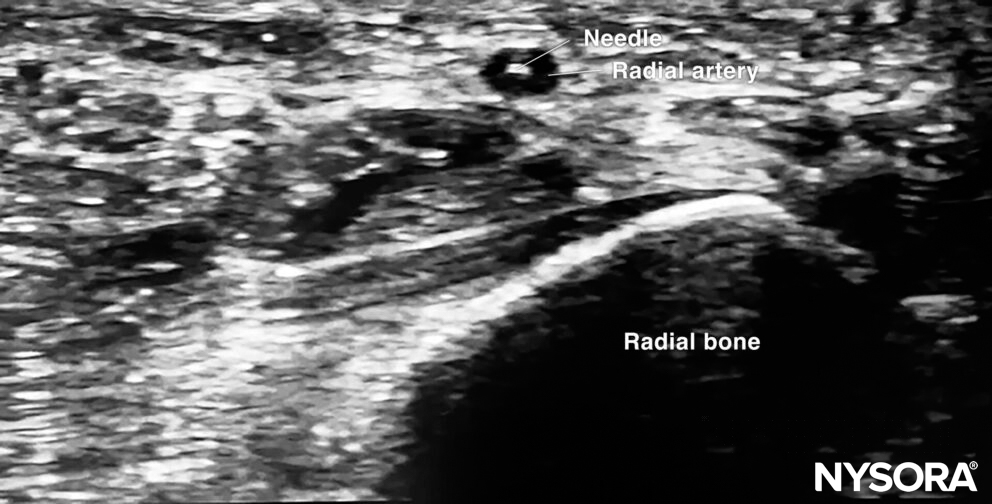
Out-of-plane cannulation of the radial artery
Tips
- The radial artery is the most common site for cannulation due to its superficial location and low complication rate.
- The radial artery is also the preferred site of insertion due to decreased risk of infection.
- Temporary occlusion, hematoma, pseudoaneurysm, nerve injury, ischemia, local infection, and sepsis are the most common complications of arterial cannulation.
Clinical updates
- Maitra et al. (The Journal of Vascular Access, 2023) conducted a randomized controlled trial in 200 perioperative patients comparing ultrasound-guided distal (dorsal) radial artery cannulation at the anatomical snuffbox with conventional volar radial artery cannulation. Distal cannulation had a significantly lower first-attempt success rate (57% vs 77%, p=0.003) and required a longer time to puncture and complete cannulation (median total time 85 s vs 44.5 s, p<0.0001), though no short-term complications or thrombosis were observed in either group. These findings suggest that, despite theoretical advantages, distal radial access is technically more challenging and may require greater operator experience in the perioperative setting.
Maitra S, Baidya DK, Ray BR, Chowhan G, Bhattacharjee S. Comparison of ultrasound guided dorsal radial artery cannulation and conventional radial artery cannulation at the volar aspect of wrist: A pilot randomized controlled trial. J Vasc Access. 2023;24(6):1463-1468.