 Nerve Blocks App
 Anesthesia Assistant App
 Ultrasound Pain App
 Pain Medicine Assistant App
 POCUS App
 IV Access App
 MSK Knee App
 VetRA App
 Nerve Block Manual
 Regional Anesthesia Updates
 Anesthesiology Manual
 Anesthesiology Review
 Anesthesia Updates 2025
 Anesthesia Updates 2026
 Pediatric Anesthesia Updates
 Airway Management Updates
 US Interventional Pain Manual
 Pain Medicine Updates
 Mastering Difficult IV Access
 PACU Nursing Manual
 RA Veterinary Manual
 Books
Books About
About
 Back to News
 6 min read



Hip fractures remain one of the most serious injuries affecting older adults worldwide. For many geriatric patients, hip arthroplasty, including total hip arthroplasty or hemiarthroplasty, becomes necessary after a fracture. However, postoperative complications, hospital readmissions, thromboembolic events, and mortality continue to pose major clinical challenges.
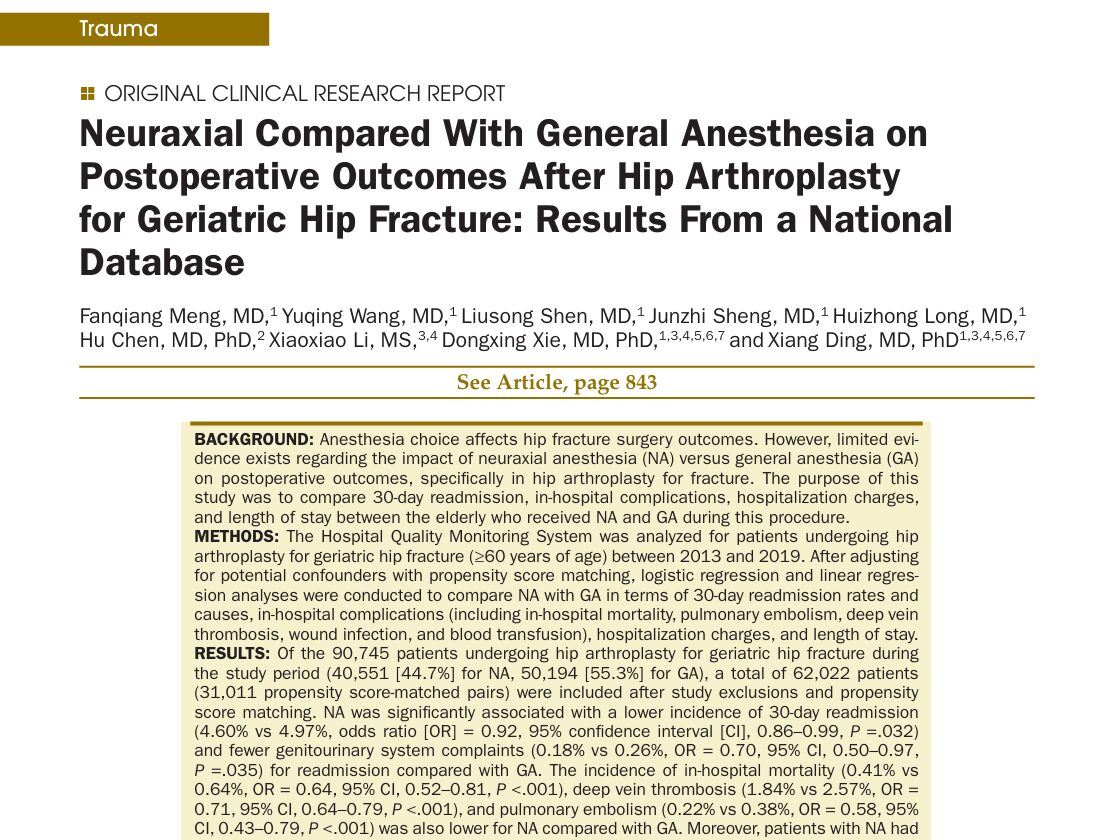
A newly published national database study in Anesthesia & Analgesia suggests that neuraxial anesthesia may offer important advantages over general anesthesia in elderly patients undergoing hip arthroplasty for fracture.
The research analyzed more than 90,000 geriatric hip fracture cases from China’s Hospital Quality Monitoring System database and found that neuraxial anesthesia was associated with:
- Lower 30-day readmission rates
- Reduced in-hospital mortality
- Lower incidence of deep vein thrombosis (DVT)
- Reduced pulmonary embolism (PE)
- Lower hospitalization costs
The findings add to growing evidence that anesthesia selection may significantly influence postoperative outcomes in orthopedic trauma surgery.
What is neuraxial anesthesia?
Neuraxial anesthesia (NA) refers to regional anesthetic techniques delivered around the spinal cord.
Common forms include:
These techniques temporarily block nerve conduction below the injection site, allowing surgery without complete unconsciousness.
General anesthesia (GA), by contrast, induces full unconsciousness and usually requires airway instrumentation and mechanical ventilation.
Why anesthesia choice matters in geriatric hip fracture surgery
Older adults are particularly vulnerable during surgery because of:
- Frailty
- Cardiovascular disease
- Reduced pulmonary reserve
- Cognitive impairment
- Multiple chronic comorbidities
Hip arthroplasty for fracture is also associated with:
- Significant blood loss
- Thromboembolic risk
- Postoperative delirium
- Respiratory complications
- Increased mortality risk
Because anesthesia influences hemodynamics, inflammatory responses, mobility, and pain control, researchers have long debated whether neuraxial anesthesia may improve outcomes compared with general anesthesia.
Previous studies have produced conflicting conclusions. Some reported reduced mortality and complications with neuraxial anesthesia, while others found minimal differences.
This new study focused specifically on hip arthroplasty patients rather than grouping all hip fracture procedures together.
Study overview
The investigators analyzed data from the Chinese Hospital Quality Monitoring System between 2013 and 2019.
Study population
Researchers identified:
- 385,004 total hip arthroplasty and hemiarthroplasty cases initially
- 90,745 eligible geriatric hip fracture patients after exclusions
Among those patients:
- 40,551 received neuraxial anesthesia
- 50,194 received general anesthesia
After propensity score matching to reduce confounding:
- 31,011 matched pairs remained for analysis
Main findings
Lower 30-day readmission rates
The primary endpoint was 30-day hospital readmission.
Researchers found:
- Neuraxial anesthesia: 4.60%
- General anesthesia: 4.97%
This represented a statistically significant reduction in readmissions with neuraxial anesthesia.
Reduced genitourinary-related readmissions
One particularly notable finding involved genitourinary complications.
Patients receiving neuraxial anesthesia had fewer readmissions related to:
- Urinary complications
- Genitourinary disorders
The authors suggested this may relate to differences in urinary catheter use and improved postoperative pain control with neuraxial techniques.
Lower mortality rates
In-hospital mortality was also significantly lower in the neuraxial anesthesia group.
Mortality results
- General anesthesia: 0.64%
- Neuraxial anesthesia: 0.41%
The reduction was clinically meaningful and statistically significant.
The authors noted that while randomized trials have sometimes shown mixed results, their large national database analysis supports the possibility that neuraxial anesthesia confers survival advantages in carefully selected elderly patients with hip fractures.
Lower rates of DVT and pulmonary embolism
Venous thromboembolism is one of the most dangerous postoperative complications after hip surgery.
The study demonstrated lower rates of both DVT and PE in the neuraxial anesthesia group.
Deep vein thrombosis
- General anesthesia: 2.57%
- Neuraxial anesthesia: 1.84%
Pulmonary embolism
- General anesthesia: 0.38%
- Neuraxial anesthesia: 0.22%
The authors proposed several possible explanations.
Potential mechanisms include:
- Improved lower limb blood flow
- Sympathetic blockade
- Reduced surgical stress response
- Earlier mobilization
- Better postoperative analgesia
Reduced hospitalization costs
Healthcare costs are increasingly important as populations age globally.
The study found significantly lower hospitalization charges among patients receiving neuraxial anesthesia.
Mean hospitalization charges
- General anesthesia: 54,754.8 Chinese Yuan
- Neuraxial anesthesia: 49,851.8 Chinese Yuan
This difference may reflect:
- Lower complication rates
- Reduced resource utilization
- Improved pain control
- Faster functional recovery
The authors emphasized that even modest cost reductions could have major economic implications given the growing burden of hip fractures worldwide.
No major difference in hospital length of stay
Interestingly, the length of stay did not differ significantly between groups.
Average hospital stay
- General anesthesia: 13.8 days
- Neuraxial anesthesia: 13.7 days
Researchers suggested that hip arthroplasty patients often require extensive rehabilitation and multidisciplinary postoperative care regardless of anesthesia type.
Why neuraxial anesthesia may improve outcomes
Several physiological mechanisms may explain the observed benefits.
Improved respiratory function
Unlike general anesthesia, neuraxial techniques may avoid:
- Endotracheal intubation
- Mechanical ventilation
- Ventilator-associated complications
This may improve pulmonary mechanics in frail elderly patients.
Reduced stress response
Surgery triggers inflammatory and neuroendocrine stress pathways.
Neuraxial anesthesia may blunt:
- Catecholamine release
- Sympathetic activation
- Hypercoagulability
These effects could help reduce thromboembolic and cardiovascular complications.
Better postoperative pain control
Regional anesthesia frequently provides superior analgesia.
This may lead to:
- Reduced opioid use
- Earlier mobilization
- Lower urinary retention risk
- Improved rehabilitation participation
Enhanced lower limb circulation
Sympathetic blockade during neuraxial anesthesia may improve venous blood flow in the lower extremities.
Improved circulation could reduce DVT risk.
How do these findings compare with prior research?
The results align with several previous observational studies that have shown improved outcomes with neuraxial anesthesia.
However, some randomized controlled trials, including the REGAIN and RAGA studies, reported no significant mortality differences between neuraxial and general anesthesia.
The discrepancy may arise because earlier studies:
- Included multiple surgical procedures
- Did not isolate arthroplasty patients
- Had lower-than-expected event rates
The authors argue that hip arthroplasty patients represent a unique subgroup with distinct physiological risks.
Clinical implications
For orthopedic surgeons, anesthesiologists, and perioperative teams, the study highlights the importance of individualized anesthesia planning.
Potential advantages of neuraxial anesthesia may include:
- Lower mortality risk
- Reduced thromboembolic complications
- Lower readmission rates
- Decreased healthcare costs
However, anesthesia selection must still consider:
- Patient comorbidities
- Coagulation status
- Spinal pathology
- Surgical complexity
- Institutional expertise
Key takeaways
The study found that neuraxial anesthesia was associated with:
- Lower 30-day readmission rates
- Reduced in-hospital mortality
- Lower DVT incidence
- Reduced pulmonary embolism risk
- Lower hospitalization costs
No major differences were found in:
- Length of hospital stay
- Blood transfusion rates
- Wound infection rates
Researchers concluded that:
Neuraxial anesthesia may represent a safer and more cost-effective strategy for geriatric patients undergoing hip arthroplasty after fracture, although randomized trials specifically targeting this population are still needed.
Reference: Meng F et al. Neuraxial Compared With General Anesthesia on Postoperative Outcomes After Hip Arthroplasty for Geriatric Hip Fracture: Results From a National Database. Anesth Analg. 2026;142:848-855
Stay ahead in perioperative care, use the NYSORA Anesthesia Assistant App to ask clinical questions, simulate anesthesia cases, and get expert guidance anytime.