 Nerve Blocks App
 Anesthesia Assistant App
 Ultrasound Pain App
 Pain Medicine Assistant App
 POCUS App
 IV Access App
 MSK Knee App
 VetRA App
 Nerve Block Manual
 Regional Anesthesia Updates
 Anesthesiology Manual
 Anesthesiology Review
 Anesthesia Updates 2025
 Anesthesia Updates 2026
 Pediatric Anesthesia Updates
 Airway Management Updates
 US Interventional Pain Manual
 Pain Medicine Updates
 Mastering Difficult IV Access
 PACU Nursing Manual
 RA Veterinary Manual
 Books
Books About
About

Learning objectives
- Description of placenta praevia
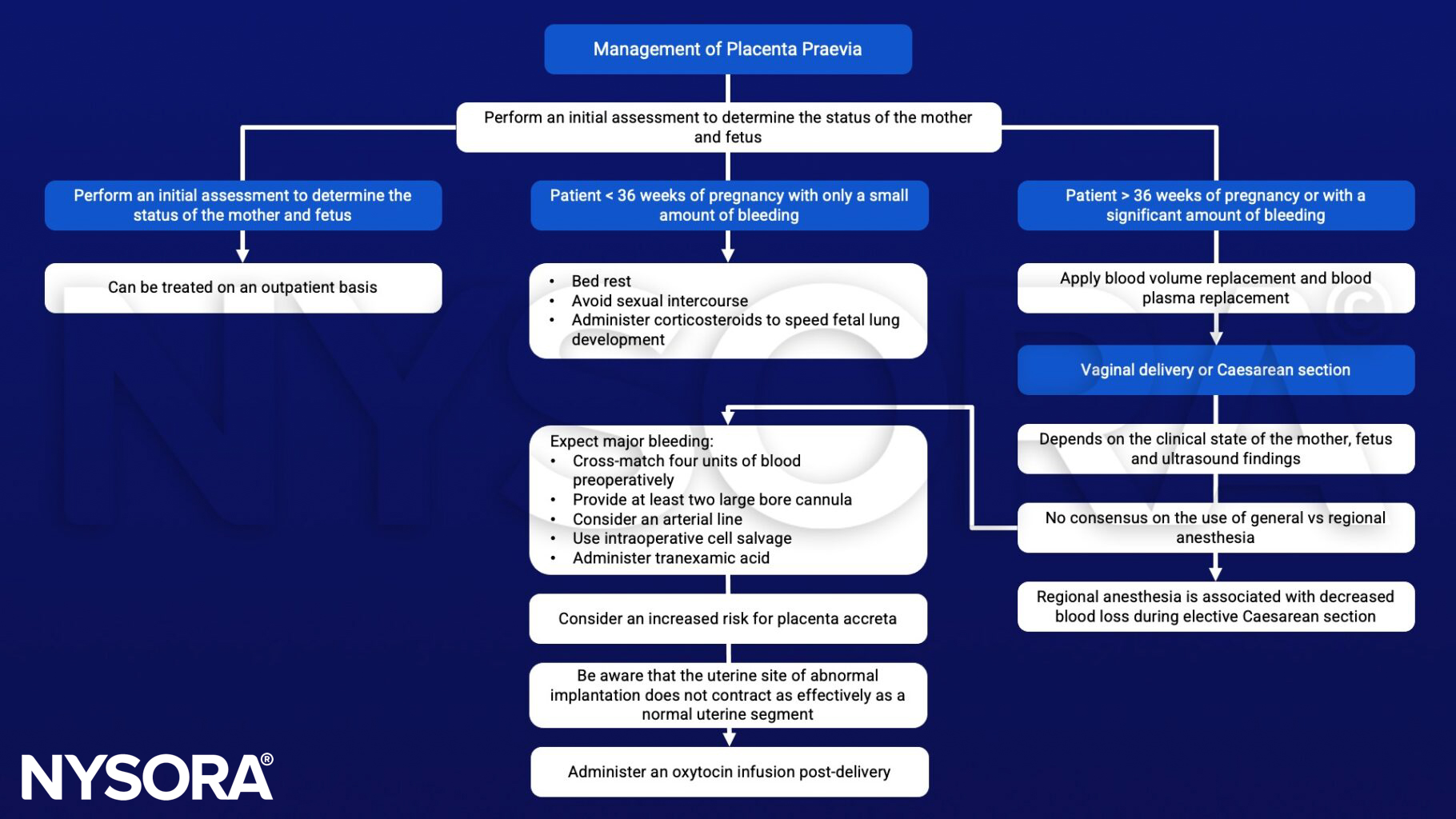
- Management of placenta praevia
Definition and mechanisms
- When the placenta attaches inside the uterus near or over the cervical opening
- Classified as a complication of pregnancy
- Commonly occurs around 32 weeks of gestation, however, placenta praevia should be suspected if there is bleeding after 24 weeks of gestation
- Affects approximately 0.5% of pregnancies
- A caesarean section is often required because of the high bleeding risk
- The cause is unknown, however, is thought to be related to abnormal vascularisation of the endometrium caused by scarring or atrophy from previous trauma, surgery, or infection
Classification
- Minor
- Placenta is in the lower uterine segment, but the lower edge does not cover the internal os
- Major
- Placenta is in the lower uterine segment, and the lower edge covers the internal os
- Other than that placenta previa can also be classified as:
- Complete:
- The placenta completely covers the cervix, blocking the vagina
- Partial:
- The placenta partially covers the cervix
- Marginal:
- Placenta is positioned at the edge of the cervix
- Touching but not covering the cervix
- More likely to resolve on its own
- Complete:
Complications
| Maternal | Fetal |
|---|---|
| Placenta accreta Hypotension Antepartum bleeding Placental abruption Postpartum hemorrhage Abnormal placentation | Intrauterine growth restriction Hypoxia Premature infant Low birth weight |
Risk factors
- Previous placenta previa, caesarean delivery, myomectomy, or endometrium damage caused by dilation and curettage
- Younger than 20 or older than 35
- Multiparity
- Smoking or cocaine use during pregnancy
- Pregnant with twins, triplets, or more
- Previous surgery on the uterus
- History of uterine fibroids
Diagnosis
- Ultrasound
Management
Suggested reading
- Pollard BJ, Kitchen, G. Handbook of Clinical Anaesthesia. Fourth Edition. CRC Press. 2018. 978-1-4987-6289-2.
- Plaat F, shonfeldd A. 2015. Major obstetric hemorrhage. BJA education. 15;4:190-193.
- Walfish, M., Neuman, A., Wlody, D., 2009. Maternal haemorrhage. British Journal of Anaesthesia 103, i47–i56.