 Nerve Blocks App
 Anesthesia Assistant App
 Ultrasound Pain App
 Pain Medicine Assistant App
 POCUS App
 IV Access App
 MSK Knee App
 VetRA App
 Nerve Block Manual 2027
 Nerve Block Manual
 Regional Anesthesia Updates
 Anesthesiology Manual
 Anesthesiology Review
 Anesthesia Updates 2025
 Anesthesia Updates 2026
 Pediatric Anesthesia Updates
 Airway Management Updates
 US Interventional Pain Manual
 Pain Medicine Updates
 Mastering Difficult IV Access
 PACU Nursing Manual
 RA Veterinary Manual
 Books
Books About
About

Learning objectives
- Prevent infective endocarditis
Definition
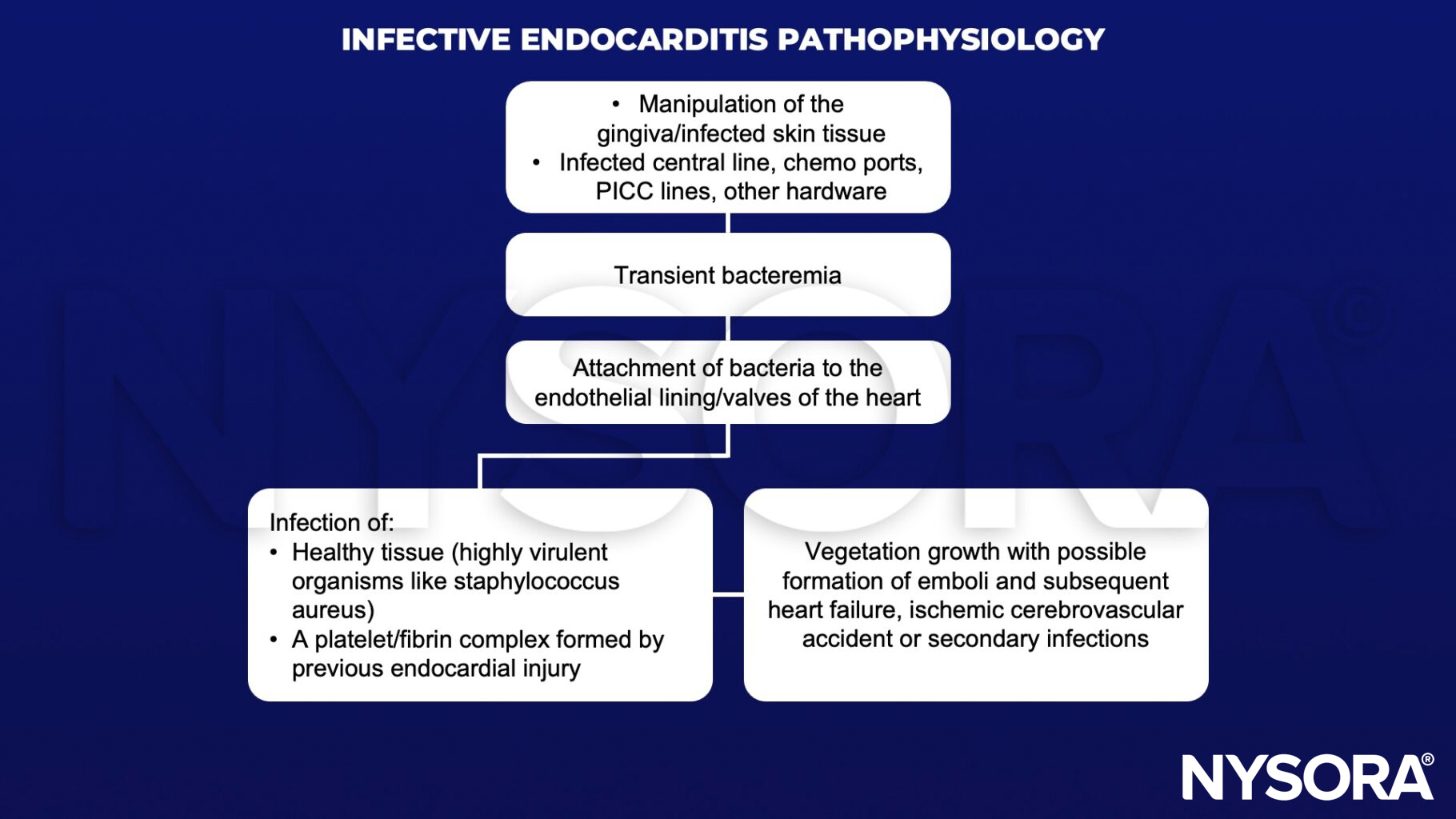
- Infective endocarditis (IE) is a life-threatening infection of the endothelial lining of the heart’s chambers and heart valves
Pathophysiology
Risk factors
| High-risk patients | Any prosthetic heart valve |
| History of IE | |
| Congenital heart disease (CHD): - Any cyanotic type of CHD - Any CHD repaired with prosthetic material, up to 6 months after the procedure or lifelong if persistent |
|
| the procedure or lifelong if persistent High | Incision of infected skin tissue |
| Dental or surgical procedures with manipulation of the gingiva | |
| Root canal treatments | |
| Root extractions |
Prophylaxis
- The absolute risk for IE is very low, and while antibiotics given at the right indication lower the incidence of IE they do not prevent all cases of IE
- Antibiotic use poses the risk of anaphylaxis or bacterial resistance
- Consider the pros and cons when giving IE prophylaxis, only use antibiotics for high-risk patients undergoing high-risk procedures
| Infected skin tissue | Dental procedures | |
|---|---|---|
| No allergy to penicillin or ampicillin | Flucloxacilline: 2 g oral, 30-60 min before procedure Child: 50 mg/kg (max. 1.5 g) | Amoxicillin: 2 g oral, 30-60 min before procedure Child: 50 mg/kg (max. 2 g) |
| Penicillin or ampicillin allergy or treatment with penicillin <7 days ago | Clindamycin: 600 mg oral, 30-60 min before procedure Child: 20 mg/kg (max. 600 mg) | Clindamycin: 600 mg oral, 30-60 min before procedure Child: 20 mg/kg (max. 600 mg) |
- Use oral antibiotics as the first choice
- Alternatively, use cephalexin 2 g (50 mg/kg IV for children), cefazolin, or ceftriaxone 1 g IV (50 mg/kg IV for children)
Suggested reading
- Habib G, Lancellotti P, Antunes MJ, et al. 2015 ESC Guidelines for the management of infective endocarditis: The Task Force for the Management of Infective Endocarditis of the European Society of Cardiology (ESC). Endorsed by: European Association for Cardio-Thoracic Surgery (EACTS), the European Association of Nuclear Medicine (EANM). Eur Heart J. 2015;36(44):3075-3128.
Clinical updates
Hermanns et al. (Anesthesiology, 2022) emphasize that infective endocarditis (IE) carries high perioperative morbidity and mortality (≈20% in-hospital, 30% at 1 year), with increasing incidence and a growing proportion of prosthetic valve and healthcare-associated cases. They highlight the need for early diagnosis using modified Duke criteria and prompt bactericidal IV antibiotics, with about 50% of patients requiring urgent or early surgery for heart failure, uncontrolled infection, or embolic risk. The review advocates a structured multidisciplinary “endocarditis team,” including anesthesiologists, to optimize perioperative management, anticoagulation strategies, and organ support in this high-risk population.