Learning objectives
- Provide an evidence-based framework for the transfusion of blood products
Definition
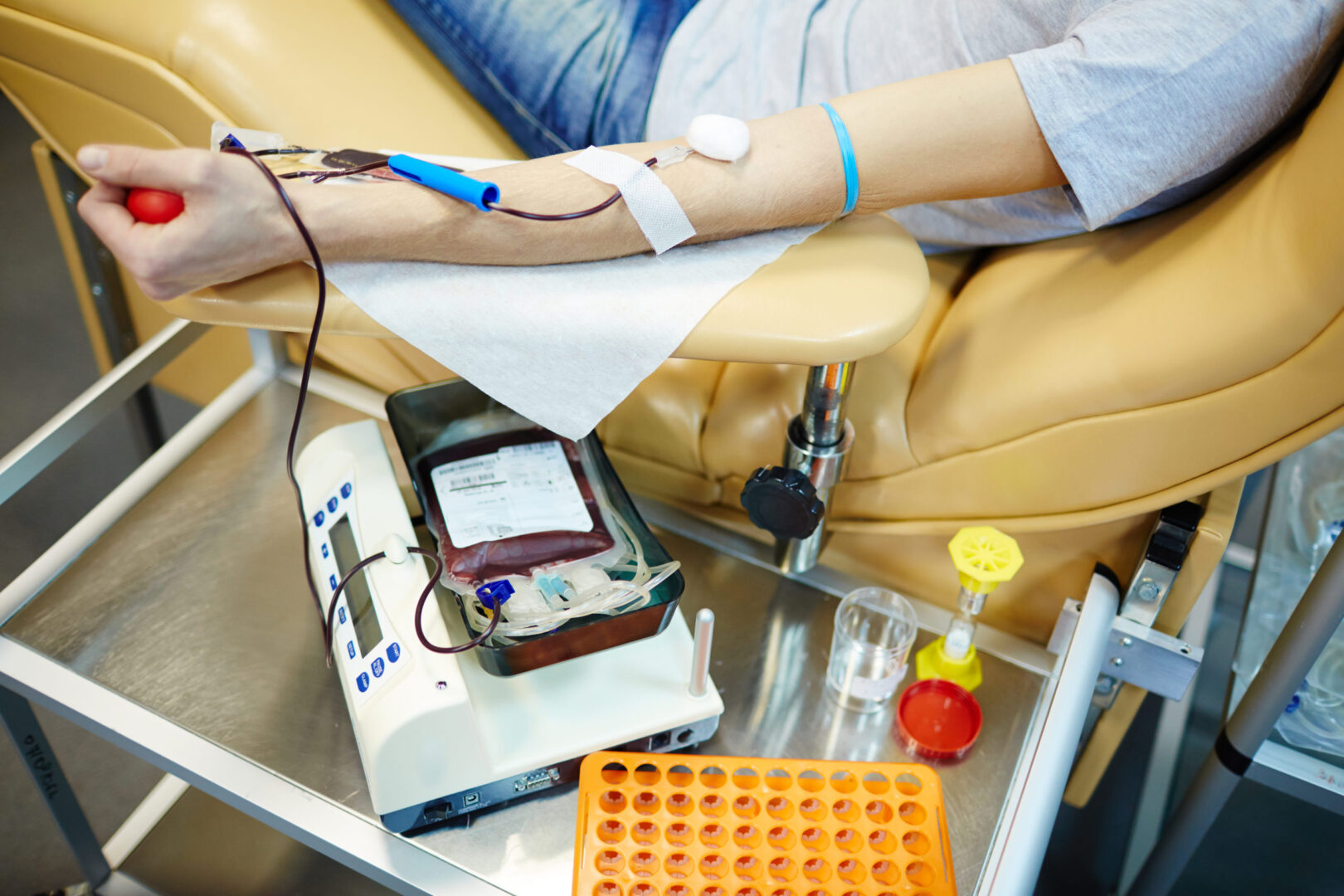
- Blood products are any therapeutic substance derived from human blood
- Including whole blood and other blood components for transfusion, and plasma-derived medicinal products
Recommendations
Massive hemorrhage
- Give red blood cells – fresh frozen plasma – platelets (whole blood derived units) in a 1-1-1 ratio
- Transition to laboratory-guided treatment once hemorrhage control is achieved
Red Blood cells (RBCs)
- 1 unit of RBCs = 350 mL
- 1 unit will raise hemoglobin by +/- 1 g/dL
- Be restrictive in transfusing RBCs
- Cutoffs for transfusion are:
- 7 g/dL in hemodynamically stable patients
- 8 g/dL for orthopedic surgery, cardiac surgery, and patients with preexisting cardiovascular disease
- There is no benefit in using fresh blood
- Do not give unnecessary transfusions
Platelets
- 1 unit = 1 apheresis unit = 4-6 whole blood derived units
- 1 unit will raise platelets by 30,000–50,000/μL
- Giving more than 2 units is rarely useful
- Transfuse prophylactically at platelet count:
- < 10,000/μL for patients with hematologic or solid malignancies, undergoing allogeneic hematopoietic stem cell transplantation
- < 20,000/μL for elective central venous catheter (CVC) placement
- < 50,000/μL for elective diagnostic lumbar puncture
- < 50,000/μL for major elective non-neuraxial surgery
- <100,000/μL for neuraxial surgery and eye surgery
- Give platelets if thrombocytopenia and active bleeding at platelet count:
- <30,000/µL for bleeding WHO grade II
- <50,000/µl for bleeding WHO grade III/IV (i.e. massive bleeding)
Fresh Frozen Plasma (FFP)
- 1 unit of FFP derived from whole blood = 250 mL
- FFP contains normal levels of coagulation factors, albumin and immunoglobulins
- Abnormal coagulation tests (PT/aPTT) are poor predictors of bleeding risk in a non-bleeding patient
- Don’t give plasma transfusions to correct minor coagulation test abnormalities in non-bleeding patients
- Standard dose is 15-20 mL/kg and raises clotting factors by +/- 25%
- Give FPP in case of:
- Massive transfusion
- Warfarin therapy-related intracranial hemorrhage
- Disseminated intravascular coagulation (DIC), liver disease or thrombotic thrombocytopenic purpura (TTP) and active bleeding
- Specific coagulation factor deficiencies without available coagulation factor concentrate
- Dilutional coagulopathy
Adverse events
| RBCs | Platelets | FFP |
|---|---|---|
| Febrile non-hemolytic transfusion reactions (FNHTRs) | FNHTRs | FNHTRs |
| Transfusion associated circulatory overload (TACO) | TACO | TACO |
| Transfusion related acute lung injury (TRALI) | TRALI | TRALI |
| Transfusion transmitted infection | Transfusion transmitted infection | Transfusion transmitted infection |
| Allergic/anaphylactic reactions | Platelet alloimmunization | Allergic or anaphylactic reactions |
| Acute and delayed hemolytic transfusion reactions | Hemolytic reaction | |
| Transfusion associated graft versus host disease (TA-GVHD) |
Suggested reading
- Storch EK, Custer BS, Jacobs MR, Menitove JE, Mintz PD. Review of current transfusion therapy and blood banking practices. Blood Rev. 2019;38:100593.
- Carson JL, Guyatt G, Heddle NM, et al. Clinical Practice Guidelines From the AABB: Red Blood Cell Transfusion Thresholds and Storage. JAMA. 2016;316(19):2025-2035.
- Holcomb JB, Tilley BC, Baraniuk S, et al. Transfusion of plasma, platelets, and red blood cells in a 1:1:1 vs a 1:1:2 ratio and mortality in patients with severe trauma: the PROPPR randomized clinical trial. JAMA. 2015;313(5):471-482.
Clinical updates
Morris et al. (British Journal of Anaesthesia, 2023) analyzed over 191,000 patients undergoing elective major abdominal surgery and found that perioperative red blood cell transfusion was associated with significantly worse outcomes, including nearly threefold higher short-term mortality, increased long-term mortality, higher overall morbidity, and almost doubled infectious complications. In oncologic surgery, transfusion was also linked to reduced overall survival and increased cancer recurrence. These findings reinforce restrictive transfusion thresholds and the implementation of structured patient blood management programs to reduce unnecessary transfusion exposure and improve perioperative outcomes.
- Read more about this study HERE.
Metcalf et al. (JAMA, 2025) present updated AABB/ICTMG international guidelines supporting a restrictive platelet transfusion strategy, showing no increase in mortality or major bleeding compared with liberal thresholds while reducing transfusion-related harms. Key recommendations include prophylactic transfusion only when platelets are < 10,000/μL in stable non-bleeding oncology patients, < 25,000/μL in non-bleeding neonates, <20,000/μL before lumbar puncture, and < 50,000/μL for major non-neuraxial surgery, with no routine transfusion in cardiovascular surgery without thrombocytopenia. These guidelines reinforce evidence-based, indication-specific transfusion practices to improve safety, conserve platelet supply, and reduce unnecessary exposure.
Cata et al. (Anesthesia & Analgesia, 2025) report in the international ARCA-1 cohort that perioperative packed red blood cell transfusion during major cancer surgery was independently associated with higher 1-year mortality, increased cancer progression, and an 85% higher hazard of death compared with non-transfused patients. A dose–response relationship was observed, with mortality rising from 7.2% (no transfusion) to 31% (≥ 2 units). These findings support restrictive transfusion strategies and structured patient blood management programs to minimize transfusion exposure and improve long-term oncologic outcomes.
- Read more about this study HERE.