Back to News
 3 min read
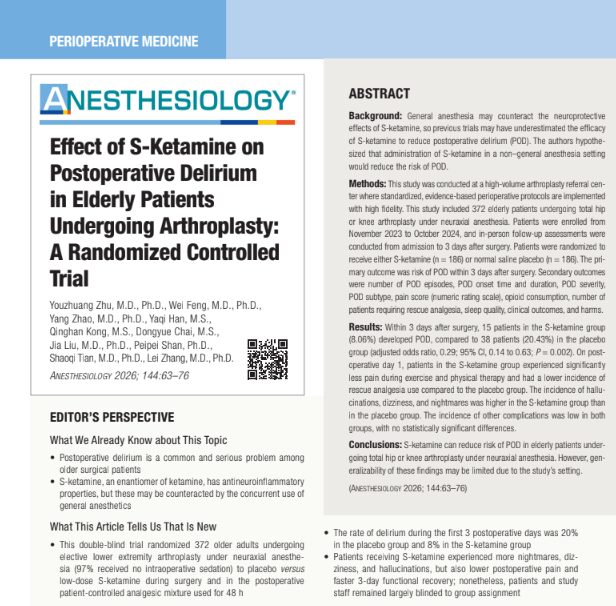
A new randomized controlled trial published in Anesthesiology (2026;144:63–76) reports that perioperative S-ketamine significantly reduces postoperative delirium (POD) in older adults undergoing total hip or knee arthroplasty under neuraxial anesthesia.
The double-blind study included 372 patients aged 60 years or older and demonstrated a clinically meaningful absolute risk reduction in delirium within the first three postoperative days.
Background: why postoperative delirium matters
Postoperative delirium is an acute neurocognitive disorder characterized by:
- Acute onset and fluctuating course
- Inattention and impaired awareness
- Cognitive dysfunction
- Altered level of consciousness
In elderly surgical patients, especially those undergoing total hip arthroplasty (THA) or total knee arthroplasty (TKA), POD incidence typically ranges from 11% to 20%.
Consequences of postoperative delirium
- Prolonged hospitalization
- Increased healthcare costs
- Elevated mortality
- Long-term cognitive decline
- Higher dementia risk
Given aging surgical populations, identifying effective preventive strategies is a major perioperative priority.
Why S-ketamine?
S-ketamine is the S-enantiomer of ketamine and has:
- N-methyl-D-aspartate (NMDA) receptor antagonism
- Anti-neuroinflammatory properties
- Modulation of microglial activation
- Promotion of brain-derived neurotrophic factor (BDNF) release
- Activation of the mTOR pathway
Previous trials under general anesthesia may have underestimated ketamine’s benefit because:
GABAergic anesthetics (e.g., propofol, benzodiazepines) may counteract ketamine’s neuroprotective effects.
This trial tested S-ketamine under neuraxial anesthesia, largely avoiding systemic sedatives.
Study design
Trial type
- Prospective
- Single-center
- Randomized
- Double-blind
- Placebo-controlled
Participants
- 372 patients ≥ 60 years
- Elective THA or TKA
- Neuraxial anesthesia
- 97% received no intraoperative sedation
Randomization:
- 186 received S-ketamine
- 186 received a placebo
Intervention protocol
Intraoperative infusion:
- 0.2 mg/kg/h S-ketamine for 1 hour
Postoperative analgesia (48 hours):
- Patient-controlled IV analgesia (PCIA)
- S-ketamine 1.0 mg/kg in infusion mixture
Primary outcome:
- Incidence of POD within 3 postoperative days
Delirium was assessed twice daily using the 3D-CAM tool.
Primary results
Incidence of postoperative delirium
Within 3 days after surgery:
- Placebo group: 20.43%
- S-ketamine group: 8.06%
Number needed to treat (NNT):
- 8 patients
This represents a substantial relative and absolute risk reduction.
Per-protocol analysis showed similar results.
Secondary outcomes
1. Pain control
On postoperative day 1:
- Lower pain during exercise
- Lower pain during physical therapy
- Fewer patients required rescue analgesia
2. Functional recovery
On postoperative day 3:
- Higher Barthel Index scores
- Improved early functional outcomes
3. No difference observed in:
- POD duration
- POD severity
- POD subtype
- Hospital length of stay
Adverse effects
S-ketamine increased certain neuropsychiatric symptoms:
- Nightmares
- Dizziness
- Hallucinations
However:
- Incidence was low
- Effects were transient
- No increase in serious complications
- No ICU transfers
- No increased nondelirious postoperative complications
How does S-ketamine reduce delirium?
Proposed mechanisms
- NMDA receptor antagonism
- Reduction of neuroinflammation
- Microglial modulation (CB2–PKC pathway)
- Increased BDNF release
- Activation of TrkB–mTOR signaling
- Enhanced synaptogenesis
Importantly, avoidance of GABAergic sedatives may preserve these effects.
The extended infusion protocol may also provide sustained receptor modulation compared with single bolus dosing.
Clinical implications
What this means for anesthesiologists
- S-ketamine may be a viable delirium prevention strategy
- Particularly effective when avoiding GABAergic sedatives
- Offers analgesic and functional recovery benefits
- Requires monitoring for mild neuropsychiatric effects
What this means for geriatric surgical care
- Delirium prevention may be achievable pharmacologically
- Multimodal perioperative strategies remain critical
- Neuraxial techniques may enhance neuroprotection
Conclusion
This randomized controlled trial provides strong evidence that perioperative S-ketamine significantly reduces postoperative delirium in elderly patients undergoing total hip or knee arthroplasty under neuraxial anesthesia.
With a number needed to treat of 8, improved pain control, and enhanced early functional recovery, S-ketamine represents a promising strategy in geriatric perioperative medicine.
However, broader generalizability requires further investigation in diverse clinical settings.
Reference: Zhu Y et al. Effect of S-Ketamine on Postoperative Delirium in Elderly Patients Undergoing Arthroplasty: A Randomized Controlled Trial. Anesthesiology. 2026;144:63-76.
Read more about this study in NYSORA’s Anesthesia Assistant App.