Back to News
 3 min read
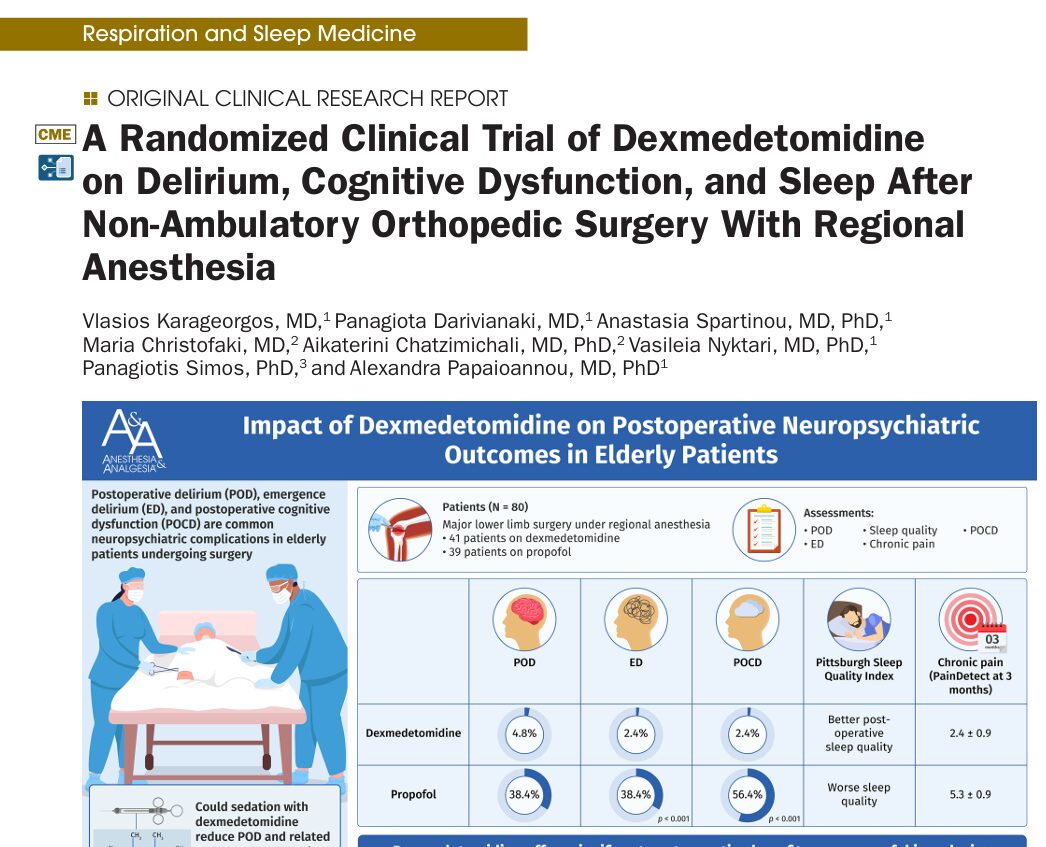
A 2026 randomized clinical trial published in Anesthesia & Analgesia offers compelling evidence that dexmedetomidine, a sedative with unique neuroprotective properties, significantly reduces the risk of postoperative delirium, cognitive dysfunction, and sleep disturbances in elderly patients following major orthopedic surgery under regional anesthesia.
Key findings at a glance
- Dexmedetomidine reduced:
- Postoperative delirium (POD) from 38.4% to 4.8%
- Emergence delirium (ED) from 38.4% to 2.4%
- Early postoperative cognitive dysfunction (POCD) from 56.4% to 2.4%
- Postoperative delirium (POD) from 38.4% to 4.8%
- Improved sleep quality (lower PSQI scores)
- Reduced long-term neuropathic pain (PainDETECT score: 2.4 vs. 5.3)
- Greater cognitive stability over 3 months
What is dexmedetomidine?
Dexmedetomidine is a selective α2-adrenergic receptor agonist used for sedation. Unlike propofol, it:
- Mimics natural sleep by acting on the preoptic hypothalamic area
- Is non-respiratory depressant, preserving normal breathing
- Has anti-inflammatory and neuroprotective effects
Study design highlights
Participants:
- 80 elderly patients (aged > 65) undergoing elective hip or knee replacement
- All surgeries used regional anesthesia only (no general anesthesia)
Groups:
- 41 patients received dexmedetomidine
- 39 received propofol
Assessment tools:
- POD: Confusion Assessment Method (CAM)
- ED: Riker Sedation-Agitation Scale
- POCD: European Psychometric Battery
- Sleep: Pittsburgh Sleep Quality Index (PSQI)
- Pain: PainDETECT tool
Timeline:
- Assessments were made preoperatively, 48–72 hours post-op, and 3 months post-op
Measurable cognitive and neurological benefits
Performance on cognitive tests:
Dexmedetomidine patients maintained stable or improved performance in:
- Visual Verbal Learning Test (VLT) – better memory recall
- Concept Shifting Test (CST) – improved cognitive flexibility
- Stroop Color Word Test (SCW) – less interference effect
- Letter Digit Coding (LDC) – stable processing speed
- Propofol patients, in contrast, showed sharp declines in all measures within 48 hours after surgery.
Better sleep quality—short and long term
According to the PSQI results:
- Dexmedetomidine group: Sleep quality improved post-op and remained better at 3 months
- Propofol group: Experienced worsened sleep immediately post-op with only partial recovery later
Main improvements were in:
- Sleep duration
- Time to fall asleep
- Reduced nighttime awakenings
Pain outcomes: long-term relief with dexmedetomidine
Although acute postoperative pain scores were only slightly lower, dexmedetomidine patients reported:
- Less severe chronic pain at 3 months
- Lower neuropathic pain scores (PainDETECT score: 2.4 vs. 5.3, P = .023)
- Men in the propofol group were especially prone to chronic pain
Conclusion: a case for routine dexmedetomidine use?
This study marks a significant shift in perioperative care for elderly orthopedic patients. The neuroprotective, sleep-stabilizing, and pain-reducing benefits of dexmedetomidine present a compelling case for its preferential use over propofol in similar surgical contexts.
What it means for practice:
- Anesthesiologists may consider dexmedetomidine as a first-line sedative for elderly patients under regional blocks.
- Surgeons may expect improved cognitive outcomes and fewer complications post-op.
- Patients benefit from a clearer mind, better sleep, and less chronic pain.
Further large-scale, multicenter studies are warranted to reinforce these findings and establish broader clinical guidelines.
Reference: Karageorgos V et al. A Randomized Clinical Trial of Dexmedetomidine on Delirium, Cognitive Dysfunction, and Sleep After Non-Ambulatory Orthopedic Surgery With Regional Anesthesia. Anesth Analg. 2026;142:102-113.
Read more about this study in NYSORA’s Anesthesia Assistant App.