Learning objectives
- Consider the limitations and challenges of non-operating room anesthesia
- Describe the anesthetic considerations for specific non-operating room anesthesia procedures
Background
- Non-operating room anesthesia (NORA) refers to all anesthetic procedures performed outside of the operating room
- NORA is a growing field in healthcare
- Unfamiliarity with the environment can be a challenge
Considerations
- Limitations of the room
- Equipment may be lacking
- Unfamiliar environment
- Staff may be unfamiliar with anesthetic procedures
- Exposure to radiation
- NORA sites have a greater proportion of ASA status III-V patients
- Anesthetic procedures, monitoring, and analgesia should be held to the same standards as in the operating room
- Potential for ad hoc requests, scheduling inconsistencies, poor communication, and less patience
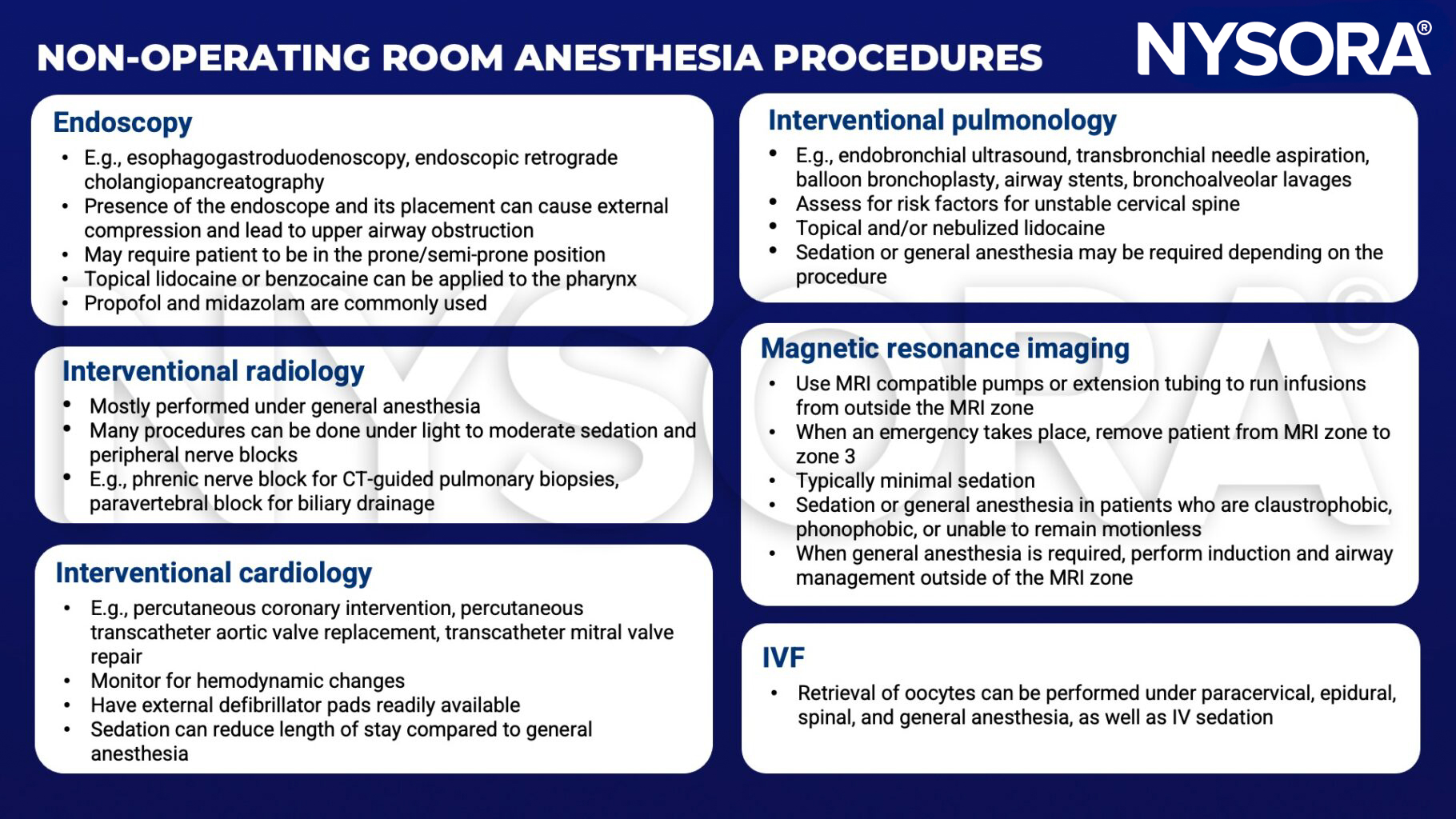
Common NORA procedures
Suggested reading
- Wong T, Georgiadis PL, Urman RD, Tsai MH. Non-Operating Room Anesthesia: Patient Selection and Special Considerations. Local Reg Anesth. 2020;13:1-9. Published 2020 Jan 8. doi:10.2147/LRA.S181458
- Chung M, Vazquez R. Non-Operating Room Anesthesia. In: Gropper MA, editor. Miller’s Anesthesia, Ninth Edition, 2020. Elsevier, Philadelphia. p. 2284-2312.
Clinical updates
Primm et al. (Current Opinion in Anesthesiology, 2025) report that NORA case volume and complexity continue to expand rapidly, with projections suggesting NORA may account for up to 50% of all anesthetics within the next decade. The review highlights major advances in gastrointestinal endoscopy, electrophysiology, and interventional radiology, alongside growing use of remimazolam for sedation due to its favorable hemodynamic profile in high-risk patients.