 Nerve Blocks App
 Anesthesia Assistant App
 Ultrasound Pain App
 Pain Medicine Assistant App
 POCUS App
 IV Access App
 MSK Knee App
 VetRA App
 Nerve Block Manual
 Regional Anesthesia Updates
 Anesthesiology Manual
 Anesthesiology Review
 Anesthesia Updates 2025
 Anesthesia Updates 2026
 Pediatric Anesthesia Updates
 Airway Management Updates
 US Interventional Pain Manual
 Pain Medicine Updates
 Mastering Difficult IV Access
 PACU Nursing Manual
 RA Veterinary Manual
 Books
Books About
About

Learning objectives
- Describe the pathophysiology and symptoms of hyperthyroidism
- Diagnose and treat hyperthyroidism
- Manage patients with hyperthyroidism or thyroid storm
Background
- Hyperthyroidism is a syndrome associated with excess thyroid hormone production
- Can lead to thyroid storm, an acute and life-threatening complication
- Most commonly caused by Graves disease (young population) and toxic multinodular goiter (older population)
- Other causes: Iodine-induced hyperthyroidism (Jod-Basedow phenomenon), thyroid adenomas, de Quervain thyroiditis (subacute thyroiditis), postpartum thyroiditis, factitious thyroiditis (thyrotoxicosis factitia)
Pathophysiology
- Graves disease
- Thyroid-stimulating antibodies mimicking the effects of thyroid-stimulating hormone (TSH)
- Typical signs: Edema of retro-orbital tissues, pretibial myxedema
- Toxic multinodaular goiter
- Palpable thyroid nodules leading to excess thyroid hormone production
- Thyroid adenoma
- Solitary palpable module causing hyperthyroidism
- Thyroiditis
- Transient increase in circulating thyroid hormone resulting from mechanical disruption of thyroid follicles
- Iodine-induced hyperthyroidism
- Typically iatrogenic
- Due to administration of iodine-containing medications (e.g., contrast media, amiodarone)
Signs & symptoms
- Weight loss despite increased appetite
- Palpitation
- Nervousness
- Tremors
- Dyspnea
- Fatigability
- Diarrhea
- Increased gastrointestinal motility
- Muscle weakness
- Heat intolerance
- Diaphoresis
- Goiter
- Palpable nodules
- Painful thyroid
Diagnosis
- Initial test: Serum TSH (decreased)
- Free T3 and T4 (increased)
- ECG when atrial fibrillation is suspected
- Palpitation of the thyroid gland
- 24-hour radioactive iodine (RAIU) uptake to distinguish between etiologies
- Increased RAIU: Graves disease, toxic multinodular goiter, thyroid adenoma
- Decreased RAIU: Subacute thyroiditis, painless thyroiditis, iodine-induced hyperthyroidism, factitious hyperthyroidism
- Thyroid receptor antibody measurement as an alternative diagnosis for Graves disease
- Radioisotope thyroid scan
Treatment
- Symptomatic
- Beta-blockers or calcium channel blockers
- Definitive
- Radioactive iodine
- Thionamide
- Subtotal thyroidectomy
- Clinical assessment and free T4 monitoring are essential for all treatments
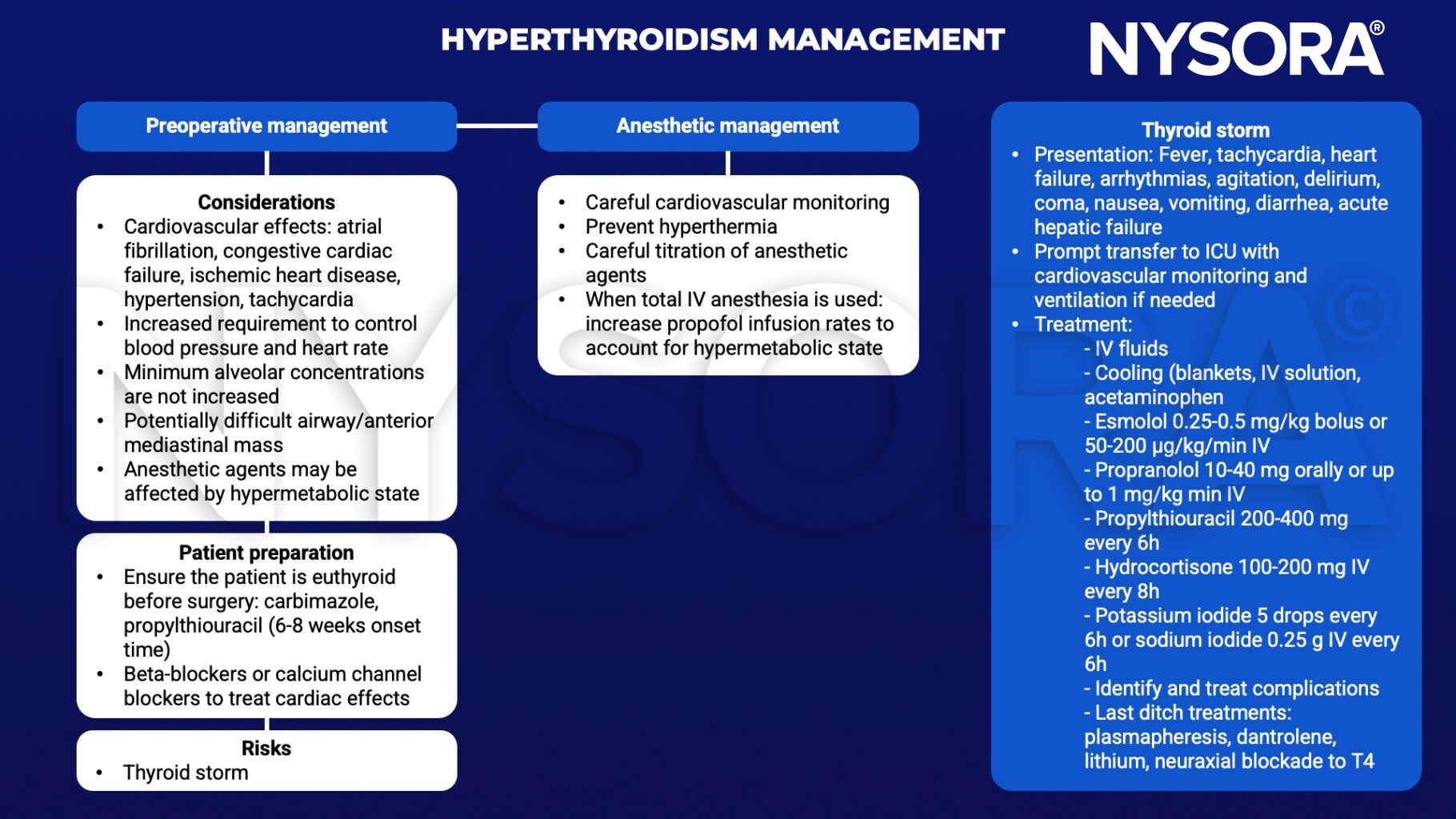
Anesthetic management
Keep in mind
- Acute coronary syndrome may be complicated with thyroid dysfunction
- Close monitoring is essential with propylthiouracil administration in pregnant patients as overcorrection can potentially cause fetal hypothyroidism
Suggested reading
- Pokhrel B, Aiman W, Bhusal K. Thyroid Storm. [Updated 2022 Oct 6]. In: StatPearls [Internet]. Treasure Island (FL): StatPearls Publishing; 2022 Jan-. Available from: https://www.ncbi.nlm.nih.gov/books/NBK448095/
- Mathew P, Rawla P. Hyperthyroidism. [Updated 2022 Jul 23]. In: StatPearls [Internet]. Treasure Island (FL): StatPearls Publishing; 2022 Jan-. Available from: https://www.ncbi.nlm.nih.gov/books/NBK537053/
- Carroll R, Matfin G. Endocrine and metabolic emergencies: thyroid storm. Ther Adv Endocrinol Metab. 2010;1(3):139-145.
- Farling PA. Thyroid disease. BJA: British Journal of Anaesthesia. 2000;85(1):15-28.
Clinical updates
Shao et al. (BMC Anesthesiology, 2024) report that thyroid storm can occur during or after non-thyroid surgery in patients with previously unrecognized or subclinical hyperthyroidism, often presenting intraoperatively under general anesthesia as refractory tachycardia with minimal or atypical systemic signs. Their case review highlights that more than half of perioperative thyroid storm cases followed missed preoperative diagnosis, emphasizing the need for meticulous history taking, early consideration of thyroid dysfunction when unexplained tachycardia or hyperthermia occurs, and prompt initiation of β-blockade, antithyroid drugs, steroids, and supportive care once thyroid storm is suspected.