Back to News
 4 min read
Effective pain management in patients with multiple rib fractures is a cornerstone of trauma care.
Inadequate analgesia can impair ventilation, suppress cough, and increase the risk of pulmonary complications such as atelectasis, pneumonia, and acute respiratory distress syndrome (ARDS).
A new randomized controlled noninferiority trial published in the British Journal of Anaesthesia (2026) directly compared:
- Continuous posterior extrathoracic fascial plane block (PEFB)
- Continuous paravertebral block (PVB)
- Systemic multimodal analgesia alone
The findings offer important clinical insights for anesthesiologists, intensivists, and trauma teams.
Study overview
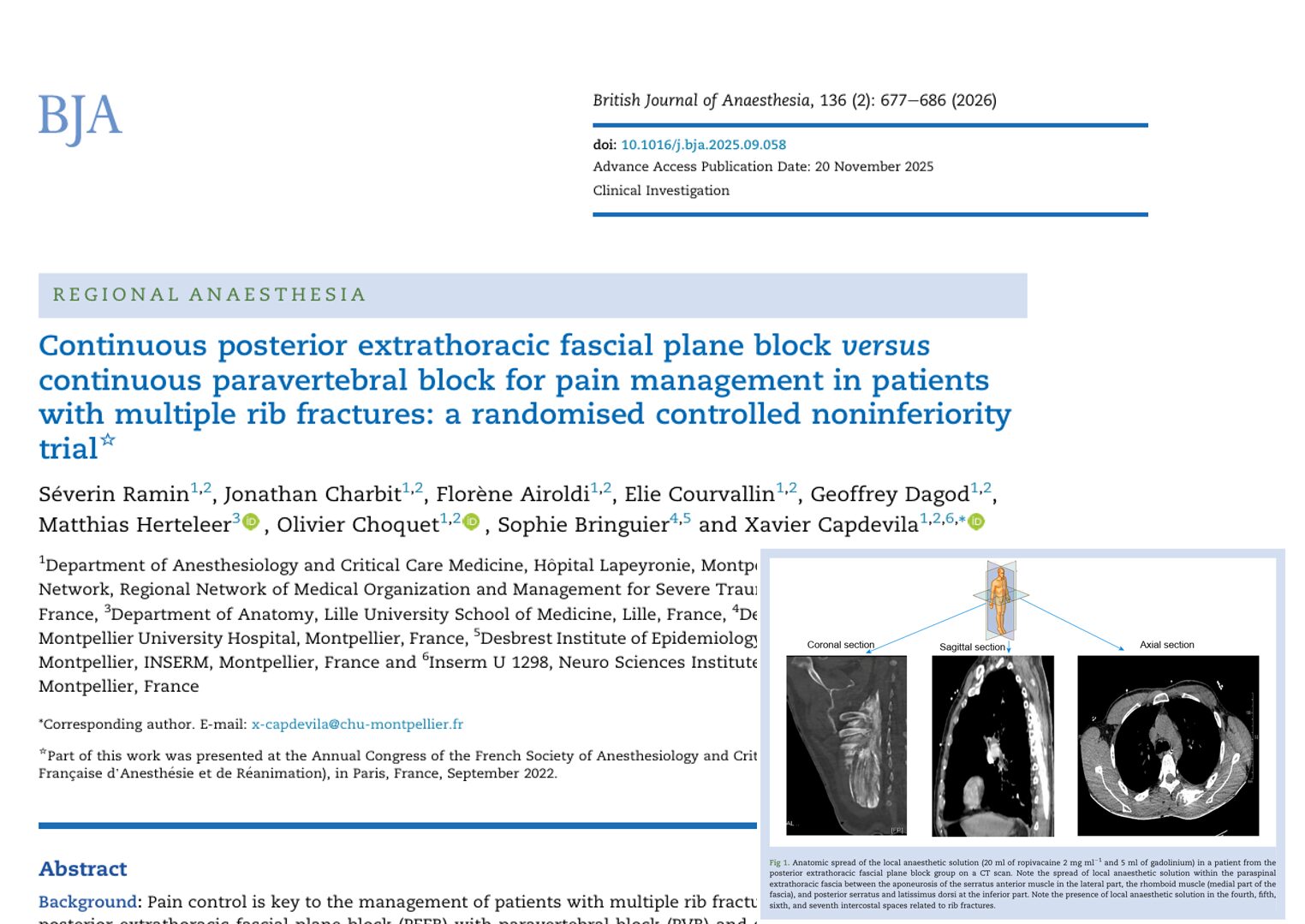
According to the randomized controlled trial by Ramin et al., the objective was to determine whether continuous PEFB is noninferior to PVB in reducing opioid consumption in trauma patients with multiple rib fractures.
Study design
- Prospective, randomized, controlled, noninferiority trial
- Conducted in a Level I trauma ICU in France
- 90 trauma patients enrolled
- Three parallel groups (1:1:1 randomization)
Inclusion criteria
- ≥ 2 homolateral rib fractures
- Numeric rating scale (NRS) pain score ≥ 3 during coughing or mobilization
- Admission within 24 hours of trauma
- Not mechanically ventilated
Primary endpoint
- Cumulative morphine consumption at 24 hours
Secondary endpoints
- Total morphine consumption at 72 hours
- Pain scores at rest and during coughing
- Rescue thoracic epidural analgesia (TEA)
- Respiratory parameters:
- Sniff nasal inspiratory pressure (SNIP)
- Maximal expiratory pressure (MEP)
- Sniff nasal inspiratory pressure (SNIP)
- Complications
Understanding the analgesic techniques
Posterior extrathoracic fascial plane block (PEFB)
PEFB is a thoracic interfascial plane block targeting the posterior extrathoracic fascia.
It aims to block:
- Dorsal rami of thoracic spinal nerves
- Lateral and potentially ventral branches via fascial spread
Mechanism:
- Local anesthetic spreads between:
- Serratus anterior muscle
- Rhomboid muscle
- Posterior thoracic fascia
- Serratus anterior muscle
- May reach multiple intercostal spaces
Advantages:
- Technically simpler
- Ultrasound-guided
- Lower theoretical risk compared to neuraxial techniques
Limitations:
- Spread may be variable
- Anterior chest wall coverage may be incomplete
Paravertebral block (PVB)
PVB involves injection of local anesthetic into the thoracic paravertebral space.
This produces:
- Unilateral somatic and sympathetic blockade
- Reliable intercostal nerve anesthesia
Advantages:
- Established efficacy
- Sustained analgesia
- Better anterior chest wall coverage
Limitations:
- Technical difficulty
- Risk of vascular puncture
- Potential pneumothorax
- Contraindicated in coagulopathy
Primary outcome: morphine consumption at 24 hours
Median morphine use:
- PEFB: 17 mg
- PVB: 21.5 mg
The difference was −3 mg (95% CI within noninferiority margin).
Key conclusion
PEFB was noninferior to PVB for morphine consumption at 24 hours.
This suggests that PEFB provides comparable short-term opioid-sparing effects.
Secondary outcomes
1. Morphine consumption at 72 hours
Median cumulative morphine:
- Control: 45 mg
- PEFB: 30 mg
- PVB: 38.5 mg
No statistically significant difference (P=0.051).
2. Rescue thoracic epidural analgesia (TEA)
This was a crucial finding.
Rescue TEA required:
- Control group: 30%
- PEFB group: 30%
- PVB group: 6.7%
Significant difference (P=0.043).
Interpretation
PVB demonstrated:
- Greater durability
- Lower failure rate
- Reduced need for escalation to epidural
PEFB may provide adequate early analgesia but may wane after 24 hours.
3. Pain scores
- No significant difference in pain at rest
- Pain during coughing was significantly lower in the PVB group
- Pain decreased over time in all groups
4. Respiratory function
Sniff nasal inspiratory pressure (SNIP)
- Improved in all groups
- No significant difference between groups
Maximal expiratory pressure (MEP)
- Significantly higher in PVB group
- Suggests improved expiratory muscle function
Improved MEP may enhance:
- Cough effectiveness
- Secretion clearance
- Prevention of pneumonia
Safety outcomes
Complications were rare.
- One vascular puncture in PVB group
- No catheter infections
- No seizures
- No arrhythmias
Interestingly:
- ARDS occurred in 13.3% of PVB patients
- None in control or PEFB groups
This finding warrants cautious interpretation.
Clinical implications
When to consider PEFB
PEFB may be ideal for:
- Patients with contraindications to neuraxial techniques
- Coagulopathy
- Hemodynamic instability
- When simpler technique preferred
When to favor PVB
PVB may be superior for:
- Sustained analgesia
- Severe anterior rib fractures
- Patients at high risk for pulmonary complications
- Need for improved cough mechanics
Key takeaways
- PEFB is noninferior to PVB for 24-hour opioid consumption.
- PVB reduces need for rescue epidural analgesia.
- PVB improves expiratory muscle strength.
- PEFB remains a practical alternative in selected patients.
Final thoughts
This randomized controlled trial provides high-quality evidence that continuous posterior extrathoracic fascial plane block is a viable first-line alternative to paravertebral block in trauma patients with multiple rib fractures.
However, paravertebral block appears more durable and more effective for dynamic pain and expiratory function.
For trauma anesthesiologists and intensivists, these findings refine our approach to multimodal rib fracture analgesia and highlight the importance of individualized regional anesthesia strategies.
As chest trauma remains a major cause of morbidity worldwide, optimizing regional analgesia continues to be essential for improving respiratory outcomes and reducing opioid exposure.
Reference: Ramin S et al. Continuous posterior extrathoracic fascial plane block versus continuous paravertebral block for pain management in patients with multiple rib fractures: a randomised controlled noninferiority trial. Br J Anaesth. 2026;136:677-686.Learn more about this study in NYSORA’s Anesthesia Assistant App.