 Nerve Blocks App
 Anesthesia Assistant App
 US Pain Management App
 Pain Medicine Assistant App
 POCUS App
 IV Access App
 MSK Knee App
 VetRA App
 Nerve Block Manual
 Regional Anesthesia Updates
 Anesthesiology Manual
 Anesthesiology Review
 Anesthesia Updates 2025
 Anesthesia Updates 2026
 Pediatric Anesthesia Updates
 Airway Management Updates
 US Interventional Pain Manual
 Pain Medicine Updates
 Mastering Difficult IV Access
 PACU Nursing Manual
 RA Veterinary Manual
 Books
Books About
About
 Back to News
 3 min read
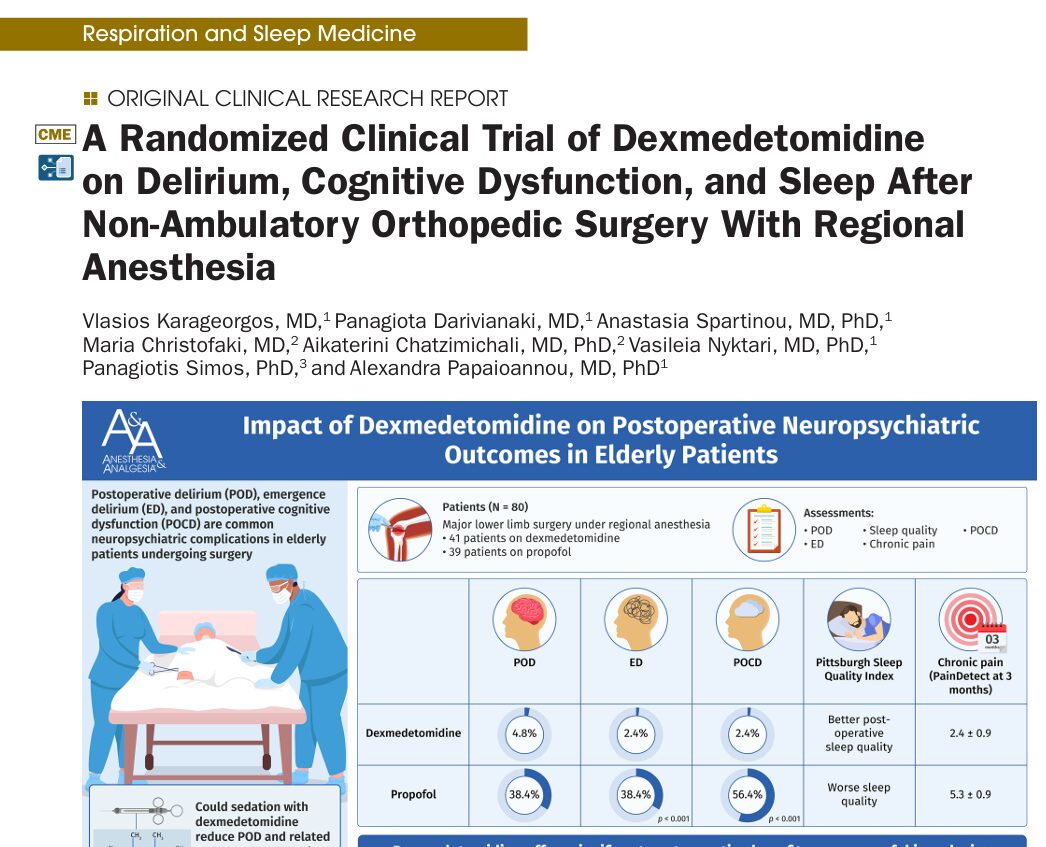
A 2026 randomized clinical trial published in Anesthesia & Analgesia offers compelling evidence that dexmedetomidine, a sedative with unique neuroprotective properties, significantly reduces the risk of postoperative delirium, cognitive dysfunction, and sleep disturbances in elderly patients following major orthopedic surgery under regional anesthesia.
Key findings at a glance
- Dexmedetomidine reduced:
- Postoperative delirium (POD) from 38.4% to 4.8%
- Emergence delirium (ED) from 38.4% to 2.4%
- Early postoperative cognitive dysfunction (POCD) from 56.4% to 2.4%
- Postoperative delirium (POD) from 38.4% to 4.8%
- Improved sleep quality (lower PSQI scores)
- Reduced long-term neuropathic pain (PainDETECT score: 2.4 vs. 5.3)
- Greater cognitive stability over 3 months
What is dexmedetomidine?
Dexmedetomidine is a selective α2-adrenergic receptor agonist used for sedation. Unlike propofol, it:
- Mimics natural sleep by acting on the preoptic hypothalamic area
- Is non-respiratory depressant, preserving normal breathing
- Has anti-inflammatory and neuroprotective effects
Study design highlights
Participants:
- 80 elderly patients (aged > 65) undergoing elective hip or knee replacement
- All surgeries used regional anesthesia only (no general anesthesia)
Groups:
- 41 patients received dexmedetomidine
- 39 received propofol
Assessment tools:
- POD: Confusion Assessment Method (CAM)
- ED: Riker Sedation-Agitation Scale
- POCD: European Psychometric Battery
- Sleep: Pittsburgh Sleep Quality Index (PSQI)
- Pain: PainDETECT tool
Timeline:
- Assessments were made preoperatively, 48–72 hours post-op, and 3 months post-op
Measurable cognitive and neurological benefits
Performance on cognitive tests:
Dexmedetomidine patients maintained stable or improved performance in:
- Visual Verbal Learning Test (VLT) – better memory recall
- Concept Shifting Test (CST) – improved cognitive flexibility
- Stroop Color Word Test (SCW) – less interference effect
- Letter Digit Coding (LDC) – stable processing speed
- Propofol patients, in contrast, showed sharp declines in all measures within 48 hours after surgery.
Better sleep quality—short and long term
According to the PSQI results:
- Dexmedetomidine group: Sleep quality improved post-op and remained better at 3 months
- Propofol group: Experienced worsened sleep immediately post-op with only partial recovery later
Main improvements were in:
- Sleep duration
- Time to fall asleep
- Reduced nighttime awakenings
Pain outcomes: long-term relief with dexmedetomidine
Although acute postoperative pain scores were only slightly lower, dexmedetomidine patients reported:
- Less severe chronic pain at 3 months
- Lower neuropathic pain scores (PainDETECT score: 2.4 vs. 5.3, P = .023)
- Men in the propofol group were especially prone to chronic pain
Conclusion: a case for routine dexmedetomidine use?
This study marks a significant shift in perioperative care for elderly orthopedic patients. The neuroprotective, sleep-stabilizing, and pain-reducing benefits of dexmedetomidine present a compelling case for its preferential use over propofol in similar surgical contexts.
What it means for practice:
- Anesthesiologists may consider dexmedetomidine as a first-line sedative for elderly patients under regional blocks.
- Surgeons may expect improved cognitive outcomes and fewer complications post-op.
- Patients benefit from a clearer mind, better sleep, and less chronic pain.
Further large-scale, multicenter studies are warranted to reinforce these findings and establish broader clinical guidelines.
Reference: Karageorgos V et al. A Randomized Clinical Trial of Dexmedetomidine on Delirium, Cognitive Dysfunction, and Sleep After Non-Ambulatory Orthopedic Surgery With Regional Anesthesia. Anesth Analg. 2026;142:102-113.
Read more about this study in NYSORA’s Anesthesia Assistant App.