Back to News
 3 min read


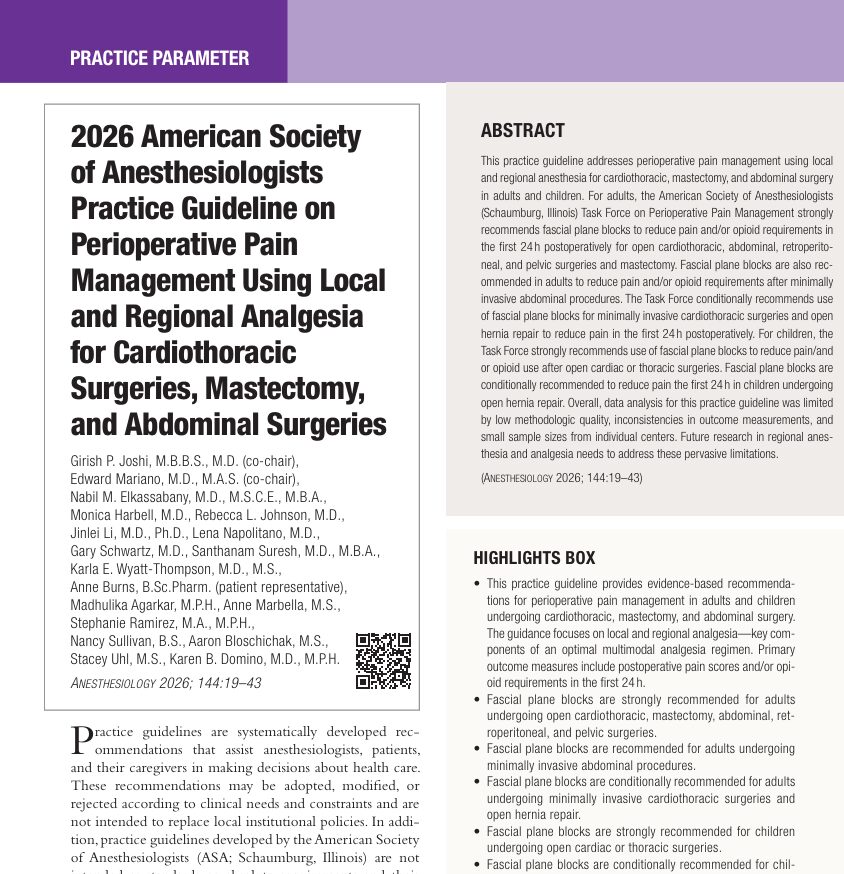
The American Society of Anesthesiologists (ASA) has released its 2026 Practice Guideline offering updated, evidence-based recommendations for managing perioperative pain using local and regional anesthesia, with a focus on cardiothoracic, mastectomy, and abdominal surgeries in both adults and children.
These recommendations aim to reduce postoperative pain and opioid use, improve patient recovery, and provide a more procedure-specific approach to analgesia.
Key highlights from the guideline
- Fascial plane blocks are now strongly recommended for many open and minimally invasive procedures.
- Recommendations are tailored by surgical type, invasiveness, and patient age group.
- The primary outcomes include pain reduction and opioid use within the first 24 hours postoperatively.
- Evidence quality ranges from moderate to low, depending on the procedure and population.
What are fascial plane blocks?
Fascial plane blocks are regional anesthesia techniques where a local anesthetic is injected into potential spaces between muscle layers. They target nerves indirectly and are particularly useful when direct nerve targeting is technically difficult or contraindicated.
Common types include:
- Erector spinae plane block
- Transversus abdominis plane (TAP) block
- Quadratus lumborum block
- Pecto-intercostal and serratus anterior blocks
Procedure-specific recommendations
1. Open cardiothoracic surgery (adults)
- Procedures: Lobectomy, valve replacement, coronary bypass, etc.
- Recommendation: Strongly recommend fascial plane blocks.
- Benefits:
- Pain at rest reduced by 1.33 points (0–10 scale)
- Opioid reduction: 60 mg oral morphine equivalents (OME)
- Pain at rest reduced by 1.33 points (0–10 scale)
2. Open abdominal, retroperitoneal, and pelvic surgery (adults)
- Recommendation: Strongly recommend fascial plane blocks.
- Key outcomes:
- Pain at rest: reduced by 0.68 points
- Dynamic pain: 0.78 point reduction
- Opioid use: 35 mg OME reduction
- Higher patient satisfaction
- Pain at rest: reduced by 0.68 points
3. Mastectomy (adults)
- Recommendation: Strongly recommend fascial plane or paravertebral blocks.
- Outcomes:
- Pain reduction (dynamic pain): 1.3 points
- Opioid use reduced by 25 mg OME
- Improved quality of recovery and patient satisfaction
- Pain reduction (dynamic pain): 1.3 points
4. Minimally invasive surgeries (adults)
Cardiothoracic
- Recommendation: Conditional for fascial plane or neuraxial blocks.
- Evidence: Lower pain scores and reduced opioid use, but effect sizes did not exceed minimum clinically important difference (MCID)
Abdominal
- Recommendation: Strongly recommended.
- Results: Consistent opioid-sparing effects across appendectomy, cholecystectomy, gastrectomy, and more.
5. Pediatric surgeries
Open cardiothoracic
- Recommendation: Strong recommendation for fascial plane blocks.
- Effect: Opioid use reduced by ~19 mg OME in 24 hours; moderate strength of evidence.
Hernia repair
- Recommendation: Conditional.
- Note: Limited data and lower strength of evidence, but potential benefits in pain reduction
How to implement fascial plane blocks in clinical practice
Step-by-step:
- Identify surgical procedure (e.g., open abdominal, mastectomy)
- Choose an appropriate block based on the surgical site
- Use ultrasound guidance for precise needle placement
- Administer long-acting local anesthetic (e.g., bupivacaine or ropivacaine)
- Monitor pain scores and opioid use post-op
- Adjust analgesia based on patient feedback
Conclusion
The ASA’s 2026 guideline marks a significant advancement in personalized perioperative pain management. It reinforces the role of fascial plane blocks as an effective, opioid-sparing technique for a wide range of surgeries, offering improved pain control and patient satisfaction when used appropriately.
Clinicians are encouraged to incorporate these blocks into their multimodal analgesia protocols and advocate for broader education, training, and access to regional anesthesia.
Reference: Joshi GP et al. 2026 American Society of Anesthesiologists Practice Guideline on Perioperative Pain Management Using Local and Regional Analgesia for Cardiothoracic Surgeries, Mastectomy, and Abdominal Surgeries. Anesthesiology. 2026;144:19-43.
Download the AA App now to put trusted anesthesia guidance in your pocket.