Back to News
 4 min read
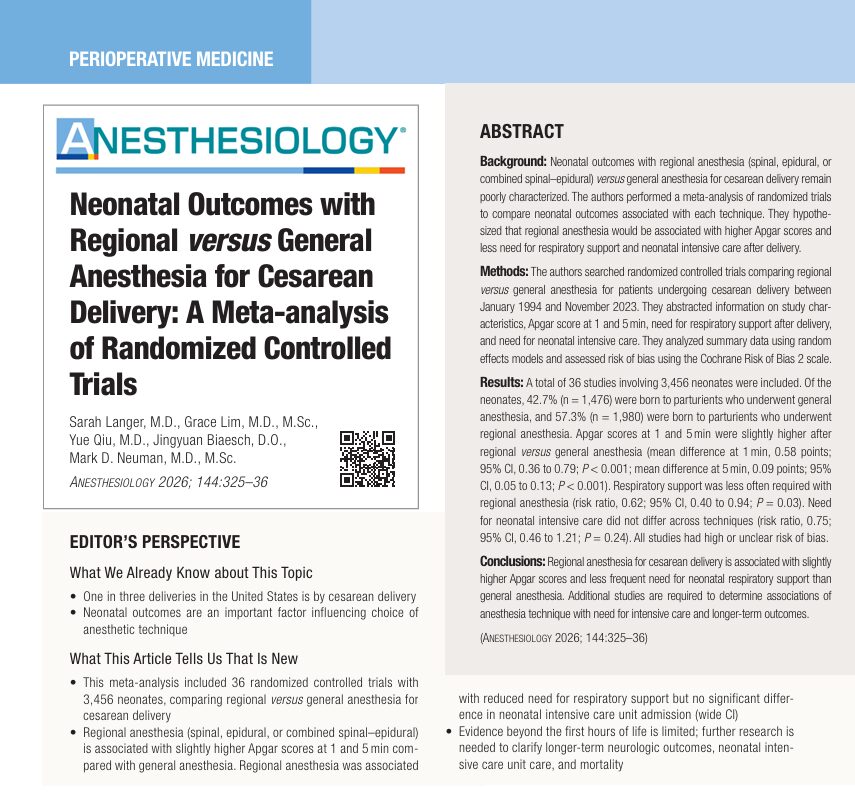
A comprehensive 2026 meta-analysis published in Anesthesiology evaluated neonatal outcomes following regional anesthesia versus general anesthesia for cesarean delivery.
The study, titled “Neonatal outcomes with regional versus general anesthesia for cesarean delivery: a meta-analysis of randomized controlled trials,” analyzed 36 randomized trials involving 3,456 neonates.
Cesarean delivery accounts for approximately one in three births in the United States. Anesthetic technique selection plays a critical role in both maternal and neonatal outcomes.
Study overview
The investigators performed a systematic review and meta-analysis of randomized controlled trials published between January 1994 and November 2023.
Included population
- 36 randomized controlled trials
- 3,456 neonates
- 1,476 exposed to general anesthesia (42.7%)
- 1,980 exposed to regional anesthesia (57.3%)
- Spinal anesthesia: 63.6%
- Epidural anesthesia: 28.3%
- Combined spinal–epidural (CSE): 8.1%
- Spinal anesthesia: 63.6%
Most trials included elective or low-risk cesarean deliveries. A smaller subset involved high-risk pregnancies, including preeclampsia and fetal compromise.
What is regional versus general anesthesia?
Regional anesthesia
Regional anesthesia includes:
- Spinal anesthesia
- Epidural anesthesia
- Combined spinal–epidural anesthesia
These techniques block nociceptive transmission at the neuraxial level, allowing the mother to remain awake while providing surgical anesthesia.
General anesthesia
General anesthesia involves:
- Intravenous induction agents
- Neuromuscular blockade
- Endotracheal intubation
- Inhalational or intravenous maintenance agents
General anesthetics cross the placenta and may transiently affect neonatal respiratory drive and tone.
Primary neonatal outcomes
The study evaluated several clinically relevant endpoints:
Coprimary outcomes
- Apgar score at 1 minute
- Apgar score at 5 minutes
Secondary outcomes
- Need for neonatal respiratory support
- Neonatal intensive care unit (NICU) admission
Exploratory outcomes
- Apgar score < 7
- Umbilical arterial and venous pH
- Umbilical arterial pH < 7.2
- Base deficit > 16
- Neurologic and adaptive capacity score at 2 and 24 hours
Key findings
1. Apgar scores
Regional anesthesia was associated with:
- Higher Apgar score at 1 minute
- Mean difference: +0.58 points
- 95% CI: 0.36 to 0.79
- P < 0.001
- Mean difference: +0.58 points
- Higher Apgar score at 5 minutes
- Mean difference: +0.09 points
- 95% CI: 0.05 to 0.13
- P < 0.001
- Mean difference: +0.09 points
Although statistically significant, these differences were small in magnitude.
2. Need for respiratory support
Neonates exposed to regional anesthesia were:
- Less likely to require respiratory support
- Risk ratio: 0.62
- 95% CI: 0.40 to 0.94
- P = 0.03
Respiratory support included:
- Bag-mask ventilation
- Facemask oxygen
- Endotracheal intubation
- Mechanical ventilation
3. NICU admission
No statistically significant difference was found:
- Risk ratio: 0.75
- 95% CI: 0.46 to 1.21
- P = 0.24
The confidence interval was wide, limiting definitive conclusions.
4. Low Apgar scores (<7)
- Reduced incidence at 1 minute with regional anesthesia
- No statistically significant difference at 5 minutes
5. Acid-base status
No significant differences were observed in:
- Umbilical arterial pH
- Umbilical venous pH
- Incidence of umbilical arterial pH < 7.2
Physiological mechanisms
Understanding the mechanisms helps contextualize the findings.
Effects of general anesthesia
- Transplacental passage of anesthetic agents
- Potential neonatal respiratory depression
- Fetal vasodilation
- Reduced systemic vascular resistance
Effects of regional anesthesia
- Sympathetic blockade
- Maternal hypotension
- Potential reduction in uteroplacental perfusion
However, contemporary obstetric anesthesia practice includes proactive management of maternal hypotension using vasopressors and fluid therapy.
Subgroup analyses
Low-risk versus high-risk pregnancies
- Apgar score differences at 5 minutes were more apparent in low-risk groups
- Respiratory support differences were more evident in high-risk groups
By type of regional block
- Spinal anesthesia showed significant differences in Apgar scores and respiratory support
- Epidural and CSE results were less consistent
These subgroup findings may reflect limited sample sizes rather than true physiological differences.
Clinical implications
For anesthesiologists
- Regional anesthesia remains the preferred technique for most cesarean deliveries.
- General anesthesia remains appropriate in:
- Severe hemorrhage
- Coagulopathy
- Maternal instability
- Urgent fetal compromise
- Severe hemorrhage
- Differences in Apgar scores are small and may not be clinically meaningful.
For obstetric teams
- Early multidisciplinary planning improves outcomes.
- Clear protocols for managing neuraxial failure are essential.
For patients
- Both techniques are generally safe.
- Regional anesthesia may reduce the likelihood of transient neonatal respiratory support.
- Long-term differences remain uncertain.
Conclusion
This updated meta-analysis suggests that regional anesthesia for cesarean delivery is associated with:
- Slightly higher Apgar scores
- Reduced need for neonatal respiratory support
- No confirmed difference in NICU admission
While statistically significant, the magnitude of benefit appears modest.
Both anesthetic techniques remain appropriate when clinically indicated. Decisions should be individualized based on maternal status, fetal condition, and procedural urgency.
Further high-quality research is required to clarify long-term neonatal outcomes and refine obstetric anesthesia practice.
Reference: Langer S et al. Anesthesiology. 2026;144:325-336.
Learn more about this study in NYSORA’s Anesthesia Assistant App.