 Nerve Blocks App
 Anesthesia Assistant App
 Ultrasound Pain App
 Pain Medicine Assistant App
 POCUS App
 IV Access App
 MSK Knee App
 VetRA App
 Nerve Block Manual
 Regional Anesthesia Updates
 Anesthesiology Manual
 Anesthesiology Review
 Anesthesia Updates 2025
 Anesthesia Updates 2026
 Pediatric Anesthesia Updates
 Airway Management Updates
 US Interventional Pain Manual
 Pain Medicine Updates
 Mastering Difficult IV Access
 PACU Nursing Manual
 RA Veterinary Manual
 Books
Books About
About
 Back to News
 6 min read

Total intravenous anesthesia (TIVA) is undergoing a major transformation in pediatric medicine. Once limited by insufficient pharmacokinetic data and concerns about dosing accuracy in infants and young children, TIVA is now emerging as a highly precise, safer, and environmentally responsible anesthetic technique.
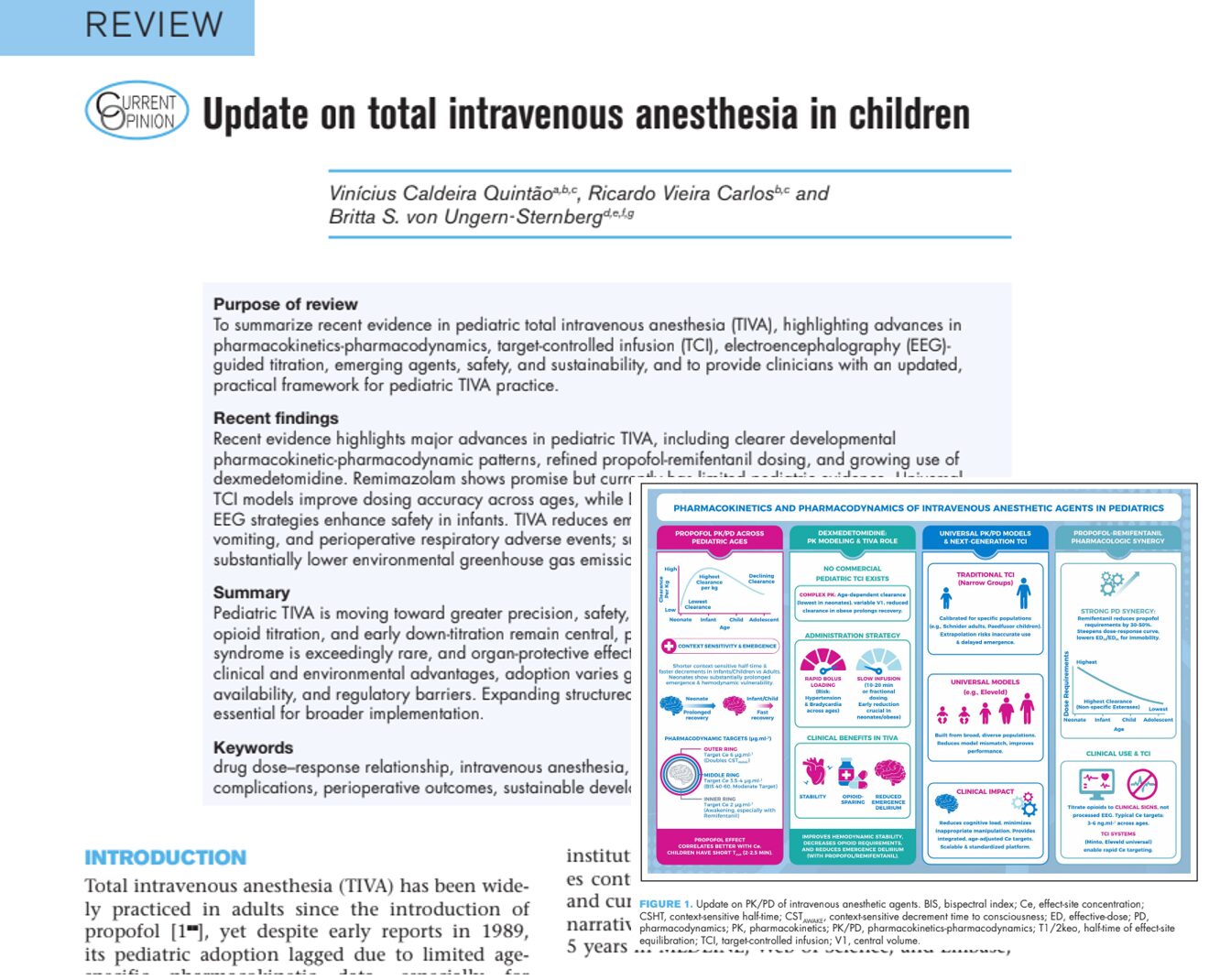
A comprehensive 2026 review by Quintão et al. highlights significant advances in pediatric TIVA, including improved pharmacokinetic-pharmacodynamic (PK/PD) models, target-controlled infusion (TCI) technology, electroencephalography (EEG)-guided dosing, and new medications such as remimazolam.
The review also emphasizes that TIVA can reduce emergence delirium, postoperative nausea and vomiting (PONV), respiratory complications, and greenhouse gas emissions compared with inhalational anesthesia.
Why pediatric TIVA is gaining momentum
TIVA relies on intravenous administration of anesthetic medications instead of inhaled anesthetic gases. While widely adopted in adult practice for decades, pediatric implementation has progressed more slowly because children exhibit significant age-dependent differences in:
- Drug clearance
- Drug distribution
- Brain sensitivity
- Cardiovascular responses
- Recovery characteristics
Recent advances now allow clinicians to better predict how anesthetic drugs behave across different pediatric age groups, from neonates to adolescents.
Key drivers behind the growing popularity of pediatric TIVA include:
- Improved PK/PD modeling
- Better infusion technology
- Enhanced EEG monitoring
- Reduced postoperative complications
- Improved conditions for neurophysiologic monitoring
- Lower environmental impact
Major advances in propofol pharmacology
Propofol remains the cornerstone of pediatric TIVA.
The review highlights several important developmental differences:
Neonates
Neonates have:
- Lower propofol clearance
- Increased sensitivity to hypotension
- Slower recovery
- Greater risk of prolonged emergence
Because of these characteristics, dosing must be conservative and carefully titrated.
Infants and children
In contrast, infants demonstrate:
- Rapid clearance
- Shorter context-sensitive half-times
- Faster recovery
- Higher weight-adjusted infusion requirements
This means younger children often require proportionally higher maintenance doses than adults.
Recommended effect-site targets
The authors recommend moderate propofol effect-site concentrations:
- Approximately 3.5–4 μg/mL during maintenance
- Up to 4–5 μg/mL during intense surgical stimulation
- Around 2 μg/mL during emergence
Avoiding unnecessarily high concentrations helps reduce delayed recovery.
Dexmedetomidine continues to expand its role
Dexmedetomidine has become an increasingly important component of balanced pediatric anesthesia.
Benefits include:
- Sedation
- Sympatholysis
- Opioid-sparing effects
- Reduced emergence delirium
- Improved hemodynamic stability
The review notes that dexmedetomidine works particularly well when combined with:
- Propofol
- Remifentanil
This combination allows clinicians to reduce opioid exposure while maintaining effective anesthesia.
Important safety consideration
Rapid loading doses may cause:
- Bradycardia
- Hypertension
For this reason, slow administration over 10–20 minutes is preferred.
Remifentanil remains the preferred opioid partner
Remifentanil continues to be the opioid of choice for pediatric TIVA because it provides:
- Rapid onset
- High potency
- Predictable recovery
- Very short context-sensitive half-time
Studies show that remifentanil can reduce propofol requirements by approximately 30–50%.
Importantly, opioid dosing should be guided primarily by clinical signs rather than EEG indices because remifentanil has minimal effect on bispectral index (BIS) values.
Remimazolam: a promising new anesthetic option
Remimazolam is one of the most exciting developments in pediatric anesthesia.
Introduced in 2020, this ultra-short-acting benzodiazepine undergoes rapid metabolism by carboxylesterase enzymes and offers:
- Fast onset
- Rapid recovery
- Hemodynamic stability
- Potentially improved safety profile
Although pediatric evidence remains limited, early studies show encouraging results.
Findings from recent pediatric trials
A multicenter randomized trial demonstrated:
- Successful induction and maintenance of anesthesia
- Less pain on injection compared with propofol
- Lower incidence of bradycardia
- Favorable overall safety profile
Additional studies suggest remimazolam may reduce emergence delirium when used during sevoflurane anesthesia.
Potential future applications include:
- High-risk infants
- Congenital heart disease
- Pulmonary disease
- Outpatient procedures
- Pediatric intensive care sedation
Better postoperative outcomes with TIVA
Reduced emergence delirium
Emergence delirium remains one of the most challenging pediatric postoperative complications.
Children may experience:
- Agitation
- Crying
- Confusion
- Self-injury
- Accidental removal of intravenous lines
According to the review, propofol-based TIVA is the most effective preventive strategy available.
Meta-analysis data show approximately:
- 75% reduction in emergence delirium risk
Dexmedetomidine also contributes significantly to prevention.
Lower postoperative nausea and vomiting
PONV is especially common after:
- Tonsillectomy
- Strabismus surgery
- Procedures in children older than three years
Compared with volatile anesthetics, TIVA substantially reduces:
- Early PONV
- Late PONV
- Need for rescue antiemetics
Current guidelines recognize propofol-based TIVA as an important preventive measure.
Improved respiratory safety
One of the most important findings concerns respiratory outcomes.
TIVA appears to decrease:
- Bronchial hyperreactivity
- Airway complications
- Perioperative respiratory adverse events
Benefits are especially notable in children with:
- Recent upper respiratory infections
- Reactive airway disease
- Obstructive sleep apnea
Large randomized studies found the lowest respiratory complication rates in children maintained with propofol-based TIVA.
Is propofol infusion syndrome still a concern?
Propofol infusion syndrome (PRIS) has historically been a major concern.
However, modern evidence is reassuring.
A nationwide study involving nearly 50,000 pediatric patients reported:
- PRIS-like findings in only about 0.13%
- No deaths
- No cases meeting full diagnostic criteria
The review concludes that PRIS is exceedingly rare in contemporary pediatric anesthesia practice.
EEG-guided anesthesia improves precision
One of the most important innovations in pediatric anesthesia is the use of EEG-guided drug titration.
Why traditional BIS monitoring has limitations
In infants younger than one year:
- BIS values may be falsely elevated
- Up to 70% of adequately anesthetized infants may appear under-anesthetized
- Clinicians may unnecessarily increase propofol doses
This increases overdose risk.
New EEG-based approaches
Experts increasingly recommend:
- Raw EEG monitoring
- Density spectral array analysis
- Age-specific EEG interpretation
- PK-EEG hybrid dosing strategies
These approaches help clinicians:
- Avoid excessive anesthetic exposure
- Detect burst suppression earlier
- Individualize dosing
- Improve safety in neonates and infants
TIVA remains the preferred choice for neurophysiologic monitoring
Children undergoing:
- Spinal surgery
- Neurosurgery
- Procedures requiring motor-evoked potentials (MEPs)
often benefit from TIVA.
The review reports that volatile anesthetics can significantly suppress:
- MEPs
- Somatosensory-evoked potentials
Propofol-remifentanil TIVA preserves signal quality and improves monitoring success.
Environmental sustainability: an unexpected advantage
Healthcare sustainability has become a major priority worldwide.
The review highlights dramatic differences in greenhouse gas emissions between anesthetic techniques.
Carbon footprint comparison
For a 60-minute anesthetic:
- Propofol-remifentanil TIVA: approximately 1.26 kg CO₂e
- Intravenous induction plus sevoflurane: approximately 2.58 kg CO₂e
- Inhalational induction and maintenance: approximately 2.98 kg CO₂e
Nitrous oxide dramatically increases emissions and remains one of the least sustainable anesthetic options.
As hospitals seek to reduce their environmental footprint, TIVA may play an increasingly important role.
Challenges preventing wider adoption
Despite its advantages, pediatric TIVA is not universally available.
Current barriers include:
- Limited access to infusion pumps
- Lack of pediatric TCI systems
- Variable clinician training
- Regulatory restrictions
- Workforce shortages
- Resource limitations in low-income settings
The review emphasizes that structured education programs significantly improve confidence and patient safety.
Conclusion
The latest evidence demonstrates that pediatric TIVA is entering a new era of precision medicine. Advances in PK/PD modeling, target-controlled infusion systems, EEG-guided titration, dexmedetomidine integration, and emerging drugs such as remimazolam are transforming the safety and effectiveness of intravenous anesthesia in children.
Beyond improving clinical outcomes, TIVA offers substantial environmental benefits and supports sophisticated neurophysiologic monitoring. While challenges involving training, technology access, and regulatory approval remain, the future direction is clear: pediatric anesthesia is becoming more individualized, safer, and more sustainable than ever before.
Reference: Quintão VC et al. Update on total intravenous anesthesia in children. Curr Opin Anesthesiol. 2026;39:304–316.
Stay ahead in perioperative care, use the NYSORA Anesthesia Assistant App to ask clinical questions, simulate anesthesia cases, and get expert guidance anytime.