Back to News
 5 min read
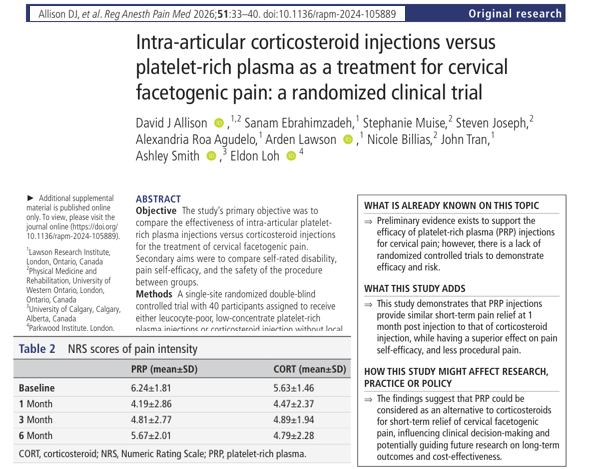
A newly published randomized controlled trial in Regional Anesthesia & Pain Medicine provides the first head-to-head comparison of intra-articular platelet-rich plasma (PRP) and corticosteroid (CORT) injections for cervical facetogenic pain.
The study, conducted by Allison et al., evaluated whether autologous leukocyte-poor PRP offers superior pain relief, functional improvement, or safety compared with intra-articular dexamethasone.
Here is what clinicians, pain specialists, and patients need to know.
Understanding cervical facetogenic pain
Cervical facetogenic pain originates from the zygapophyseal (facet) joints of the cervical spine.
These synovial joints:
- Provide stability and controlled motion
- Contain richly innervated joint capsules
- Can become inflamed or degenerative
- Frequently cause axial neck pain
The condition has an age-standardized prevalence of approximately 27 per 1000 individuals.
Clinical characteristics
Patients typically report:
- Localized axial neck pain
- Pain aggravated by extension or rotation
- Referred pain to the occiput, shoulders, or upper back
- Absence of radiculopathy
Diagnosis often requires dual cervical medial branch blocks (MBBs), considered the reference standard for identifying facet-mediated pain.
Why compare PRP and corticosteroids?
Intra-articular corticosteroids:
- Reduce inflammation
- Inhibit phospholipase A2 and cytokine production
- Provide short-term analgesia
- May carry systemic risks with repeated exposure
Potential systemic risks include:
- Hyperglycemia
- Hypothalamic–pituitary–adrenal axis suppression
- Osteoporosis
- Increased infection risk
PRP is derived from autologous peripheral blood and contains:
- Platelets enriched with growth factors
- Transforming growth factor-beta (TGF-β)
- Platelet-derived growth factor (PDGF)
- Vascular endothelial growth factor (VEGF)
These biologically active molecules may:
- Enhance tissue repair
- Modulate inflammation
- Improve capsular healing
However, prior to this trial, no randomized controlled trial had compared PRP with corticosteroid injections for cervical facetogenic pain.
Study design and methodology
This single-site, double-blind randomized controlled trial included 40 participants with confirmed cervical facetogenic pain.
Participants were required to have:
- Age ≥ 18 years
- Pain intensity ≥ 4/10 on Numeric Rating Scale (NRS)
- Greater than 50% relief with dual MBBs
Patients were randomized to receive:
- Leukocyte-poor PRP (1 mL per facet joint), or
- 0.5 mL dexamethasone (10 mg/mL) + 0.5 mL saline per joint
Up to four facet joints could be injected.
To maintain blinding:
- All participants had 16 mL of venous blood drawn
- Blood from the CORT group was discarded
- Fluoroscopy-guided injections were performed identically
How the injection was performed
- Patient positioned prone under fluoroscopy
- Targeted facet joints identified
- 25-gauge needle advanced via lateral approach
- Contrast injected to confirm intra-articular placement
- Study injectate administered
- Procedure repeated contralaterally if indicated
Seventeen injections (16%) were periarticular due to technical difficulty.
Primary outcome: pain intensity (NRS)
Baseline scores (mean ± SD):
- PRP: 6.24 ± 1.81
- CORT: 5.63 ± 1.46
One-month results:
Both groups showed statistically significant reductions at 1 month.
- PRP: 4.19 ± 2.86
- CORT: 4.47 ± 2.37
There was:
- Significant main effect for time (p = 0.02)
- No significant group-by-time interaction
Three and six months:
- Pain reduction was not statistically significant compared to baseline at 3 or 6 months.
- No superiority of PRP over corticosteroid was demonstrated at any time point.
Clinically meaningful improvement
≥50% pain relief at 1 month:
- PRP: 47.6%
- CORT: 36.8%
The difference was not statistically significant.
Minimal clinically important difference (≥2-point NRS reduction)
At 1 month:
- PRP: 57.1%
- CORT: 36.8%
Again, no statistically significant between-group difference.
Secondary outcomes
Pain self-efficacy (PSEQ):
PRP demonstrated a significant group-by-time interaction at 1 month (p = 0.04).
This indicates:
- Greater short-term improvement in patient confidence in managing pain
- Effect not sustained at 3 or 6 months
Neck disability index (NDI):
Both groups demonstrated significant reductions in disability:
- Significant improvement at 3 months
- Significant improvement at 6 months
- No between-group difference
Baseline NDI scores:
- PRP: 22.0
- CORT: 20.4
Safety and adverse events
No statistically significant difference in adverse events was found between groups.
Procedural pain
The PRP group reported significantly less procedural discomfort:
- PRP: 6.7 ± 1.78
- CORT: 7.9 ± 1.32
- p = 0.02
Strengths of the study
- First double-blind RCT in cervical spine
- Strict dual MBB diagnostic protocol
- Fluoroscopic guidance
- Intention-to-treat analysis
- Standardized outcome measures
Limitations
- Small sample size (n = 40)
- Single center
- Leukocyte-poor, low-concentration PRP
- Single injection only
- PRP composition not laboratory-confirmed
- Longer pain duration in the PRP group (17 vs 8 months, p = 0.01)
Clinical implications
When might PRP be considered?
- Patients wishing to avoid corticosteroids
- Patients with contraindications to steroids
- Those prioritizing autologous biologic therapies
- Concern about cumulative steroid exposure
When corticosteroids remain appropriate
- Need for rapid short-term relief
- Cost-sensitive settings
- Lack of PRP access
PRP is generally more expensive and resource-intensive.
Future research directions
The authors emphasize the need for:
- Larger multicenter trials
- Higher platelet concentration PRP evaluation
- Leukocyte-rich vs leukocyte-poor comparison
- Repeated dosing protocols
- Cost-effectiveness analysis
- Long-term outcome data
Conclusion
This landmark randomized controlled trial demonstrates:
- PRP and corticosteroid injections provide similar short-term pain relief
- Both improve self-rated disability at 3 and 6 months
- PRP improves short-term pain self-efficacy
- PRP causes less procedural discomfort
- No superiority in long-term pain reduction was shown
While PRP did not outperform corticosteroids in pain intensity reduction, it remains a promising biologic alternative with a favorable procedural experience profile.
Further high-powered trials will determine whether optimized PRP formulations can provide durable benefits in cervical facetogenic pain management.
For more information, refer to the full article in RAPM.
Allison DJ, Ebrahimzadeh S, Muise S, et al. Intra-articular corticosteroid injections versus platelet-rich plasma as a treatment for cervical facetogenic pain: a randomized clinical trial. Reg Anesth Pain Med. 2026;51(1):33-40.
For a detailed guide on ultrasound-guided cervical facet joint injections, download NYSORA’s Ultrasound Pain App!