 Nerve Blocks App
 Anesthesia Assistant App
 Ultrasound Pain App
 Pain Medicine Assistant App
 POCUS App
 IV Access App
 MSK Knee App
 VetRA App
 Nerve Block Manual
 Regional Anesthesia Updates
 Anesthesiology Manual
 Anesthesiology Review
 Anesthesia Updates 2025
 Anesthesia Updates 2026
 Pediatric Anesthesia Updates
 Airway Management Updates
 US Interventional Pain Manual
 Pain Medicine Updates
 Mastering Difficult IV Access
 PACU Nursing Manual
 RA Veterinary Manual
 Books
Books About
About
 Back to News
 4 min read
Introduction
For decades, patients scheduled for surgery have routinely been instructed not to eat or drink after midnight. Although this practice was originally intended to reduce the risk of pulmonary aspiration during anesthesia, modern evidence has increasingly shown that prolonged fasting, particularly from clear fluids, may do more harm than good.
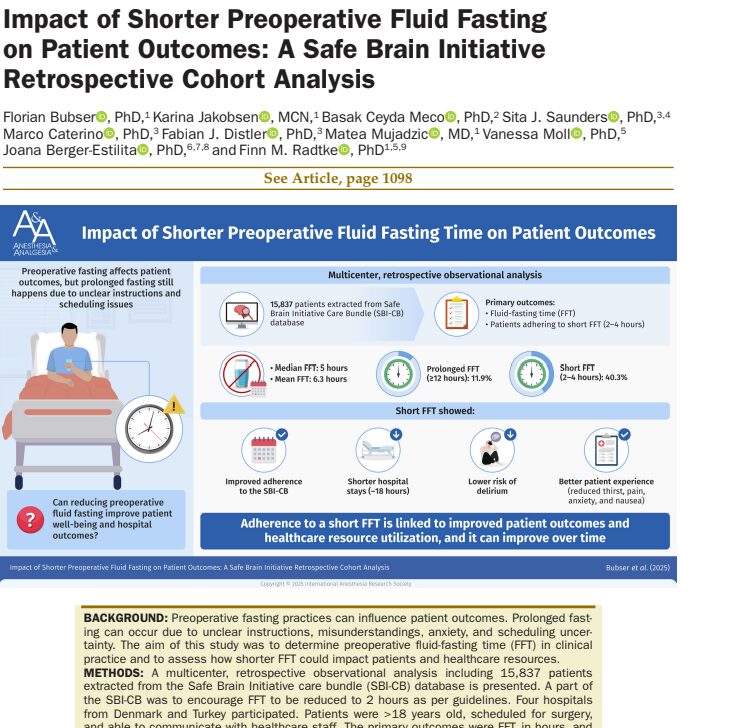
A large multicenter study published in Anesthesia & Analgesia evaluated whether reducing preoperative clear fluid fasting to the guideline-recommended 2–4 hours could improve patient outcomes. The findings suggest that shorter fasting is associated with better patient comfort, lower rates of postoperative delirium, shorter hospital stays, and more efficient healthcare resource utilization.
What was the purpose of the study?
Researchers wanted to determine:
- How long patients actually fast from clear fluids before surgery.
- Whether hospitals can successfully reduce fasting times.
- Whether shorter fasting improves patient outcomes.
- Whether shorter fasting reduces healthcare resource use.
The investigation analyzed data from 15,837 adult surgical patients treated in four hospitals participating in the Safe Brain Initiative.
Why prolonged fasting remains common
Despite international anesthesia guidelines recommending that healthy patients may consume clear fluids up to 2 hours before anesthesia, many hospitals continue to experience unnecessarily long fasting periods because of:
- Traditional “nothing after midnight” instructions.
- Operating room scheduling uncertainty.
- Poor communication.
- Patient misunderstanding.
- Fear of aspiration.
These organizational challenges often result in fasting durations far longer than recommended.
Study design
Researchers performed a multicenter retrospective observational cohort study involving adults undergoing elective or semi-elective surgery in Denmark and Turkey.
Primary outcomes included:
- Actual fluid fasting time.
- Adherence to recommended fasting guidelines.
Secondary outcomes included:
- Postoperative delirium.
- Hospital length of stay.
- Patient-reported thirst.
- Pain.
- Anxiety.
- Stress.
- Nausea and vomiting.
- Overall well-being.
To reduce bias, investigators adjusted for important clinical variables including:
- Age.
- Sex.
- ASA physical status.
- Surgical duration.
- Type of anesthesia.
- Hospital site.
Key findings
Average fasting time remained longer than recommended
The study found:
- Median fasting time: 5 hours
- Mean fasting time: 6.3 hours
- Only 40.3% of patients achieved the recommended fasting duration of 2–4 hours.
- Nearly 12% of patients fasted 12 hours or longer.
These findings demonstrate that prolonged fasting remains widespread despite longstanding clinical guidelines.
Hospitals improved adherence over time
Implementation of the Safe Brain Initiative increased adherence to shorter fasting protocols throughout the study period.
Hospitals using structured education and repeated staff feedback achieved the greatest improvements, suggesting that systematic implementation strategies are effective.
Shorter fasting improved patient outcomes
Patients who fasted for 2–4 hours experienced multiple clinically important benefits.
Reduced postoperative delirium
Postoperative delirium occurred less frequently among patients following shorter fasting protocols.
- Short fasting: 4.3%
- Longer fasting: 6.0%
After statistical adjustment, shorter fasting remained independently associated with lower odds of postoperative delirium.
Shorter hospital stay
One of the most striking findings was a substantial reduction in hospital length of stay.
Median stay:
- Short fasting: 10.7 hours
- Longer fasting: 28.7 hours
This represents an approximate reduction of 18 hours, suggesting meaningful improvements in healthcare efficiency.
Better patient experience
Patients reported significant improvements across several important outcomes.
Benefits included:
- Less thirst before surgery.
- Lower postoperative pain.
- Less anxiety.
- Less stress.
- Reduced nausea and vomiting.
- Better overall postoperative well-being.
These improvements support the growing emphasis on patient-reported outcome measures in perioperative care.
Why might shorter fasting help?
Several physiological mechanisms may explain the observed benefits.
Allowing patients to drink clear fluids closer to surgery may:
- Improve hydration.
- Reduce discomfort.
- Reduce thirst.
- Lower anxiety.
- Improve circulatory stability.
- Reduce physiologic stress responses.
- Support faster postoperative recovery.
Improved hydration may also contribute indirectly to lower delirium risk and faster recovery after surgery.
Clinical implications
The findings reinforce current international anesthesia guidelines recommending clear fluid intake until approximately two hours before anesthesia for appropriate patients.
Potential benefits include:
- Better patient satisfaction.
- Enhanced recovery.
- Lower postoperative complications.
- Reduced healthcare costs.
- Improved operating room efficiency.
However, implementation requires coordinated education of:
- Surgeons.
- Anesthesiologists.
- Nurses.
- Administrative staff.
- Patients.
Conclusion
This large multicenter study provides strong real-world evidence that reducing preoperative clear fluid fasting to 2–4 hours is associated with improved patient comfort, lower postoperative delirium, shorter hospital stays, and better overall recovery. While many patients continue to fast far longer than recommended, structured quality improvement initiatives can successfully increase adherence to evidence-based fasting protocols.
Optimizing preoperative hydration represents a relatively simple, low-cost intervention with the potential to improve both patient-centered outcomes and healthcare efficiency.
Reference: Bubser F et al. Impact of Shorter Preoperative Fluid Fasting on Patient Outcomes: A Safe Brain Initiative Retrospective Cohort Analysis. Anesth Analg. 2026;142:1101-1110.
Read more about recent evidence like this in NYSORA’s Anesthesia Assistant app. Simulate case, check dosages and search through NYSORA knowledge database!