Back to News
 6 min read
Introduction
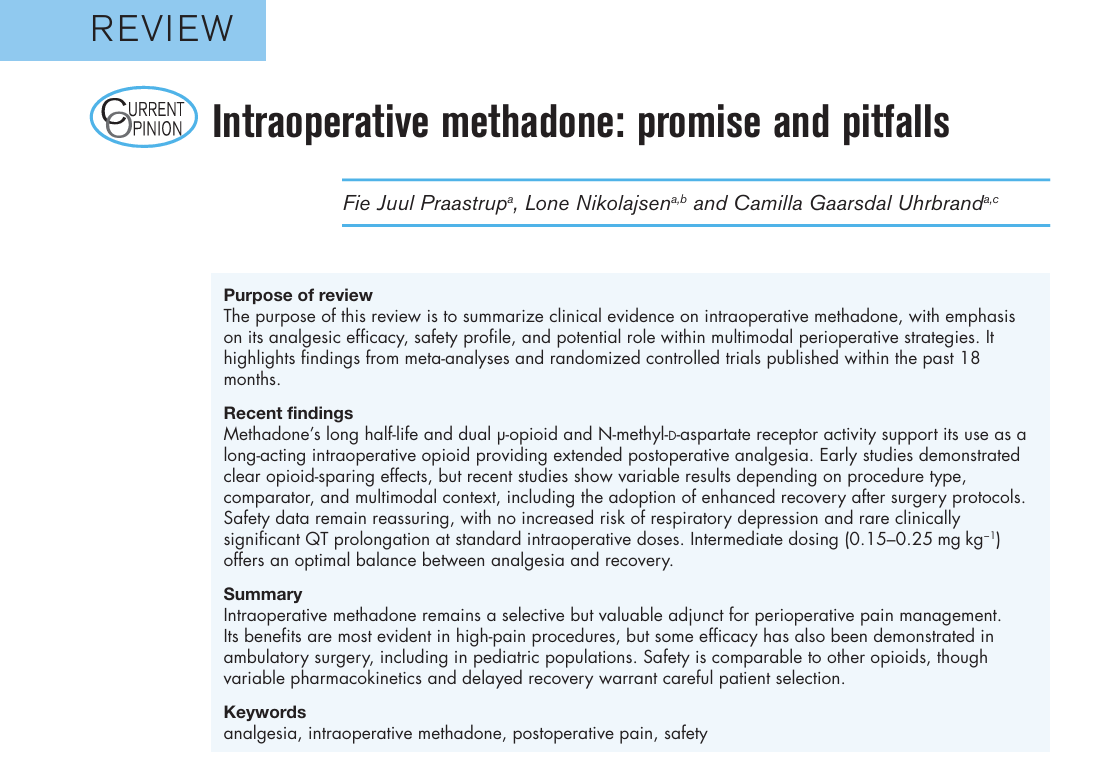
Intraoperative methadone has re-emerged as a topic of major interest in modern anesthesiology. Traditionally used for opioid dependence treatment and chronic pain management, methadone is now being reconsidered as a long-acting intraoperative analgesic capable of providing extended postoperative pain relief after a single intravenous dose.
Recent clinical research highlights both the potential advantages and limitations of this strategy. The pharmacological profile of methadone, characterized by μ-opioid receptor agonism and N-methyl-D-aspartate (NMDA) receptor antagonism, offers unique benefits compared with conventional intraoperative opioids such as fentanyl or morphine.
However, evidence remains mixed. While several randomized controlled trials and meta-analyses demonstrate improved postoperative analgesia and reduced opioid consumption, others report only modest or context-dependent benefits.
What is intraoperative methadone?
Methadone is a synthetic opioid with several pharmacologic characteristics that distinguish it from other perioperative opioids.
Key pharmacological mechanisms
Methadone exerts analgesic effects through multiple mechanisms:
- μ-opioid receptor agonism producing potent analgesia
- NMDA receptor antagonism reducing central sensitization
- inhibition of serotonin reuptake
- inhibition of norepinephrine reuptake
This multimodal pharmacodynamic profile may:
- decrease opioid tolerance
- reduce opioid-induced hyperalgesia
- provide longer-lasting analgesia after surgery
Pharmacokinetics
Methadone has several pharmacokinetic features that influence its perioperative use:
- rapid onset when administered intravenously
- high lipophilicity and large volume of distribution
- extensive protein binding
- prolonged elimination half-life (typically 24–36 hours, sometimes up to 60 hours)
These characteristics allow a single intraoperative dose to provide analgesia that extends into the postoperative period.
However, the long and variable half-life also introduces potential risks, including delayed respiratory depression or prolonged sedation.
Clinical evidence from recent studies
Randomized controlled trials
Clinical evidence evaluating intraoperative methadone includes numerous randomized controlled trials (RCTs) across multiple surgical specialties.
Early studies demonstrated impressive benefits:
- 20–40% reduction in postoperative opioid requirements
- improved pain scores after high-pain procedures
- extended analgesic effect lasting up to 48–72 hours
Procedures showing benefit include:
- cardiac surgery
- spinal fusion surgery
- major abdominal surgery
- orthopedic surgery
However, more recent pragmatic trials, often incorporating multimodal analgesia and enhanced recovery protocols, have produced more variable results.
In some settings, methadone improves pain scores without significantly reducing total opioid consumption.
Meta-analysis findings
Several systematic reviews and meta-analyses have assessed the overall evidence.
Key findings
Across studies, intraoperative methadone is associated with:
- lower pain scores at 24 hours postoperatively
- reduced opioid consumption in some procedures
- greatest benefits when compared with short-acting opioids such as fentanyl
However:
- Benefits beyond 48 hours are inconsistent
- Opioid-sparing effects vary widely
- Results depend heavily on the comparator drug and the multimodal analgesic context
When compared specifically with morphine, some meta-analyses show improved early pain scores but no significant reduction in total opioid use.
Optimal dosing strategies
Determining the optimal dose of intraoperative methadone remains an area of active research.
Typical adult dosing
Most studies use doses within the following range:
- 0.10–0.20 mg/kg intravenous
- fixed doses of 10–20 mg
Dosing considerations
Research suggests:
- Doses < 0.10 mg/kg may fail to maintain therapeutic plasma levels
- Doses > 0.30 mg/kg increase the risk of prolonged sedation and delayed recovery
Recommended intermediate dose
An intermediate dose of approximately:
0.15–0.25 mg/kg
appears to offer the best balance between analgesia and safety.
Special dosing considerations
Elderly patients
Older patients may require lower dosing due to increased sensitivity.
Evidence suggests:
- 0.10 mg/kg may represent the maximal tolerable dose in elderly hip fracture patients.
Pediatric patients
Pediatric studies typically use:
- 0.10–0.15 mg/kg
These doses have shown opioid-sparing effects in procedures such as:
- tonsillectomy
- orchiopexy
- spinal fusion
- strabismus surgery
Timing of administration
Another important consideration is when methadone should be administered during surgery.
Two main strategies exist:
- administration at anesthesia induction
- administration near surgical closure
Current evidence
Studies show:
- no consistent difference in postoperative outcomes between the two strategies
- therapeutic plasma concentrations are maintained for 1–2 postoperative days regardless of timing
Therefore, anesthesiologists may tailor timing based on:
- surgical duration
- anesthetic plan
- anticipated postoperative pain trajectory.
Safety profile
Despite concerns regarding methadone’s long half-life, current evidence suggests its safety profile is comparable to that of other opioids.
Respiratory depression
Large studies report:
- no increased risk of respiratory complications compared with morphine.
However, monitoring remains essential due to possible delayed respiratory effects.
QT interval prolongation
Chronic methadone therapy is known to prolong the QT interval.
Fortunately:
- Single intraoperative doses rarely produce clinically significant QT prolongation.
In one cardiac surgery cohort, QT intervals returned to baseline within 24 hours.
Other reported adverse events
Occasional adverse effects include:
- postoperative nausea and vomiting
- slightly prolonged PACU stay
- delayed sedation in rare cases
Overall, the safety profile remains reassuring with standard dosing.
When does intraoperative methadone work best?
Clinical data suggest that methadone is most beneficial in procedures associated with moderate to severe postoperative pain.
Surgeries with the greatest benefit
Evidence supports use in:
- cardiac surgery
- complex spine surgery
- major orthopedic procedures
- major abdominal operations
In these settings, methadone may significantly reduce opioid requirements and improve pain control.
Procedures with modest benefit
For lower-pain surgeries such as:
- laparoscopic gynecologic procedures
- ambulatory surgery
the benefits appear smaller and less consistent.
Role in multimodal analgesia and ERAS protocols
Modern perioperative care increasingly relies on multimodal analgesia, combining multiple non-opioid and opioid agents to optimize pain control while minimizing opioid exposure.
Enhanced recovery after surgery (ERAS) pathways often include:
- acetaminophen
- NSAIDs
- regional anesthesia
- gabapentinoids
- low-dose opioids
Within these protocols, the added benefit of methadone may be reduced because baseline analgesia is already optimized.
This phenomenon is known as the analgesic ceiling effect.
Nevertheless, methadone may still be useful as a targeted adjunct in selected high-pain cases.
Conclusion
Intraoperative methadone represents a promising yet selective tool for perioperative pain management.
Its unique pharmacologic profile allows:
- prolonged postoperative analgesia
- potential opioid-sparing effects
- improved early postoperative comfort
However, its benefits are highly context dependent. Evidence suggests the greatest value occurs in surgeries associated with significant postoperative pain.
While safety data remain reassuring, the drug’s long and variable half-life requires careful dosing, patient selection, and postoperative monitoring.
Until larger trials clarify optimal use strategies, intraoperative methadone should be viewed not as a universal solution but as a targeted adjunct within multimodal perioperative analgesia.
Reference: Praastrup FJ et al. Intraoperative methadone: promise and pitfalls. Curr Opin Anaesthesiol. 2026;39:200-205.
Read more about intraoperative methadone in the Anesthesia Assistant App. Instant clinical support. When seconds matter.