 Nerve Blocks App
 Anesthesia Assistant App
 Ultrasound Pain App
 Pain Medicine Assistant App
 POCUS App
 IV Access App
 MSK Knee App
 VetRA App
 Nerve Block Manual 2027
 Nerve Block Manual
 Regional Anesthesia Updates
 Anesthesiology Manual
 Anesthesiology Review
 Anesthesia Updates 2025
 Anesthesia Updates 2026
 Pediatric Anesthesia Updates
 Airway Management Updates
 US Interventional Pain Manual
 Pain Medicine Updates
 Mastering Difficult IV Access
 PACU Nursing Manual
 RA Veterinary Manual
 Books
Books About
About
 Back to News
 9 min read


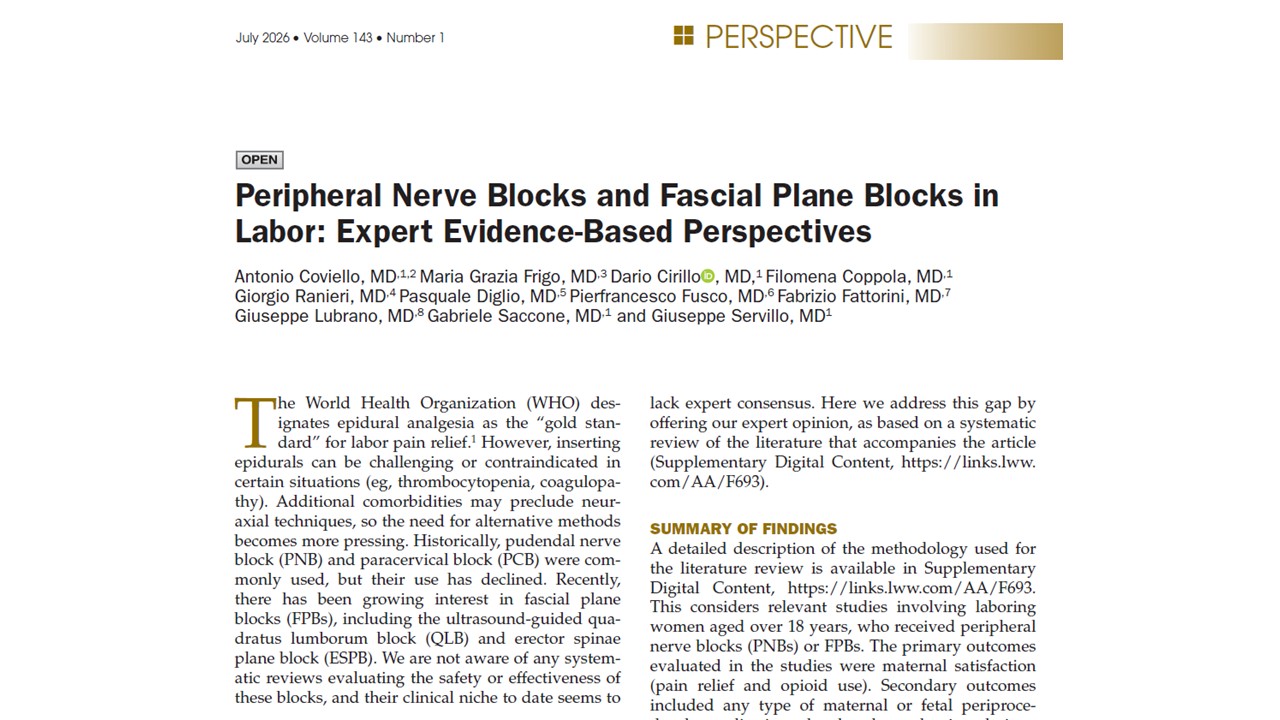
Labor pain management is entering a new phase of scientific discussion as anesthesiologists explore whether peripheral nerve blocks (PNBs) and fascial plane blocks (FPBs) can provide safe and effective alternatives when epidural analgesia cannot be used. A newly published expert evidence-based perspective by Coviello et al. in Anesthesia & Analgesia concludes that while several regional anesthesia techniques demonstrate encouraging results in selected clinical situations, none currently match the reliability, flexibility, and overall effectiveness of neuraxial analgesia for routine obstetric care.
The review comes at a time when increasing numbers of clinicians are seeking options for women with contraindications to epidural analgesia, including thrombocytopenia, coagulation disorders, spinal abnormalities, or failed neuraxial blocks.
Why alternative labor analgesia matters
The World Health Organization continues to recommend epidural analgesia as the preferred method for relieving labor pain. However, epidurals cannot always be safely or successfully performed.
Clinical situations that may prevent neuraxial analgesia include:
- Severe thrombocytopenia
- Coagulopathy or anticoagulant therapy
- Anatomical spinal abnormalities
- Previous spinal surgery
- Failed epidural placement
- Patient refusal
- Limited access to experienced anesthesiologists
In these circumstances, clinicians require alternative regional anesthesia techniques capable of providing meaningful pain relief while maintaining maternal and fetal safety.
The newly published review evaluates five principal techniques:
- Paracervical block (PCB)
- Pudendal nerve block (PNB)
- Posterior quadratus lumborum block (QLB)
- Erector spinae plane block (ESPB)
- Sacral erector spinae plane block (S-ESPB)
Evidence remains surprisingly limited
Although these techniques have existed for decades or have gained popularity more recently, high-quality evidence remains scarce.
The investigators initially identified 12,575 publications. After applying strict selection criteria, only 16 studies were considered sufficiently relevant for analysis. These consisted of randomized controlled trials, observational studies, systematic reviews, case reports, and case series.
The review, therefore, highlights not only what is currently known but also the substantial gaps in efficacy, safety, and long-term maternal and neonatal outcomes.
Paracervical block provides first-stage pain relief—but carries important risks
Paracervical block was once commonly used before epidural analgesia became widely available.
The reviewed randomized trials showed that PCB can significantly reduce first-stage labor pain compared with placebo and may provide analgesia comparable to intravenous fentanyl in selected patients. Women receiving PCB generally reported higher satisfaction than those treated with intramuscular opioids.
Neonatal outcomes were generally reassuring, with acceptable Apgar scores reported across studies.
However, the review also identifies important safety concerns.
Reported maternal complications included:
- Dizziness
- Sweating
- Tingling of the lower limbs
Transient fetal bradycardia was also documented.
Beyond findings reported in clinical trials, the authors emphasize additional procedural risks associated with PCB, including:
- Inadvertent intravascular injection
- Pelvic hematoma
- Sacral plexus injury
- Pelvic abscess
- Bleeding complications
Because the paracervical tissues are highly vascular, the procedure is considered unsuitable for women with significant coagulation abnormalities or thrombocytopenia.
The authors conclude that although PCB remains effective for first-stage labor analgesia, its declining use reflects both technical challenges and safety concerns. Furthermore, no studies have directly compared PCB with epidural analgesia, preventing meaningful conclusions regarding comparative effectiveness.
Pudendal nerve block offers limited benefits during labor
Pudendal nerve block primarily targets pain arising from the perineum during the second stage of labor.
The review found mixed evidence regarding its effectiveness.
Several studies demonstrated reduced pain during episiotomy repair, while one randomized trial found that bilateral PNB reduced episiotomy rates through improved perineal relaxation.
However, spinal anesthesia consistently produced superior analgesia for operative vaginal delivery.
Investigators also found no convincing evidence that a pudendal block improved the overall childbirth experience compared with women who received no block.
Technical limitations further reduce its usefulness.
The pudendal nerve is located deep near the ischial spine, making accurate needle placement challenging even with ultrasound guidance. In addition, the analgesic effect is relatively short-lived, limiting its usefulness during prolonged second-stage labor.
Potential complications include:
- Urinary retention
- Perineal hematoma
- Bleeding
- Technical failure
The authors conclude that PNB may still have a role during episiotomy repair, but it is difficult to justify as a routine labor analgesia technique given its limitations.
Quadratus lumborum block shows promise—but evidence is minimal
The posterior quadratus lumborum block has attracted growing interest because of its ability to provide both somatic and visceral analgesia.
However, current evidence consists of only a single published case report.
In that report, a woman with hemophilia A underwent bilateral posterior QLB and experienced effective first-stage labor analgesia lasting approximately three to four hours before an uncomplicated vaginal delivery.
Although encouraging, one successful case cannot establish clinical effectiveness.
The review highlights several practical challenges associated with QLB during pregnancy:
- An enlarged uterus alters anatomical landmarks.
- Pregnancy increases tissue edema.
- Ultrasound visualization becomes more difficult.
- Greater needle depth increases procedural complexity.
- Increased vascularity raises bleeding risk.
The authors also caution that QLB requires relatively large volumes of local anesthetic, increasing the potential risk of local anesthetic systemic toxicity (LAST), particularly in pregnant patients whose physiology alters drug distribution and metabolism.
Consequently, QLB should currently be reserved for carefully selected patients and performed only by experienced clinicians using meticulous ultrasound guidance.
Erector spinae plane block continues to attract attention
Among the newer fascial plane techniques, ESPB has generated perhaps the greatest enthusiasm.
Across the literature review, investigators identified 18 reported obstetric cases.
Most patients experienced meaningful reductions in pain during the first stage of labor.
Several case series reported:
- Pain score reductions of three to eight points
- Effective relief of abdominal pain
- Analgesia lasting approximately one to two hours
- Successful vaginal delivery in many patients
However, effectiveness frequently diminished during the second stage of labor, when perineal pain becomes dominant.
Some women ultimately required rescue analgesia or cesarean delivery for obstetric reasons unrelated to the block itself.
Importantly, no published cases of epidural hematoma or local anesthetic systemic toxicity were identified.
Nevertheless, the authors emphasize that the absence of reported complications should not be interpreted as proof of safety, as the available studies involve very small numbers of patients.
Sacral ESPB may improve second-stage analgesia
One of the newest developments involves the sacral erector spinae plane block.
The rationale is straightforward.
Standard lumbar ESPB appears more effective during the first stage of labor than during the second. Sacral ESPB aims to improve analgesia by targeting sacral nerve pathways responsible for perineal pain.
Current evidence remains extremely limited.
The review identified only one published case demonstrating substantial pain reduction after S-ESPB.
Although promising, investigators emphasize that much larger clinical studies are needed before this approach can be recommended for routine practice.
Bleeding risk remains a major consideration
A particularly important aspect of the review focuses on women with thrombocytopenia or coagulation disorders.
These patients often cannot safely receive epidural analgesia, making alternative techniques especially attractive.
However, not all regional blocks carry the same bleeding risk.
The authors distinguish between deep, non-compressible blocks and more superficial techniques.
Higher-risk procedures include:
- Paracervical block
- Transgluteal pudendal block
- Posterior quadratus lumborum block
Lower theoretical bleeding risk may exist with:
- Transvaginal pudendal block
- Erector spinae plane block
Even so, the review stresses that evidence remains insufficient to confirm safety in obstetric patients.
Every decision should therefore involve multidisciplinary assessment, individualized risk-benefit analysis, careful ultrasound guidance, and close post-procedure monitoring.
Local anesthetic toxicity requires careful attention
Another recurring concern involves local anesthetic systemic toxicity.
Many fascial plane blocks require relatively large volumes of local anesthetic.
Pregnancy itself increases susceptibility to systemic toxicity because physiological changes alter protein binding, cardiac output, and drug pharmacokinetics.
The authors recommend:
- Using the lowest effective dose
- Avoiding unnecessary combinations of regional blocks
- Monitoring cumulative local anesthetic exposure
- Maintaining continuous maternal and fetal observation
- Ensuring immediate access to treatment protocols for LAST
These precautions become particularly important when multiple regional techniques are combined during complex obstetric care.
Why epidural analgesia still remains unmatched
Despite growing innovation, the review concludes that none of the alternative techniques currently replicate the adaptability of epidural analgesia.
Unlike single-shot peripheral blocks, epidurals can be continuously titrated throughout labor, providing adjustable analgesia that evolves alongside changing pain patterns during cervical dilation and delivery.
The authors identify several persistent limitations shared by alternative techniques:
- Fixed duration of action
- Incomplete dermatomal coverage
- Limited ability to address both visceral and somatic pain simultaneously
- Technical complexity
- Operator dependence
- Anatomical variability during pregnancy
These factors collectively prevent alternative regional techniques from replacing neuraxial analgesia in routine obstetric practice.
Future research priorities
The review identifies numerous unanswered questions that future studies must address.
Among the highest priorities are:
- Large randomized controlled trials comparing alternative blocks with epidural analgesia
- Better evaluation of maternal satisfaction
- Standardized neonatal neurological assessment
- Long-term maternal outcomes
- Optimal local anesthetic dosing strategies
- Safety in women with coagulation disorders
- Mechanisms underlying visceral pain relief
- Standardized procedural techniques
Without stronger evidence, widespread adoption of these techniques cannot be justified.
Clinical implications
The expert perspective ultimately delivers a balanced message.
Peripheral nerve blocks and fascial plane blocks represent valuable additions to the obstetric anesthesia toolbox, particularly for women who cannot receive epidural analgesia. However, their use should remain individualized and confined to carefully selected clinical scenarios.
Rather than replacing epidural analgesia, these techniques currently serve as complementary options when neuraxial anesthesia is contraindicated, unavailable, or unsuccessful.
Until larger, high-quality clinical trials establish consistent efficacy and safety, epidural analgesia will continue to represent the benchmark against which all alternative labor analgesia techniques are measured.
Conclusion
The latest evidence suggests that peripheral nerve blocks and fascial plane blocks are expanding the range of analgesic options available for women in labor, particularly for those who cannot receive epidural analgesia because of contraindications such as thrombocytopenia, coagulopathy, spinal abnormalities, or failed neuraxial techniques. Techniques including paracervical block, pudendal nerve block, quadratus lumborum block, erector spinae plane block, and sacral erector spinae plane block have all demonstrated varying degrees of analgesic benefit in selected clinical settings. However, the current evidence base remains limited, with most data derived from small randomized trials, observational studies, case series, and individual case reports rather than large, high-quality clinical trials.
Importantly, the review concludes that none of these alternative regional anesthesia techniques can currently match the adaptability, comprehensive pain coverage, and proven effectiveness of epidural analgesia throughout the dynamic stages of labor. Each technique has unique advantages but also significant limitations related to procedural complexity, duration of analgesia, incomplete dermatomal coverage, operator dependence, and potential complications, particularly in women with coagulation abnormalities or increased risk of bleeding.
For more information, refer to the full article in Anesthesia & Analgesia.
Coviello A, Frigo MG, Cirillo D, Coppola F, Ranieri G, Diglio P, Fusco P, Fattorini F, Lubrano G, Saccone G, Servillo G. Peripheral Nerve Blocks and Fascial Plane Blocks in Labor: Expert Evidence-Based Perspectives. Anesth Analg. 2026 Jul 1;143(1):59-67.
Read more about fascial plane blocks in our Regional Anesthesiology Module on NYSORA 360 on NYSORA360 – an essential learning resource for residents with practical, up-to-date guidance.