 Nerve Blocks App
 Anesthesia Assistant App
 Ultrasound Pain App
 Pain Medicine Assistant App
 POCUS App
 IV Access App
 MSK Knee App
 VetRA App
 Nerve Block Manual
 Regional Anesthesia Updates
 Anesthesiology Manual
 Anesthesiology Review
 Anesthesia Updates 2025
 Anesthesia Updates 2026
 Pediatric Anesthesia Updates
 Airway Management Updates
 US Interventional Pain Manual
 Pain Medicine Updates
 Mastering Difficult IV Access
 PACU Nursing Manual
 RA Veterinary Manual
 Books
Books About
About
 Back to News
 6 min read
Traumatic brain injury (TBI) remains one of the leading causes of death and long-term disability worldwide. While the initial impact causes the primary injury, much of the neurological damage that follows occurs during the hours and days afterward. This secondary brain injury is driven by impaired cerebral blood flow, increased intracranial pressure, neuroinflammation, oxidative stress, and metabolic dysfunction. Preventing these secondary processes has become one of the most important goals in neurocritical care.
A recently published pilot study by Kostadinov and colleagues, published in Regional Anesthesia & Pain Medicine, explores an intriguing therapeutic approach: ultrasound-guided stellate ganglion block (SGB). Although SGB has traditionally been used for chronic pain conditions, complex regional pain syndrome, vascular disorders, and post-traumatic stress disorder, growing evidence suggests it may also influence cerebral circulation and inflammatory pathways.
By temporarily blocking cervical sympathetic nerve activity, SGB may reduce cerebrovascular resistance, improve cerebral perfusion, decrease intracranial pressure, and attenuate inflammatory responses following brain injury. These physiological effects make it an attractive candidate for limiting secondary brain damage.
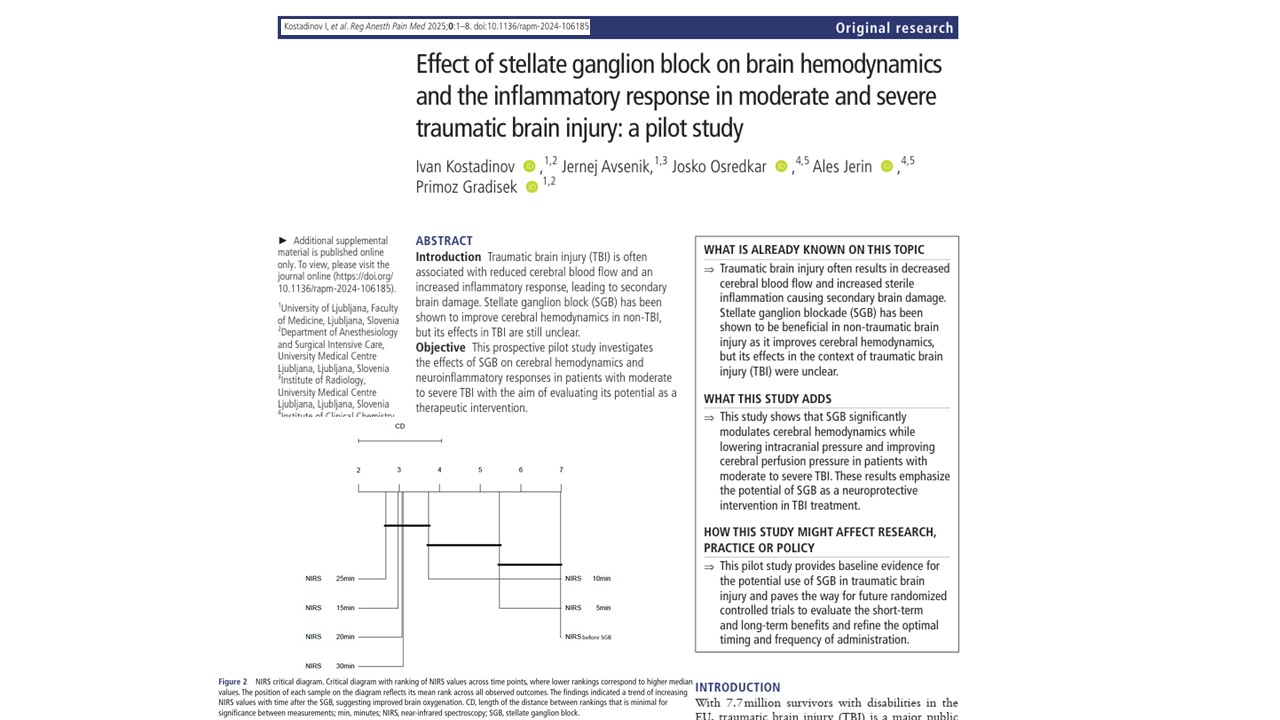
This prospective pilot study evaluated whether SGB could improve cerebral hemodynamics and reduce neuroinflammation in patients with moderate-to-severe TBI. While the study was relatively small, its findings provide encouraging early evidence that sympathetic modulation may represent a novel adjunctive therapy in neurocritical care.
Study methods
This was a prospective, single-center observational pilot study conducted in the intensive care unit of the University Medical Centre Ljubljana.
Patient population
- 20 adults with moderate or severe TBI
- Glasgow Coma Scale ≤12 before intubation
- All patients underwent standard neurocritical care management
Intervention
Patients received:
- Ultrasound-guided stellate ganglion block
- Performed on the side of the most severely injured cerebral hemisphere
- 8 mL of 0.5% levobupivacaine injected at the C6 level
Outcomes measured
Researchers evaluated several physiological parameters before and after SGB, including:
- Middle cerebral artery blood flow velocity using transcranial duplex ultrasound
- Cerebral artery diameter using CT angiography
- Cerebral blood flow and cerebral blood volume using CT perfusion imaging
- Intracranial pressure
- Cerebral perfusion pressure
- Brain tissue oxygenation
Inflammatory biomarkers were also measured at baseline, 12 hours, and 24 hours:
- Interleukin-6 (IL-6)
- S100B
- Neuron-specific enolase (NSE)
- Glial fibrillary acidic protein (GFAP)
Key findings
The study demonstrated several important physiological improvements following stellate ganglion block.
Improved cerebral hemodynamics
Researchers observed:
- Significant reduction in middle cerebral artery blood flow velocity
- Enlargement of major cerebral arterial diameters
- Improved cerebral blood flow in selected brain regions
- Increased cerebral blood volume on the treated side
These findings suggest that sympathetic blockade reduced cerebrovascular resistance, allowing more effective cerebral perfusion despite lower flow velocities.
Lower intracranial pressure
One of the most clinically relevant findings was a measurable reduction in intracranial pressure after SGB.
Lower ICP is a cornerstone objective in severe TBI management because sustained elevations are associated with worse neurological outcomes.
Improved cerebral perfusion pressure
As ICP decreased, cerebral perfusion pressure improved.
Maintaining adequate CPP is essential to preserve oxygen delivery to injured brain tissue and reduce secondary ischemic injury.
Better brain oxygenation
Brain tissue oxygen measurements increased after SGB, suggesting improved oxygen delivery to vulnerable brain regions.
Reduced inflammatory response
Several biomarkers associated with neuroinflammation decreased after treatment.
Most notably:
- IL-6 declined significantly within 24 hours
- S100B levels also decreased
These changes suggest that SGB may influence inflammatory pathways in addition to improving cerebral circulation.
Safety
Importantly:
- No major adverse events were reported
- The procedure was well tolerated
- No significant complications occurred during the study
Although encouraging, the small sample size limits definitive conclusions regarding safety.
Why might SGB work?
The stellate ganglion is part of the cervical sympathetic nervous system.
Blocking this ganglion temporarily reduces sympathetic outflow to the head and neck, producing several potential benefits:
- Cerebral vasodilation
- Reduced vascular resistance
- Improved cerebral perfusion
- Lower cerebrovascular tone
- Reduced inflammatory signaling
- Improved oxygen delivery
Rather than directly treating the injured brain tissue, SGB appears to optimize the physiological environment surrounding the injury, potentially limiting secondary damage.
Clinical implications
Although this study should not immediately change clinical practice, it introduces an exciting concept in neurocritical care.
Potential implications include:
- SGB may become an adjunctive therapy for selected patients with moderate or severe TBI.
- Sympathetic modulation may represent a new therapeutic target alongside current ICP-directed management.
- Improvements in cerebral perfusion could complement existing neuroprotective strategies.
- The minimally invasive nature of ultrasound-guided SGB makes it attractive if larger trials confirm benefit.
At present, however, SGB should still be considered investigational for traumatic brain injury.
Routine implementation awaits stronger evidence from randomized controlled trials.
Future research
This pilot study raises several important questions.
Future studies should investigate:
- Whether physiological improvements translate into better neurological outcomes.
- Which patients benefit the most from SGB.
- The optimal timing after injury.
- Whether repeated blocks provide greater benefit than a single procedure.
- Long-term functional recovery and mortality.
- Safety in larger multicenter populations.
- Integration of SGB into established neurocritical care protocols.
Randomized controlled trials will be essential before widespread adoption.
Clinical pearls
- Secondary brain injury remains a major contributor to poor outcomes after TBI.
- Maintaining cerebral perfusion while controlling intracranial pressure is a cornerstone of neurocritical care.
- Stellate ganglion block influences sympathetic nervous system activity and cerebral vascular tone.
- In this pilot study, SGB improved cerebral perfusion, lowered ICP, increased brain oxygenation, and reduced inflammatory biomarkers.
- No significant adverse events were observed in the study cohort.
- Current evidence supports further investigation but is insufficient for routine clinical implementation.
Conclusion
This pilot study provides compelling early evidence that ultrasound-guided stellate ganglion block may improve cerebral physiology after moderate and severe traumatic brain injury. Patients experienced improved cerebral blood flow, lower intracranial pressure, enhanced cerebral perfusion pressure, better brain oxygenation, and reduced inflammatory biomarkers without significant complications.
While these findings should be interpreted cautiously given the small sample size and observational design, they highlight the growing potential of sympathetic nervous system modulation as a novel neuroprotective strategy. Larger randomized controlled trials will determine whether these promising physiological improvements ultimately translate into better neurological recovery and long-term outcomes for patients with TBI.
Practical tip
For clinicians managing severe TBI, remember that optimizing cerebral perfusion involves more than simply lowering intracranial pressure. Emerging therapies such as stellate ganglion block may eventually complement established neurocritical care strategies by improving cerebral blood flow and reducing neuroinflammation—but for now, they should remain within experienced centers and research protocols until higher-quality evidence becomes available.
For more information, refer to the full article in RAPM.
Kostadinov I, Avsenik J, Osredkar J, Jerin A, Gradisek P. Effect of stellate ganglion block on brain hemodynamics and the inflammatory response in moderate and severe traumatic brain injury: a pilot study. Reg Anesth Pain Med. 2026 Jun 5;51(6):687-694.
Get full access to the stellate ganglion block in the NYSORA Nerve Blocks app: technique walkthroughs, PRO tips, clinical videos, and more.