 Nerve Blocks App
 Anesthesia Assistant App
 Ultrasound Pain App
 Pain Medicine Assistant App
 POCUS App
 IV Access App
 MSK Knee App
 VetRA App
 Nerve Block Manual
 Regional Anesthesia Updates
 Anesthesiology Manual
 Anesthesiology Review
 Anesthesia Updates 2025
 Anesthesia Updates 2026
 Pediatric Anesthesia Updates
 Airway Management Updates
 US Interventional Pain Manual
 Pain Medicine Updates
 Mastering Difficult IV Access
 PACU Nursing Manual
 RA Veterinary Manual
 Books
Books About
About
 Back to News
 4 min read
You are mentoring a first year anesthesiology resident.
It’s 6:45 a.m. The operating room schedule is full. A 72-year-old patient arrives for an elective colectomy. Hypertension. Type 2 diabetes. A coronary stent placed several years ago. The resident turns to you.
“Can you watch me do the preoperative assessment?”
The resident begins the interview. The questions come, but not always in the right order. Important details emerge late. A few opportunities to probe deeper are missed.
Nothing dangerous happens. But everyone in the room recognizes the same reality:
Preoperative assessment is a skill that takes years to develop.
For many residents, these early encounters are both exciting and uncomfortable. The preanesthesia evaluation requires clinical reasoning, communication skills, risk stratification, and decision-making, all at once. Yet exposure during the first weeks of training can be inconsistent, and opportunities for deliberate practice are often limited.
The challenge for educators is obvious: How do we give trainees more opportunities to practice before they face increasingly complex patients?
New Evidence: AI Enhances Anesthesia Education
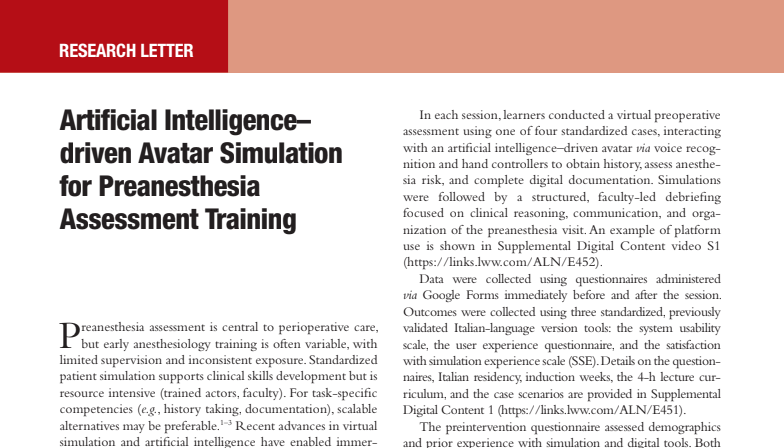
A recent research letter published in Anesthesiology explored whether artificial intelligence–driven virtual patients could help bridge this gap.
Investigators enrolled first-year anesthesiology residents and placed them in immersive virtual reality scenarios where they conducted complete preanesthesia assessments using AI-powered avatars. Residents interacted with virtual patients through voice recognition, gathered histories, assessed anesthetic risk, and completed digital documentation before participating in structured faculty-led debriefings.
The goal was simple: determine whether AI-driven simulation could provide a scalable way to teach foundational preoperative assessment skills.
What Did They Find?
After just a single simulation session, residents reported:
- Greater confidence conducting preanesthesia evaluations
- Improved ability to structure a preoperative assessment
- Better recognition of perioperative risks
- Enhanced communication skills with patients
- Higher overall self-perceived competence
Importantly, many residents had little prior experience with virtual reality or AI-based simulation, suggesting the technology was accessible even for novice users.
Author Perspective
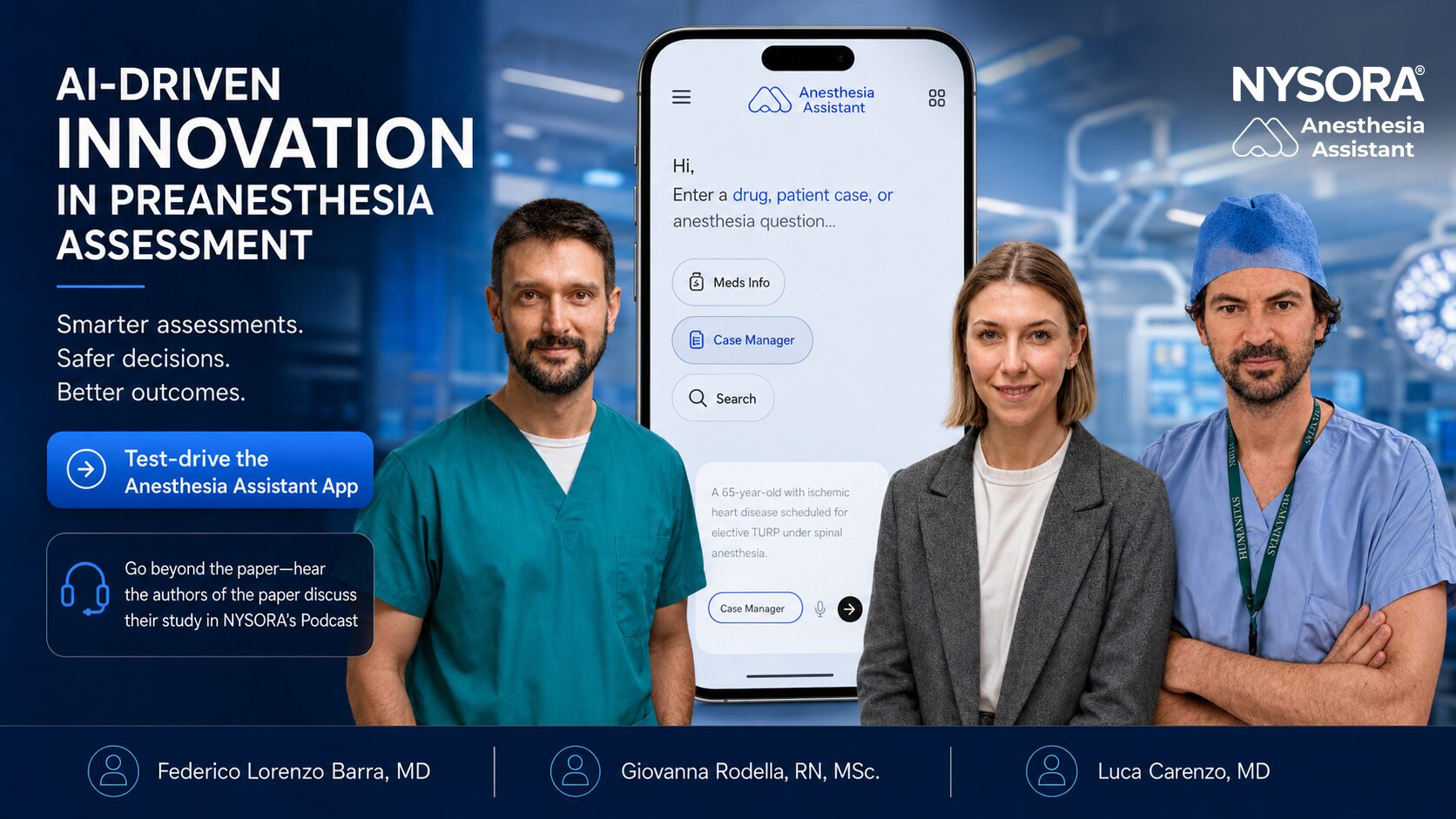
To better understand the study, NYSORA spoke with Dr. Federico Lorenzo Barra and Dr. Luca Carenzo, two of the study’s authors.
One point they emphasized was that the goal of AI-driven simulation is not to replace faculty, mentors, or traditional simulation.
“The avatar can create a safe clinical encounter, but the educator helps transform that encounter into learning.”
The authors also cautioned against overinterpreting the findings. While residents reported greater confidence after the simulation, the study measured self-perceived competence rather than objective clinical performance.
“The right conclusion is not that AI works by itself. The better conclusion is that AI-driven simulation may be useful when it is embedded in a well-designed educational structure.”
You can hear our full discussion with Dr. Barra in this week’s episode of the NYSORA Podcast, where we explore the study’s findings, limitations, and implications for the future of anesthesiology education.
The Bigger Picture
Simulation has long been one of anesthesiology’s greatest educational strengths.
But traditional simulation comes with limitations. Standardized patients require trained actors. High-fidelity sessions require faculty time, physical space, scheduling coordination, and significant financial investment.
AI-driven simulation offers a potentially different model.
Virtual patients can be available anytime. Scenarios can be repeated endlessly. Learners can practice difficult conversations, history-taking, and clinical reasoning in a psychologically safe environment before applying those skills to real patients.
Will AI replace traditional simulation? Almost certainly not.
The most effective educational environments will continue to rely on expert faculty, meaningful debriefing, and real human interaction. But studies like this suggest AI may become a valuable addition to the educational toolbox, particularly for repetitive practice and early skill development.
What This Means for Clinical Practice
At NYSORA, we believe AI should enhance, not replace, clinical education. The future is not artificial intelligence versus traditional teaching. It’s combining expert knowledge, clinical experience, simulation, and AI-powered support tools to accelerate learning and improve patient care.
The NYSORA Anesthesia Assistant app was developed with this philosophy in mind. Built on NYSORA’s extensive knowledge base, it provides anesthesiologists and trainees with rapid access to practical, evidence-based guidance exactly when they need it.
Use the Anesthesia Assistant app before your next preoperative assessment.
Institutional access is now available for residency programs, departments, and hospitals.
Reference: Barra FL et al. Artificial Intelligence-driven Avatar Simulation for Preanesthesia Assessment Training. Anesthesiology. 2026;145:240-243.