 Nerve Blocks App
 Anesthesia Assistant App
 Ultrasound Pain App
 Pain Medicine Assistant App
 POCUS App
 IV Access App
 MSK Knee App
 VetRA App
 Nerve Block Manual
 Regional Anesthesia Updates
 Anesthesiology Manual
 Anesthesiology Review
 Anesthesia Updates 2025
 Anesthesia Updates 2026
 Pediatric Anesthesia Updates
 Airway Management Updates
 US Interventional Pain Manual
 Pain Medicine Updates
 Mastering Difficult IV Access
 PACU Nursing Manual
 RA Veterinary Manual
 Books
Books About
About

Learning objectives
- Describe the causes, risk factors, and consequences of perioperative hypothermia
- Prevent and manage perioperative hypothermia
Definition & mechanisms
- Perioperative hypothermia is defined as a core body temperature <36.0°C
- Common consequence of anesthesia
- Inability of the body to respond effectively to the multiple causes of heat loss during surgery and anesthesia
Causes
3 phases:
- Redistribution: Vasodilatation leads to warm blood reaching the peripheries and cool blood from the peripheries entering the core circulation, causing a rapid decline in temperature
- Heat loss exceeds heat produced from metabolism as the metabolic rate is reduced by 15-40% during general anesthesia, causing a linear decline in temperature
Sources of heat loss:
-
- Radiation
- Convection
- Evaporation
- Conduction
3. Plateau phase: Heat loss is balanced by heat produced metabolically, mostly due to maximal vasoconstriction
Risk factors
- ASA grade 2-5 (higher grade, greater risk)
- Preoperative temperature <36.0°C
- Combined general and regional anesthesia
- Major or intermediate surgery
- At risk of cardiovascular complications
- Low BMI
- Diabetic neuropathy
- Paraplegia
- Severe hypothyroidism
Consequences
- Increased risk of surgical site infection
- Decrease in drug metabolism
- Increased bleeding and transfusion requirements
- Increased risk of cardiac events
- Shivering
- Delayed discharge from post-anesthesia care unit
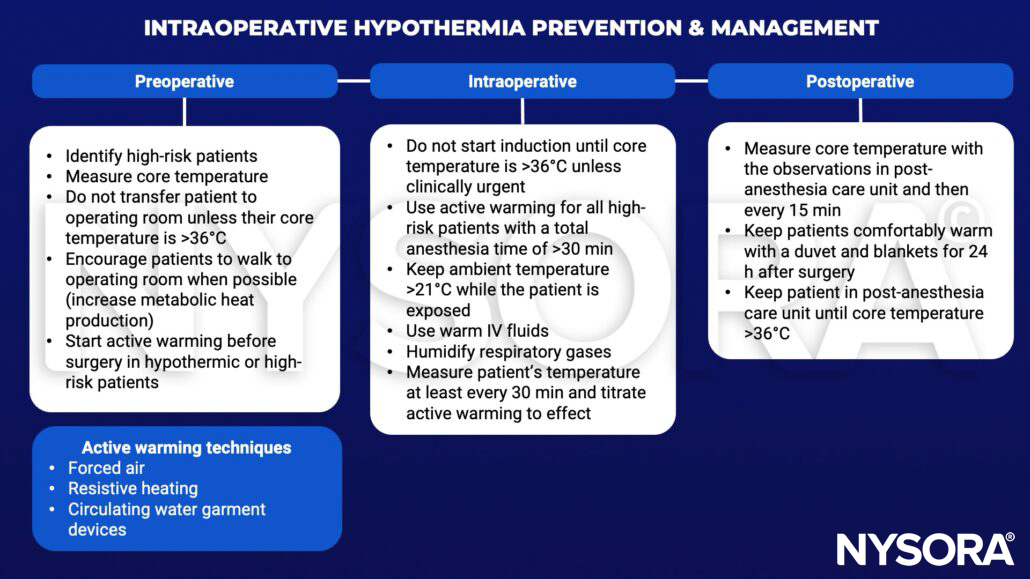
Prevention & management
Suggested reading
- Rauch S, Miller C, Bräuer A, Wallner B, Bock M, Paal P. Perioperative Hypothermia-A Narrative Review. Int J Environ Res Public Health. 2021;18(16):8749. Published 2021 Aug 19.
- Riley C, Andrzejowski J. Inadvertent perioperative hypothermia. BJA Educ. 2018;18(8):227-233.
Clinical updates
Ji et al. (BMC Surgery, 2024) provide an updated synthesis of perioperative hypothermia management, confirming forced-air warming (FAW) as the most effective and cost-efficient gold standard for maintaining normothermia, reducing infections, cardiovascular events, bleeding, and length of stay. The review highlights newer alternatives, including carbon-fiber resistive heating systems, self-heating blankets, and circulating-water mattresses, which offer comparable efficacy in selected settings. It emphasizes that warming strategies should be individualized based on surgical type, patient risk, and resource availability, rather than relying on a single modality.