Continuous Popliteal Nerve Block (Lateral Approach)

Overview
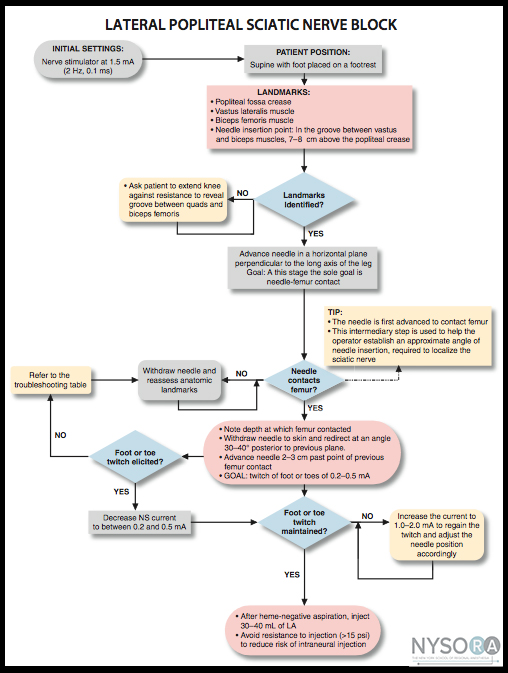
  • Indications: Ankle and foot surgery
  • Landmarks:
    • Popliteal fossa crease
    • Vastus lateralis
    • Biceps femoris muscles
  • Nerve stimulation: Twitch of the foot or toes at 0.2-0.5 mA current
  • Local anesthetic: 35-45 mL
  • Complexity level: Intermediate


General considerations

Continuous popliteal blockade is an advanced regional anesthesia technique and expertise with the single-shot technique is necessary to ensure its efficacy and patient comfort and safety. The technique is similar to the single-shot injection, however, slight angulation of the needle cephalad is necessary to facilitate threading the catheter. Securing and maintenance of the catheter are easy and convenient with this technique. A lateral popliteal block is suitable for surgery and post-operative pain management in patients undergoing a wide variety of lower leg, foot, and ankle surgeries.

Regional anesthesia anatomy
Distribution of anesthesia
Patient positioning
Equipment

A standard regional anesthesia tray is prepared with the following equipment:

  • Sterile towels and 4"x4" gauze packs
  • Three 20-mL syringes with local anesthetic
  • Sterile gloves, marking pen, and surface electrode
  • One 1½" 25-gauge needle for skin infiltration
  • A 10-cm long, insulated stimulating needle
  • Catheter
  • Peripheral nerve stimulator
Image
Landmarks

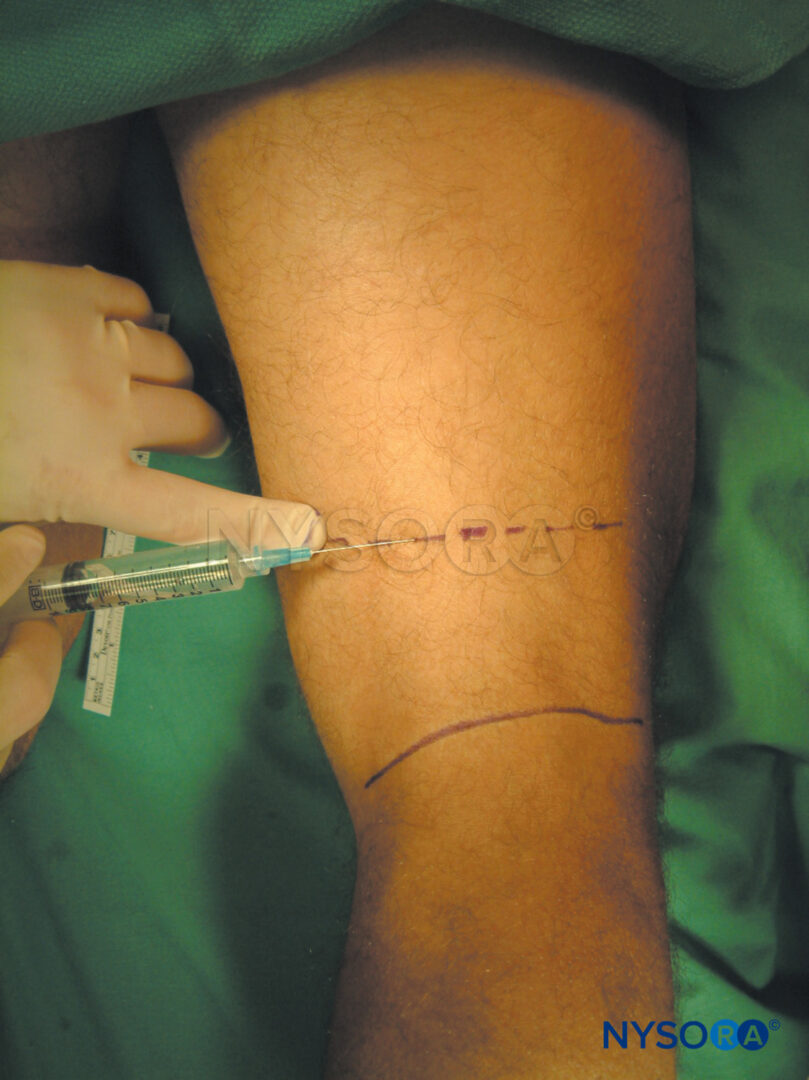
The landmarks for continuous popliteal block through the lateral approach are essentially the same as those in the single-shot technique and include:

  1. Popliteal fossa crease
  2. Vastus lateralis
  3. Biceps femoris

The needle insertion site is marked at 8-cm proximal to the popliteal fossa crease in the groove between vastus lateralis and biceps femoris.

Image
Technique
Image

The continuous popliteal block technique is similar to the single-shot technique. With the patient in the prone position, infiltrate the skin with local anesthetic at the injection site 8 cm above the popliteal fossa crease and in the groove between the biceps femoris vastus lateralis muscles using a 25-gauge needle. A 10-cm Tuohy-style tip needle for continuous nerve block is connected to the nerve stimulator (1.5 mA) and inserted to contact the femur.

Once the femur is contacted, the needle is withdrawn to the skin and redirected in a slight cranial and 30º posterior direction to the insertion plane in which the femur is contacted.

Image

The needle is advanced slowly while seeking a plantar flexion or dorsi-flexion of the foot or toes. After obtaining appropriate twitches, continue manipulating the needle until the desired response is seen or felt using a current of 0.5 mA. After negative aspiration for blood, 35-45 mL of the local anesthetic of choice is injected.

TIPS:
  • Stimulation at a current intensity of 0.5 mA may not be possible in some patients with long standing diabetes mellitus, peripheral neuropathy, sepsis, or severe peripheral vascular disease. In these cases, stimulating currents up to 1.0 mA should be accepted as long as the motor response is specific and clearly seen or felt.
  • Occasionally, a very small (e.g., 1 mm) movement of the needle results in a change of the motor response from that of the popliteal nerve (plantar flexion of the foot) to that of the common peroneal nerve (dorsiflexion of the foot). This indicates an intimate needle-nerve relationship at a level before the divergence of the sciatic nerve.

Catheter Insertion

Image

The catheter should be advanced some 5-7 cm beyond the tip of the needle. The needle is then withdrawn back to the skin level, while simultaneously advancing the catheter to prevent its inadvertent removal. Before activating, the catheter is checked for inadvertent intravascular placement by negative test for blood and injection of an epinephrine-containing local anesthetic.

Image

The needle is then withdrawn while continuously advancing the catheter to prevent accidental withdrawal of the catheter.

Image

The catheter is left 5-10 cm beyond the tip of the needle. The inser-tion site is dressed and the catheter secured to the skin.

TIP: When catheter insertion proves difficult, rotate the needle slightlyand try reinserting again. When these maneuvers do not fascilitate insertion of the catheter, angle the needle in a cephalad direction before reattempting to insert the catheter.

Management of Continuous Infusion Catheter

Continuous infusion is initiated after an initial bolus of dilute local anesthetic through the catheter is administered. It should be noted that for initiation of the block, the bolus is administered first through the needle using a higher concentration of local anesthetic. For the initial bolus, 20 mL of 0.5% ropivacaine or 0.5% bupivacaine (l-bupivacaine) would be most appropriate. This is followed by a continuous infusion of dilute concentration of a local anesthetic (e.g. 0.2% ropivacaine). The infusion is maintained at 10 mL/hr or 5 mL/hr when a PCA dose is planned (5 mL).

TIPS:
  • Breakthrough pain in patients on continuous infusion is always managed by administering a bolus of local anesthetic. Increasing the rate of infusion only is not adequate. With patients on the ward, a higher concentration of a shorter acting local anesthetic (e.g., 1% mepivacaine or lidocaine) is useful to both manage the pain and test the position of the catheter.
  • When the bolus injection through the catheter fails to result in blockade after 30 minutes, the catheter should be considered dislodged and it should be removed.
  • Every patient receiving continuous nerve block infusion should be prescribed an alternative pain management protocol because incomplete analgesia and catheter dislodgment can occur. For inpatients, this is probably best done using a back-up IV PCA.
Goal
Choice of local anesthetic
Block Dynamics and Perioperative Management
Complications and How to Avoid Them

Complications after a popliteal block are rare. The table below provides specific instructions on possible complications and how to avoid them.

Infection - Use a stric aseptic technique
Hematoma - Avoid multiple needle passes with a continuous block needle; the larger needle diameter and/or Tuohy design may result in a hematoma of the biceps fernoris or vastus lateralis muscles
- When the nerve is not localized on the first two or three needle passes, localize the nerve using a smaller gauge, single-shot needle first and then reinsert the continuous needle using the same angle; this technique is essentially similar to the localization of the internal jugular vein with a "localization needle" before inserting a large needle for canalization
Vascular puncture - Avoid too deep an insertion of the needle, because the vascular sheath is positioned medially and deeper to the sciatic nerve
- When the nerve is not localized within 2cm after the local twitches of the biceps musle cease, the needle should be withdrawn and reinserted to a different angle, rather than advanced deeped
Nerve injury - Exceedingly rare; use nerve stimulation and slow needle advancement; do not inject when the patient complains of pain or high pressures on injection are met; do not inject when stimulation is obtained at < 0.2mA current (100µsec)
- Avoid a combination of epinephrine in local anesthetic and application of tourniquet over the injection site to decrease the risk of prolonged ischemia of the nerve
Pressure necrosis of the heel - Instruct the patient on the care of the insensate extremity
- Use heel padding and frequent repositioning
Bibliography
  • Chelly JE, Casati A, Fanelli G: Continuous peripheral nerve block techniques. An illustrated guide. London, Mosby International Limited, 2001.
  • di Benedetto P, Casati A, Bertini L, Fanelli G, Chelly JE: Postoperative analgesia with continuous sciatic nerve block after foot surgery: a prospective, randomized comparison between the popliteal and subgluteal approaches. Anesth Analg 2002; 94:996-1000.
  • Ilfeld BM, Morey TE, Wang RD, Enneking FK: Continuous popliteal sciatic nerve block for postoperative pain control at home: a randomized, double-blinded, placebo-controlled study. Anesthesiology 2002; 97:959-65.
  • Singelyn FJ, Aye F, Gouverneur JM: Continuous popliteal sciatic nerve block: an original technique to provide postoperative analgesia after foot surgery. Anesth Analg 1997; 84:383-6.

GO TO TOP


Site map

Acknowledgments


Valid XHTML 1.0!


COPYRIGHT © 1996, 2006 NYSORA.COM
No part of this web page may be reproduced without the permission of the authors.

DISCLAIMER: The material presented on this Web page has not been peer-reviewed. The indications, techniques and dosages on this Web page have been recommended in the medical literature and/or conform to OUR clinical practice. The medications and equipment have not necessarily been approved by the Food and Drug Administration (FDA) for use in the techniques and dosages for which they are recommended. The package insert for each drug and/or equipment should be consulted for use and dosage as recommended by the FDA. Because standards, practices and recommendations change, it is advisable to keep abreast of revised recommendations, particularly those concerning new drugs and techniques. While the techniques and dosages described are successfully used in our practice, they should be followed with a discretion since their complications may be dependent on the operator, patient and/or other accompanying clinical circumstances. The development and maintenance of this web page has not been supported by any pharmaceutical or medical manufacturing industry. The medications and/or equipment discussed in the web page is shown solely for teaching purposes. Similar equipment or medications from other manufacturers may produce similar clinical results to ours.