Popliteal Block: Lateral Approach
Overview
- Indications: Ankle and foot surgery
- Landmarks: Popliteal fossa crease, vastus lateralis, and biceps femoris muscles
- Nerve stimulation: Twitch of the foot or toes at 0.2-0.5mA current
- Local anesthetic: 35-45 mL
- Complexity level: Intermediate
|
|
General considerations
The lateral approach to popliteal blockade is a block of the sciatic nerve at
the level of the popliteal fossa. This is an intermediate nerve block
technique and sound knowledge of the principles of nerve sti-mulation and anatomic
characteristics of the sciatic nerve are needed for its successful implementation.
This block is well-suited for surgery on the calf, Achilles tendon, ankle, and foot.
It provides complete analgesia for the calf tourniquet without the need for
supplementary blocks of the saphenous nerve.
|
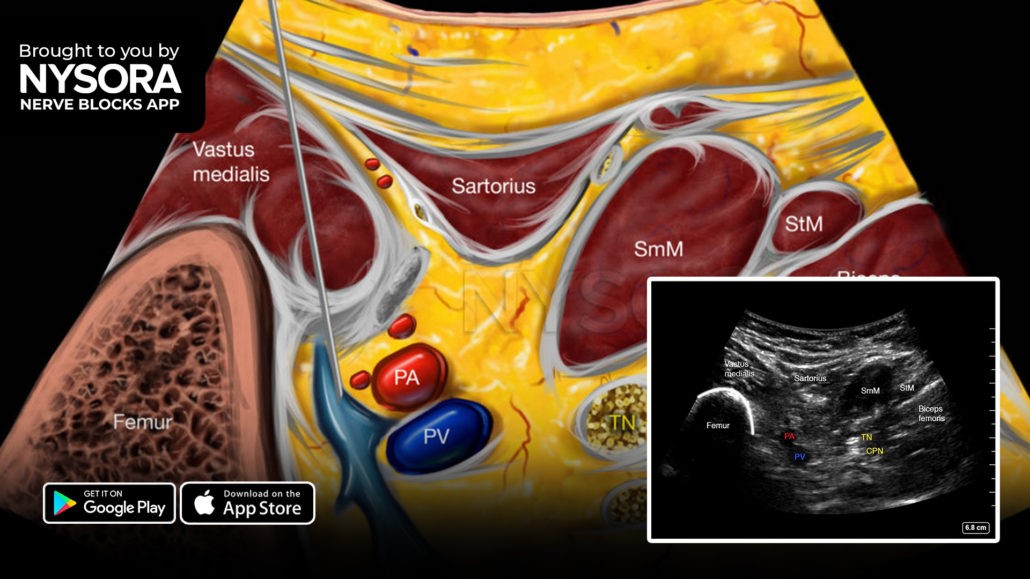
Regional anesthesia anatomy
The sciatic nerve consists of two separate nerve trunks, the tibial and common
peroneal nerves. A common epineural sheath envelops these two nerves at their
outset in the pelvis. As the sciatic nerve descends toward the knee, the two
components eventually diverge in the popliteal fossa, giving rise to the tibial
and common peroneal nerves. This division of the sciatic nerve usually occurs
between 50 and 120 mm proximal to the popliteal fossa crease.
|
An MRI image of the popliteal fossa at the level of the blockade (8 cm above the
popliteal fossa crease). Note the position of the sciatic nerve between the biceps
and semitendinosus muscles. During block performance, stimulation of the common
peroneal nerve is usually obtained first (65%) because this nerve is positioned
lateral and more superficial than the tibial nerve.
|
Distribution of anesthesia
Popliteal block results in anesthesia of the entire distal two thirds of the
lower extremity, with the exception of the medial aspect of the leg. Cutaneous
innervation of the medial leg below the knee is provided by the saphenous nerve.
The saphenous nerve is a cutaneous extension of the femoral nerve. Depending on
the level of surgery, the addition of a saphenous nerve block may be required
for complete surgical anesthesia.
|
Patient positioning
The patient is in the lateral position. The foot on the side to be blocked should
be positioned so that even the slightest movements of the foot or toes can be easily
observed. This is best achieved by placing the foot on a foot rest. Attention should
be paid so that the Achilles tendon is also protruding off the foot rest. This
positioning allows easy visualization of any foot movement during nerve stimulation.
|
Equipment
A standard regional anesthesia tray is prepared with the following equipment:
- Sterile towels and 4"x4" gauze packs
- Two 20-mL syringes with local anesthetic
- Sterile gloves, marking pen, and surface electrode
- One 1½", 25-gauge needle for skin infiltration
- A 10-cm long, short bevel, insulated stimulating needle
- Peripheral nerve stimulator
|
|
Landmarks
Surface Landmarks
The following surface anatomy landmarks are used to determine the insertion point for the needle:
- Vastus lateralis muscle
- Biceps femoris muscle
- Patella
- Popliteal fossa crease
|
Anatomic Landmarks
Landmarks for the lateral approach to popliteal block include:
- Popliteal fossa crease
- Vastus lateralis muscle
- Biceps femoris muscle
The needle insertion site is marked in the groove between the vastus lateralis
and biceps femoris muscle. Note that the lateral femoral epycondyle is another
landmark that can be used in this technique. It is easily palpated on the lateral
aspect of the knee. This landmark is positioned 1 cm cephalad to the popliteal fossa
crease.
TIP: In some patients, the biceps muscle may be atrophic and the iliotibial
aponeurosis may be more prominent. In such cases, the needle insertion site is
labeled in the groove between the vastus lateralis and the iliotibial tract.
|
Maneuvers to accentuate the anatomic landmarks
When not immediately apparent visually, the groove between the vastus lateralis
and biceps femoris is examined by firmly pressing the fingers of the palpating hand
against the adipose tissue in the groove approximately at 8 cm above the popliteal
fossa crease.
TIPS:
-
Asking the patient to lift the foot off the table can be used to accentuate the landmarks
in patients in whom the landmarks are not immediately apparent.
-
This maneuver requires that both the quadriceps (vastus lateralis) muscle (leg
extension) and biceps femoris (leg flexion) be tensed and opposing, which nicely
accentuates the groove between the two muscles.
|
Technique
The operator should be seated, facing the side to be blocked. The height
of the bed with the patient is adjusted to allow for an ergonomic position
and a greater precision during block placement. This position also allows
the performer to simultaneously monitor both the patient and the responses to
nerve stimulation. The figure below depicts the correct patient and anesthesiologist
position during block placement.
|
Local anesthetic skin infiltration
The site of needle insertion is cleaned with an antiseptic solution and infiltrated
with local anesthetic at the site of estimated needle insertion using a 1½" 25 gauge
needle. It is useful to infiltrate the skin in a line, rather than raise a single
skin wheel. This allows for a needle reinsertion at a different site when necessary,
without a need to anesthetize the skin again.
|
Needle insertion
A 10cm 22G needle is connected to a nerve stimulator, inserted in a horizontal
plane between the vastus lateralis and biceps femoris muscles and advanced to
contact the femur. The contact with the femur is important because it provides
information on the depth of the nerve (typically 1-2 cm beyond the skin-femur
distance) as well as on the angle that the needle will need to be redirected
posterior in order to stimulate the nerve. The initial current intensity is
initially set at 1.5 mA.
|
Keeping the fingers of the palpating hands firmly pressed and immobile in the
groove, the needle is then withdrawn to the skin, redirected 30º posterior to the
angle at which the femur was contacted and advanced toward the nerve.
|
This MRI image demonstrates:
-
The initial plane of needle insertion between vastus lateralis and biceps
femoris muscles to reach the sciatic nerve in the popliteal fossa
-
The angle of approximately 30º at which the needle is redirected to reach the
sciatic nerve.
When the sciatic nerve is not localized on the first needle pass, the needle
is withdrawn to the skin level and the following algorithm is followed:
-
Assure that the nerve stimulator is functional, properly connected to the
patient and to the needle and that it is set to deliver current of desired intensity
-
Assure that the leg is not externally rotated in the hip joint and that the foot
forms a 90º angle to the horizontal plane of the table. Any deviation from this
angle changes the relationship of the sciatic nerve to the femur and biceps femoris muscle.
-
Mentally visualize the plane of the initial needle insertion and redirect the
needle in a slightly posterior direction (5-10º posterior angulation).
-
If the maneuver above fails, withdraw the needle and reinsert with additional
5-10º posterior redirection.
-
If the maneuvers above fail, withdraw the needle to the skin and reinsert 1 cm
inferior to the initial insertion site, then repeat the above steps.
-
Failure to obtain foot response to nerve stimulation should prompt reassessment
of the landmarks and arm position. In addition, the stimulating current should be
increased to 2 mA.
TIPS:
-
Note that after the redirection, the needle passes through the biceps femoris
muscle. Consequently, local twitches of the biceps femoris muscle are often
obtained during needle advancement (see the MRI image). Cessation of the biceps
femoris twitches should prompt slower needle advancement as this signify that
the needle has entered the popliteal fossa and proximity to the nerve.
-
When the stimulation of the sciatic nerve is not obtained within 2 cm after
cessation of the biceps femoris twitches, the needle is probably not in plane
with the nerves and it should not be advanced further as this carries a risk
of puncturing the popliteal vessels.
|
Goal
The ultimate goal of nerve stimulation is to obtain visible or palpable twitches
of the foot or toes at a current of 0.2-0.5 mA.
TIPS:
-
Stimulation of the sciatic nerve can result in tibial (plantar flexion) or common peroneal
(dorsiflexion) response. Either of these is acceptable when a low-intensity current
stimulation is obtained and large volume of local anesthetic is used. injection of large
volume of local anesthetic will spread within the sheath to block both divisions of the nerve.
-
Some authors recommend a double-stimulation/injection technique to increase the success rate
of blockade of both division of the nerve. This involves, succinctly stimulating and injection
both divisions of the sciatic nerve (tibial and common peroneal). This is not necessary with
the technique described in this book.
-
Isolated twitches of the calf muscles should not be accepted because they may be the
result of stimulation of the sciatic nerve branches to the calf muscles that may be outside
the sciatic nerve sheath.
-
In some patients with long standing diabetes mellitus, renal failure or peripheral neuropathy,
it may not be possible to obtain stimulation with low current intensity. In this case,
stimulation of the tibial nerve (plantar flexion) often proves to be more reliable.
After the initial stimulation of the sciatic nerve is obtained, the stimulating current is
gradually decreased until twitches are still seen or felt at 0.2-0.5 mA. This typically
occurs at a depth of 5-7 cm. At this point, the needle should be stabilized and after
negative aspiration for blood, 35-45 mL of local anesthetic is slowly injected. The hands
should be kept as immobile as possible to prevent injection outside the sheath of the
sciatic nerve.
|
Troubleshooting
| Response Obtained |
Interpretation |
Problem |
Action |
| Local twitch of the biceps muscle |
Direct stimulation of the biceps femoris muscle |
Too shallow a placement of the needle |
Advance the needle deeper |
| Local twitch of the vastus lateralis muscle |
Direct stimulation of the vastus lateralis muscles |
Too anterior a placement of the needle |
Withdraw the needle and reinsert posteriorly |
| Twitch of the calf muscles without the foot or toe movement |
Stimulation of the muscular branches of the sciatic nerve |
These small branches are often outside the sciatic sheath |
Disregard and continue advancing the needle until foot/toes twitches are obtained |
| Vascular puncture |
Blood in the syringe mostly commonly indicates placement into the popliteal artery or vein |
Too deep and anterior a placement of the needle |
Withdraw and redirect laterally |
| Twitches of the foot or toes |
Stimulation of the sciatic nerve |
None |
Accept and inject local anesthetic |
Choice of local anesthetic
Popliteal block requires larger volume of local anesthetic in order to achieve anesthesia
of both divisions of the nerve. The choice of the type and concentration of local anesthetic
should be based on whether the block is planned for surgical anesthesia or pain management.
As could be seen in the table below, type and concentration of local anesthetics as well as
the choice of additives to local anesthetic influence the onset and particularly duration
of the blockade.
|
Onset (min) |
Anesthesia (hrs) |
Analgesia (hrs) |
| 3% 2-Chloroprocaine (+ HCO3) |
10-15 |
1 |
2 |
| 3% 2-Chloroprocaine (+HCO3 + epinephrine) |
10-15 |
1.5-2 |
2-3 |
| 1.5% Mepivacaine (+ HCO3) |
15-20 |
2-3 |
3-5 |
| 1.5% Mepivacaine (+ HCO3 + epinephrine) |
15-20 |
2-2 |
3-8 |
| 2% Lidocaine (+ HCO3 + epinephrine) |
10-20 |
2-5 |
3-8 |
| 0.5% Ropivacaine |
15-30 |
4-8 |
5-12 |
| 0.75% Ropivacaine |
10-15 |
5-10 |
6-24 |
| 0.5 Bupivacaine (or l-bupivacaine) |
15-30 |
5-15 |
6-30 |
Block Dynamics and Perioperative Management
This technique is associated with a moderate patient discomfort because the needle
transverses the biceps femoris muscle and adequate sedation and analgesia are
necessary. Administration of midazolam (2-4 mg IV) and a short-acting narcotic
(250-750 µg alfentanyl) assures patient comfort and prevents patient movement during
block performance. Failure to administer appro-priate premedication makes it difficult
to interpret response to nerve stimulation due to patient's moving during needle
advancement. A typical onset time for this block is 10-25 minutes, depending on the
type, concentration and volume of local anesthetic used. The first signs of onset of
blockade are usually report by the patient that the foot "feels different" or inability
to wiggle toes. Sensory anesthesia of the skin with this block is often the last to
develop. Inadequate skin anesthesia despite the apparent timely onset of the blockade
is common and it may take up to 30 minutes to develop. Thus, local infiltration at
the site of the incision by the surgeon is often all that is needed to allow the
surgery to proceed.
Complications and How to Avoid Them
| Infection |
Use a strict aseptic technique |
| Hematoma |
- Avoid multiple needle passes with a continuous block needle; the larger needle
diameter and/or Tuohy design may result in a hematoma of the biceps femoris or
vastus lateralis muscles
- When the nerve is not localized on the first two or three needle passes, localize the
nerve using a smaller gauge, single-shot needle first and then reinsert the
continuous needle using the same angle; this technique is essentially similar to the
localization of the internal jugular vein with a "localization needle" before inserting a
large needle for canalization
|
| Vascular puncture |
- Avoid too deep an insertion of the needle, because the vascular sheath is
positioned medially and deeper to the sciatic nerve
- When the nerve is not localized within 2 cm after the local twitches of the biceps
muscle cease, the needle should be withdrawn and reinserted at a different angle,
rather than advanced deeper
|
| Nerve injury |
- Exceedingly rare; use nerve stimulation and slow needle advancement; do not inject
when the patient complains of pain or high pressures on injection are met; do not
inject when stimulation is obtained at <0.2 mA current (100µsec)
- Avoid a combination of epinephrine in local anesthetic and application of a
tourniquet over the injection site to decrease the risk of prolonged ischemia of the
nerve
|
| Pressure necrosis of the heel |
- Instruct the patient on the care of the insensate extremity
- Use heel padding and frequent repositioning
|
Bibliography
- Benzon HT, Kim C, Benzon HP, et al: Correlation between evoked motor response of the sciatic nerve and sensory blockade. Anesthesiology 1997; 87:548-52
- Hadzic A, Vloka JD: A comparison of the posterior versus lateral approaches to the block of the sciatic nerve in the popliteal fossa. Anesthesiology 1998; 88:1480-6
- Hadzic A, Vloka JD, Singson R, Santos AC, Thys DM: A comparison of intertendinous and classical approaches to popliteal nerve block using magnetic resonance imaging simulation. Anesth Analg 2002; 94:1321-4
- McLeod DH, Wong DH, Claridge RJ, Merrick PM: Lateral popliteal sciatic nerve block compared with subcutaneous infiltration for analgesia following foot surgery. Can J Anaesth 1994; 41:673-6
- McLeod DH, Wong DH, Vaghadia H, Claridge RJ, Merrick PM: Lateral popliteal sciatic nerve block compared with ankle block for analgesia following foot surgery. Can J Anaesth 1995; 42:765-9
- Sunderland S: The sciatic nerve and its tibial and common peroneal divisions. Anatomical features. Nerves and Nerve Injuries. Edinburgh and London, E. & S. Livingstone LTD, 1968, pp 1012-95
- Vloka JD, Hadzic A, Kitain E, Lesser JB, Kuroda M, April EW, Thys DM: Anatomic considerations for sciatic nerve block in the popliteal fossa through the lateral approach. Reg Anesth 1996; 21:414-8.
- Vloka JD, Hadzic A, Lesser JB, Kitain E, Geatz H, April EW, Thys DM: A Common Epineural Sheath for the Nerves in the Popliteal Fossa and Its Possible Implications for Sciatic Nerve Block. Anesth Analg 1997; 84:387-90
- Vloka JD, Hadzic A, April EW, Geatz H, Thys, DM: Division of the sciatic nerve in the popliteal fossa and its possible implications in the popliteal nerve blockade. Anesth Analg 2001; 92:215-7
- Zetlaoui PJ, Bouaziz H: Lateral approach to the sciatic nerve in the popliteal fossa. Anesth Analg 1998; 87:79-82
GO TO TOP
|