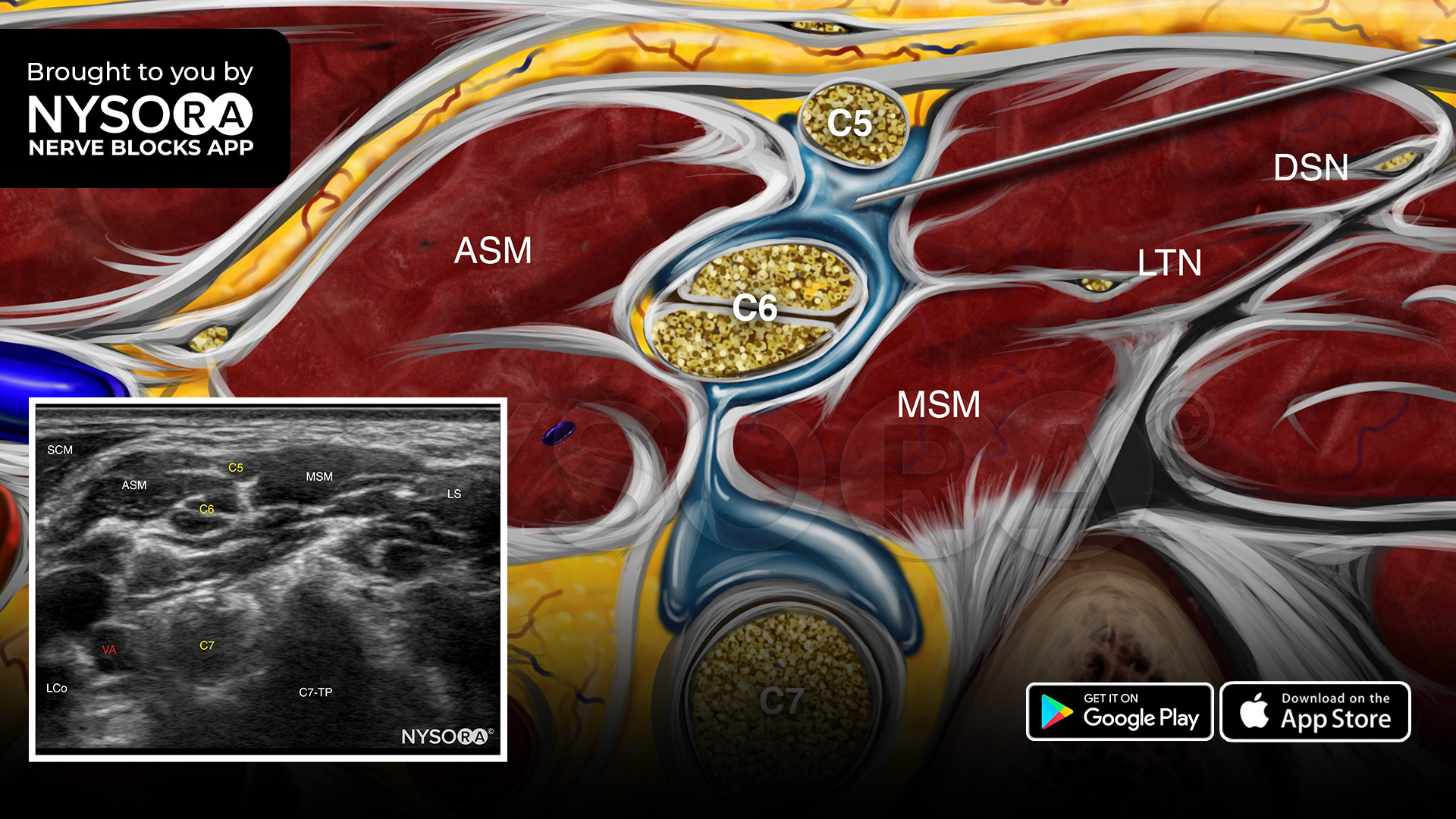
The superficial cervical plexus supplies innervation to the skin of the anterolateral neck through anterior primary rami of C2 through C4. The individual nerves emerge as four distinct nerves from the posterior border of the sternocleidomastoid muscle. The lesser occipital nerve usually is a direct branch from the main stem of the second cervical nerve. The larger remaining part of this stem then unites with a part of the third cervical nerve to form a trunk that arises as the greater auricular and the transverse cervical nerves. Another part of the third cervical nerve runs downward to unite with a major part of the fourth to form a supraclavicular trunk, which then divides into the three groups of supraclavicular nerves.
The following surface anatomy landmarks are helpful for estimating the location of the posterior border of the sternocleidomastoid muscle and for estimating the site of needle injection:
Mastoid process
Chassaignac's tubercle of C6
The fingers of the palpating hand should be stretched to outline the posterior border of the clavicular head of the sternocleidomas-toid muscle and to help visualize the line connecting the mastoid process with the C6 transverse process.
Anatomic landmarks
A line extending from the mastoid to C6 is drawn. The site of needle insertion is marked at the midpoint of the line connecting the mastoid process with Chassaignac's tubercle of C6 transverse process. This is the location of the branches of the superficial cervical plexus as they emerge behind the posterior border of the sternocleidomastoid muscle.
After skin cleansing with an antiseptic solution, a skin wheel is raised at the site of needle insertion using a 25-gauge needle. Next, using a "fan" technique with superior-inferior needle redirections, the local anesthetic is injected alongside the posterior border of the sternoclei-domastoid muscle 2-3 cm below and above the needle insertion site. This injection technique should be adequate to achieve blockade of all four major branches of the superficial cervical plexus.
The goal of the injection is to infiltrate the local anesthetic subcutaneously and behind the sternocleido-mastoid muscle. Attention should be paid to avoid deep needle insertion (e.g., less than 1-2 cm).
TIPS:
The transverse process is never sought with the superficial cervical plexus technique.
Paresthesia is occasionally elicited during needle insertion. However, paresthesia is nonspecific and should not be routinely sought.
A superficial cervical plexus block requires 10-15 mL of local anesthetic (3-5 mL per each redirection/ injection). Most patients benefit from the use of a long-acting local anesthetic. Since motor block is not sought with this technique, some anesthesiologists suggest using a low-concentration of local anesthetic (e.g., 0.2-0.5% ropivacaine or 0.25% bupivacaine). Although a low concentration may suffice when the needle is ideally placed in the vicinity of the cervical plexus nerves, this is often not the case and the higher concentration results in both a higher success rate and a longer duration of blockade.
This block is associated with minor patient discomfort. Small doses of midazolam 1-2 mg for sedation and alfentanil 250 to 500 µg for analgesia just before needle insertion should produce a comfortable and cooperative patient during nerve localization. Similarly to the deep cervical plexus blockade, the sensory coverage of the neck is complex and a degree of cross-coverage from the cervical plexus branches from the opposite side of the neck should be expected. The onset time for this block is 10-15 minutes and the first sign of the blockade is the decreased sensation in the area of the distribution of the respective components of the cervical plexus. Excessive sedation should be avoided before and during head and neck procedures because many procedures require a fully conscious, oriented, and cooperative patient during the entire surgical procedure. In addition, airway management, when it becomes necessary, may prove difficult because of the shared access to the head and neck with the surgeon.
TIP: A subcutaneous midline injection of the local anesthetic extending from the thyroid cartilage distally to the suprasternal notch will block the branches crossing from the opposite side. This injection can be considered as a "field" block. It is very useful for preventing pain from surgical skin retractors on the medial aspect of the neck.
Avoid multiple needle injections, particularly in anticoagulated patients
Keep a 5 minute steady pressure on the site when the cartoid artery is inadvertenly punctured
Phrenic nerve blockade
Phrenic nerve blockade (diaphragmic paresis) invariably occurs with a deep cervical plexus block
A deep cervical block should be carefully considered in patients with significant respiratory disease
Bilateral deep cervical block in such patients may be considered contraindicated
Blockade of the phrenic nerve does not occur after superficial cervical plexus block
Local anesthetic toxicity
Central nervous system toxicity is the most serious consequence of the cervical plexus block. This complication occurs because of the rich vascularity of the neck, including vertebral and carotid artery vessels; it is usually caused by an inadvertent intravascular injection of local anesthetic rather then absorption
Careful and frequent aspiration should be performed during the operation
Nerve injury
Local anesthetic should never be injected against resistance or when the patient complains of severe pain on injection
Spinal anesthesia
This complication may occur with injection of larger volume of local anesthetic inside the dural sleeve that accompanies the nerves of the cervical plexus
It should be noted that a negative aspiration test for CSF does not rule out the possibility of intrathecal spread of local anesthetic
Avoidance of high volume and pressure during injection are the best measures to avoid this complication
Aunac S, Carlier M, Singelyn F, De Kock M: The analgesic efficacy of bilateral combined superficial and deep cervical plexus block administered before thyroid surgery under general anesthesia. Anesth Analg 2002; 95:746-50.
Diedone N, Gomola A, Bonnichon P, Ozier YM: Prevention of postoperative pain after thyroid surgery: A double-blinded randomized study of bilateral superficial cervical plexus blocks. Anesth Analg 2001; 92:1538.
Murphy TM: Somatic Blockade of Head and Neck. In Cousins, M.J., and Bridenbaugh PO(eds): Neuronal Blockade in Clinical Anesthesia and Management of Pain. Philadelphia, J.B. Lippincott-Raven Publishers, 1988, pp 489-514.
Pandit JJ, Bree S, Dillon P, Elcock D, McLaren ID, Crider B: A comparison of superficial versus combined (superficial and deep) cervical plexus block for carotid endarterectomy: a prospective, randomized study. Anesth Analg 2000; 91:781-6.
Stoneham MD, Doyle AR, Knighton JD, Dorje P, Stanley JC: Prospective, randomized comparison of deep or superficial cervical plexus block for carotid endarterectomy surgery. Anesthesiology 1998; 89:907-12.