A deep cervical plexus block is essentially a paravertebral block of the C2, C3, and C4 spinal nerves as they emerge from the foramina of the respective vertebrae. Blockade of the deep cervical plexus also results in the blockade of the superficial cervical plexus.
A deep cervical plexus block is essentially a paravertebral block of the C2, C3, and C4 spinal nerves as they emerge from the foramina of the respective vertebrae. Blockade of the deep cervical plexus also results in the blockade of the superficial cervical plexus. A deep cervical block is often accidentally accomplished when a larger volume of local anesthetic is used in the interscalene brachial plexus block. The most common clinical use for this block in our practice includes a carotid endarterectomy and removal of cervical lymph nodes.
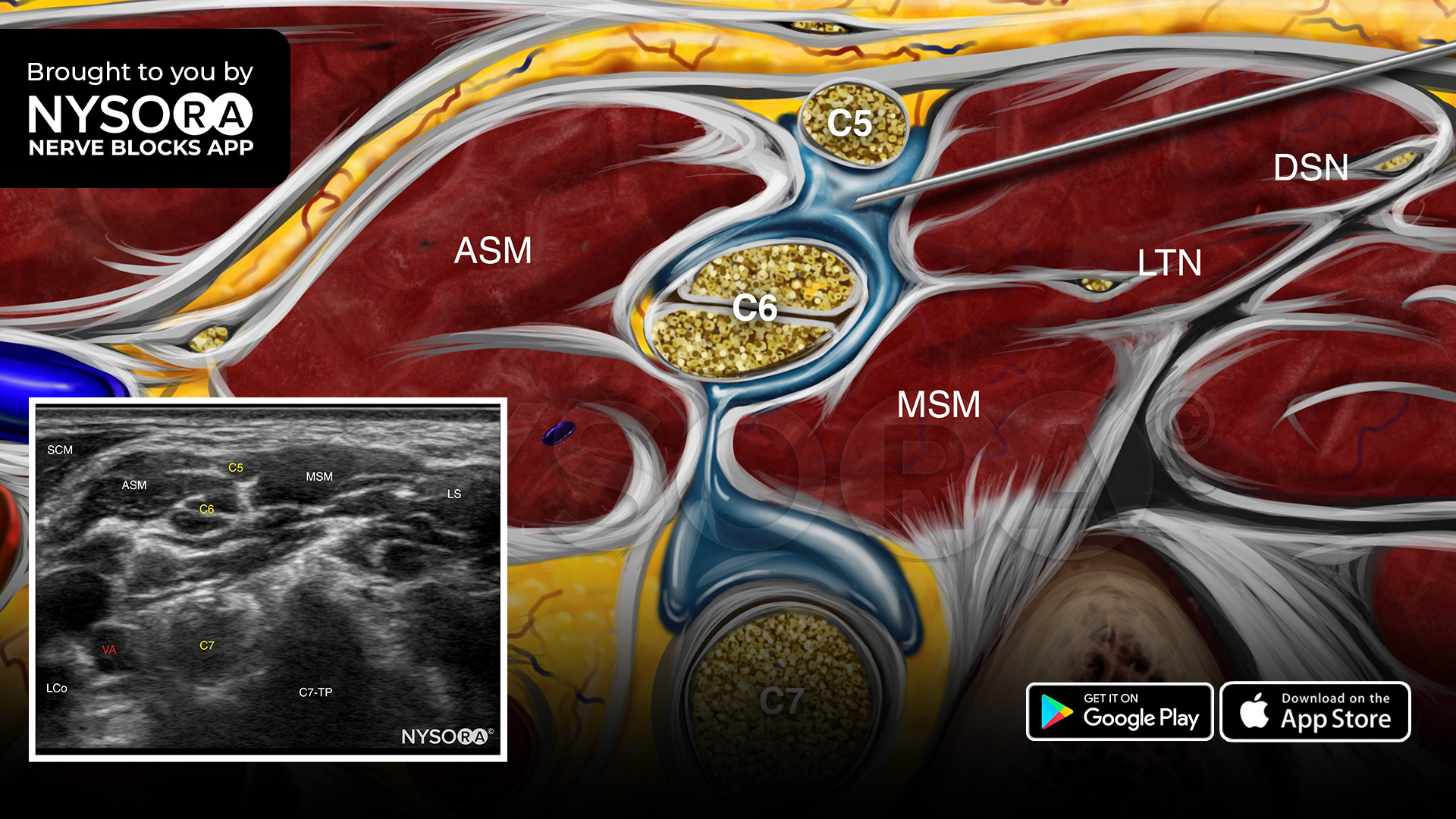
The cervical plexus is formed by the anterior divisions of the four upper cervical nerves. The plexus is situated on the anterior surface of the four upper cervical vertebrae, resting on the levator anguli scapulae and scalenus medius muscle, and is covered by the sternocleidomastoid muscle. Their dorsal and ventral roots combine to form spinal nerves as they exit through the intervertebral foramen. The anterior rami of C2 through C4 form the cervical plexus (the C1 root is a primarily motor nerve and it is not blocked by this technique). The cervical plexus lies in the plane just behind the sternocleidomastoid muscle, giving off both superficial (superficial cervical plexus) and deep branches (deep cervical plexus). The branches of the superficial cervical plexus supply innervation to the skin and superficial structures of the head, neck, and shoulder. The deep branches of the cervical plexus innervate the deeper structures of the neck, including the muscles of the anterior neck and the diaphragm (phrenic nerve). The third and fourth cervical nerves typically send a branch to the spinal accessory nerve, or directly into the deep surface of the trapezius to supply sensory fibers to this muscle.
The fourth cervical nerve may send a branch downward to join the fifth cervical nerve and participate in the formation of the brachial plexus.
The cutaneous innervation of both the deep and superficial cervical plexus blocks includes skin of the anterolateral neck and the ante- and retro-auricular areas.
The following surface anatomy landmarks are helpful for estimating the location of the transverse processes: mastoid process, transverse process of the sixth cervical vertebra (C6), and the posterior border of the sternocleidomastoid muscle.
TIP: The proportions of the shoulder girdle, size of the neck, prominence of the muscles, and other areas vary among patients. For that reason, always perform a "reality check" when in doubt and estimate the three bony landmarks: sternal notch, clavicle, and mastoid process.
Anatomic Landmarks
The following three landmarks for a deep cervical plexus block are identified and marked:
Mastoid process
Chassaignac's tubercle of C6
Posterior border of the sternocleidomastoid muscle
TIPS:
The anatomic landmarks for this block can be accentuated by asking the patient to:
Turn the head slightly away from the side to be blocked
Lift the head up (tenses the sternocleidomastoid muscles)
Reach the knee with the hand on the ipsilateral side
To estimate the line of needle insertion that overlies the transverse processes, the mastoid process (MP) and Chassaignac's tubercle of C6 transverse process are identified and marked. The transverse process of C6 is usually easily palpated behind the clavicular head of the sternocleidomastoid muscle at the level just below the cricoid cartilage.
Next, a line is drawn connecting the mastoid process (MP) to Chassaignac's tubercle of C6 transverse process. The palpating hand is best positioned just behind the posterior border of the sternoclediomastoid muscle.
Once this line is drawn, the insertion sites over the C2, C3, and C4 are labeled as follows: the C2, C3, and C4 are located on the MP-C6 line some 2-cm, 4-cm, and 6-cm caudal from the mastoid process, respectively.
After cleaning the skin with an antiseptic solution, local anesthetic is infiltrated subcutaneously alongside the line estimating the position of the transverse processes. The local anesthetic is best infiltrated over the entire length of the line, rather than at the projected insertion sites. This allows reinsertion of the needle slightly caudally or cranially when the transverse process is not contacted without the need to infiltrate the skin at a new insertion site.
Needle Insertion
A needle connected via flexible tubing to the syringe with local anesthetic is inserted between the palpating fingers and advanced at an angle perpendicular to the skin plane. The needle should never be oriented cephalad. A slight caudal orientation of the needle is the single best method to prevent the inadvertent insertion of the needle toward the cervical spinal cord. The needle is advanced slowly until the transverse process is contacted. At this point, the needle is withdrawn 1-2 mm, firmly stabilized, and 4 mL of local anesthetic is injected, after a negative aspiration test for blood. The needle is then removed and the entire procedure is repeated at the consecutive levels.
TIPS:
The transverse process is typically contacted at a depth of 1-2 cm in most patients. This distance can be further shortened by exerting pressure on the skin during needle advancement.
The needle should never be advanced beyond 2.5 cm to avoid the risk of cervical cord injury or carotid or vertebral artery puncture.
Paresthesia is often elicited in proximity to the transverse process but it should not be relied on because of its non-specific radiating pattern.
Contact with the posterior tubercle of the transverse process.
The spinal nerves at the individual levels are located just in front of the transverse process.
TIP: While some books recommend eliciting paresthesia, the nature of the paresthesia is non-specific and often difficult to discern from the local pain during needle advancement.
Failure to contact the transverse process on the first needle pass
When insertion of the needle does not result in contact with the transverse process within 2 cm, the following maneuvers are followed:
Keep the palpating hand in the same position and the skin between the fingers stretched while avoiding skin movement.
Withdraw the needle to the skin, redirect it 15o inferiorly, and repeat the procedure.
Withdraw the needle to the skin, reinsert the needle 1cm caudal, and repeat the above procedure.
TIPS:
When these maneuvers fail to result in contact with the transverse process, the needle should be withdrawn and the landmarks should be reassessed.
Redirecting the needle cephalad in an attempt to contact the transverse process should be avoided because it carries a risk of cervical cord injury when the needle is advanced too deep.
A deep cervical plexus block requires 3-5 mL of local anesthetic per level to ensure reliable blockade. Except perhaps with patients with significant respiratory disease (blockade of the phrenic nerve), most patients benefit from the use of a long-acting local anesthetic.
Onset (min)
Anesthesia (hrs)
Analgesia (hrs)
1.5% Mepivacaine (+HCO3; + epinephrene)
10-15
2-2.5
3-6
2% Lidocaine (+HCO3; + epinephrene)
10-15
2-3
3-6
0.5% Ropivacaine
10-20
3-4
4-10
0.25% Bupivacaine (+ epinephrene)
10-20
3-4
4-10
Although the placement of deep cervical block may be associated with moderate patient discomfort, excessive sedation should be avoided. During neck surgery the airway management may be difficult due to the shared access to the head and neck with the surgeon. Surgeries like carotid endarterectomy require that the patient be fully conscious, oriented and cooperative during the entire surgical procedure. In addition, excessive sedation and the consequent lack of patient cooperation can result in restlessness and create a difficulty for the surgeon. The onset time for this block is 10-15 minutes. The first sign of the blockade is the decreased sensation in the area of the distribution of the respective components of the cervical plexus. It should be noted that due to the complex arrangement of the neuronal coverage of the various layers in the neck area as well as the cross-coverage from the contralateral side, the anesthesia achieved with cervical plexus block is rarely complete. While this should not be discouraging from the use of cervical plexus block, its use does require an understanding surgeon who is willing to supplement the block with the local anesthetic as necessary.
TIP: Carotid surgery also requires blockade of the glossopharyngeal nerve branches. This is easily accomplished intraoperatively by injecting the local anesthetic inside the carotid artery sheath.
Avoid multiple needle insertions, particularly in anticoagulated patients
Keep a 5 minute steady pressure on the site when the carotid artery is inadvertenly punctured
Phrenic Nerve Blockade
Phrenic nerve blockade (diaphragmatic paresis) invariably occurs with a deep cervical plexus block
A deep cervical plexus block should be carefully considered in patients with significant respiratory disease
Bilateral deep cervical block in such patients may be considered contraindicated
Blockade of the phrenic nerve does not occur after superficial cervical plexus block
Local anesthetic toxicity
Central nervous system toxicity is the most serious consequence of the cervical plexus block. This complication occurs because of the rich vascularity of the neck, including vertebral and carotid artery vessels; it is usually caused by an inadvertent intravscular injection of local anesthetic rather then absorbtion
Careful and frequent aspiration should be performed during the injection
Nerve injury
Local anesthetic should never be injected against resistance or when the patient complains of severe pain on injection
Spinal anesthesia
This complication may occur with injection of a larger volume of local anesthetic inside the dural sleeve that accompanies the nerves of the cervical plexus
It should be noted that a negative aspiration test for CSF does not rule out the possibility of intrathecal spread of local anesthetic
Avoidance of high volume and pressure during injection are the best measures to avoid this complication
Aunac S, Carlier M, Singelyn F, De Kock M: The analgesic efficacy of bilateral combined superficial and deep cervical plexus block administered before thyroid surgery under general anesthesia. Anesth Analg 2002; 95:746-50.
Benzon HT, Raja SN, Borsook D, Molloy RE, Strichartz G: Essentials of Pain Medicine and Regional Anesthesia. Philadelphia, Churchill Livingston, 1999.
Brown DL: Atlas of Regional Anesthesia. Philadelphia, Saunders, 1992.
Carling A, Simmonds M. Complications from regional anaesthesia for carotid endarterectomy. Br J Anaesth 2000; 84:797-800.
Davies MJ, Silbert BS, Scott DA, Cook RJ, Mooney PH, Blyth C: Superficial and deep cervical plexus block for carotid artery surgery: A prospective study of 1000 blocks. Reg Anesth 1997; 22:442-6.
Emery G, Handley G, Davies MJ, Mooney PH: Incidence of phrenic nerve block and hypercapnia in patients undergoing carotid endarterectomy under cervical plexus block. Anaesth Intensive Care 1998; 26:377-81.
Johnson TR: Transient ischaemic attack during deep cervical plexus block. Br J Anaesth 1999; 83:965-7.
Kulkarni RS, Braverman LE, Patwardhan NA: Bilateral cervical plexus block for thyroidectomy and parathyroidectomy in healthy and high risk patients. J Endocrinol Invest 1996; 19:714-8.
Lo Gerfo P, Ditkoff BA, Chabot J, Feind C: Thyroid surgery using monitored anesthesia care: an alternative to general anesthesia. Thyroid 1994; 4:437-9.
Masters RD, Castresana EJ, Castresana MR: Superficial and deep cervical plexus block: Technical considerations. AANA J 1995; 63:235-43.
Murphy TM: Somatic Blockade of Head and Neck. In Cousins MJ, Bridenbaugh PO (eds): Neuronal Blockade in Clinical Anesthesia and Management of Pain. Philadelphia, J.B. Lippincott-Raven Publishers, 1988, pp 489-514.
Pandit JJ, Bree S, Dillon P, Elcock D, McLaren ID, Crider B: A comparison of superficial versus combined (superficial and deep) cervical plexus block for carotid endarterectomy: a prospective, randomized study. Anesth Analg 2000; 91:781-6.
Stoneham MD, Wakefield TW: Acute respiratory distress after deep cervical plexus block. J Cardiothorac Vasc Anesth 1998; 12:197-8.
Stoneham MD, Doyle AR, Knighton JD, Dorje P, Stanley JC: Prospective, randomized comparison of deep or superficial cervical plexus block for carotid endarterectomy surgery. Anesthesiology 1998; 89:907-12.