Sciatic Nerve Block: Posterior Approach
Overview
- Indications: Surgery on the knee, tibia, ankle, and foot
- Landmarks: Greater trochanter, superior posterior iliac spine, midline between the two
- Nerve Stimulation: Twitch of the hamstrings, calf, foot, or toes at 0.2-0.5mA current
- Local anesthetic: 20 mL
- Complexity level: Intermediate
|
|
General considerations
The posterior approach to sciatic blockade has wide clinical applicability for surgery and pain
management of the lower extremity. Consequently, sciatic block is one of the most commonly
used techniques in our practice. In contrast to common belief, this block is relatively easy to
perform. It is associated with a high success rate when properly performed. It is particularly
well-suited for surgery on the knee, calf, Achilles tendon, ankle, and foot. It provides complete
anesthesia of the leg below the knee with the exception of the medial strip of skin, which is
innervated by the saphenous nerve. When combined with a femoral nerve or lumbar plexus block,
anesthesia of almost entire leg is achieved.
Regional anesthesia anatomy
The sciatic nerve is formed from the L4 through S3 roots. These roots of the sacral plexus form on
the anterior surface of the lateral sacrum and are assembled into the sciatic nerve on the anterior
surface of the priformis muscle. The sciatic nerve is the largest nerve in the body and measures nearly
2 cm in breadth at its commencement. It exits thepelvis through the greater sciatic foramen, below the
piriformis; descends between the greater trochanter of the femur and the tuberosity of the ischium.
The nerve then runs along the back of the thigh to about its lower one-third, where it diverges
into two large branches, the tibial and common peroneal nerves. A course of the nerve can be estimated by
drawing a line on the back of the thigh beginning from the apex of the popliteal fossa to the midpoint
of the line joining the ischial tuberosity to the apex of the greater trochanter. The sciatic nerve also
gives off numerous articular (hip, knee) and muscular branches.
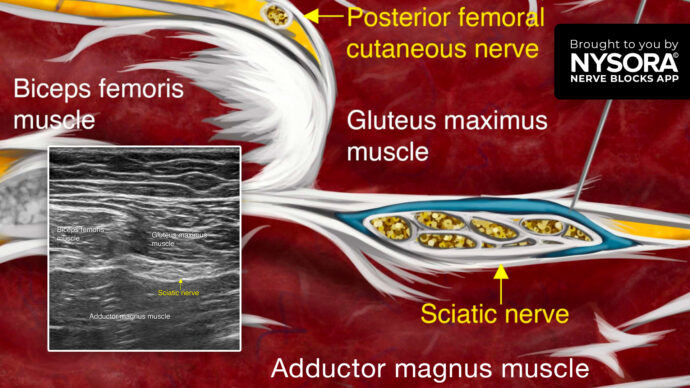
In the upper part of its course, the sciatic nerve is situated deep in the major gluteal muscle, and
rests first on the posterior surface of the ischium. The nerve crosses the external rotators, obturator
internus gemelli muscle, and then passes on to the quadratus femoris, by which it is separated from the
obturator externus and the hip joint. On its medial side, the sciatic nerve is accompanied by the posterior
cutaneous nerve of the thigh and the inferior gluteal artery. More distally, it lies on the adductor magnus.
It is crossed obliquely by the long head of the biceps femoris. The articular branches of the sciatic nerve
arise from the upper part of the nerve, and supply the hip joint by perforating the posterior part of its
capsule; they are sometimes derived directly from the sacral plexus. The muscular branches of the sciatic
nerve are distributed to the biceps femoris, semitrendinosus, semimembranosus, and to the ischial head of
the adductor magnus; the branches of the latter two arise by a common trunk. The nerve to the short head of
the biceps femoris comes from the common peroneal division, the other muscular branches from the tibial
division of the sciatic nerve.
TIPS:
-
There are variations in the course of the sciatic nerve through the gluteal region. In some
15% of people, the piriformis muscle divides the nerve. The common peroneal componen
passes through the muscle or above it, and only the tibial component passes below the muscle.
-
The components of the sciatic nerve diverge at a variable distance from the knee joint. By
and large, most nerves diverge at or above 7 cm above the popliteal fossa crease.
Distribution of anesthesia
|
Sciatic nerve blockade results in anesthesia of the skin of the posterior aspect of the thigh,
hamstrings and biceps muscles, part of hip and knee joint, and entire leg below the knee, with the
exception of the skin of the medial aspect of the lower leg. Depending on the level of surgery, the
addition of a saphenous or femoral nerve block may be required.
|
|
Patient positioning
The patient is in the lateral decubitus position with a slight forward tilt. The foot on the side
to be blocked should be positioned over the dependent leg so that twitches of the foot or toes
can be easily noted.
TIP: It should be noted that the skin over the gluteal area is highly movable. It is
crucially important that the patient remain in the same position in which the landmarks are
outlined. Small forward or backward tilts can result in a significant shift of the landmarks
due to the sagging of the skin and subcutaneous tissue, leading to difficulty in localizing the
sciatic nerve.
Equipment
A standard regional anesthesia tray is prepared with the following equipment:
- Sterile towels and 4"x4" gauze packs
- 20-mL syringes with local anesthetic
- Sterile gloves, marking pen, and surface electrode
- One 1½" 25-gauge needle for skin infiltration
- A 10-cm long, short bevel, insulated stimulating needle
- Peripheral nerve stimulator
|
|
Landmarks
Technique
Local anesthetic skin infiltration
After cleaning with an antiseptic solution, local anesthetic is infiltrated subcutaneously at the
determined needle insertion site. The anesthesiologist performing the block should assume an ergonomic
position to allow precise needle maneuvering and monitoring and observe the responses to nerve stimulation.
TIP: The height of the bed should be raised to allow a comfortable and stable position for the
patient during block placement and for observation of the muscle twitches obtained during nerve stimulation.
|
Needle insertion
The fingers of the palpating hand should be firmly pressed on the gluteus muscle to decrease the skin-nerve
distance. Also, the skin between the index and middle finger is stretched to allow for greater precision
during block placement. The palpating hand should not be moved during the entire block placement procedure.
Even small movements of palpating hand can substantially change the position of the needle insertion site
because of the highly movable skin and soft tissues in the gluteal region. The needle is introduced at a
perpendicular angle to the spherical skin plane. The nerve stimulator should be initially set to deliver
1.5 mA current (2 Hz, 100µsec) to allow detection of twitches of the gluteal muscles and stimulation
of the sciatic nerve.
|
Needle advancement
As the needle is advanced, twitches of the gluteal muscles are observed first. These twitches merely indicate
that the needle position is still too shallow. Once the gluteal twitches disappear, brisk response of the
sciatic nerve to stimulation is observed (hamstrings, calf, foot, or toe twitches). After the initial stimulation
of the sciatic nerve is obtained, the stimulating current is gradually decreased until twitches are still seen
or felt at 0.2 - 0.5 mA. This typically occurs at a depth of 5-8 cm. After negative aspiration for blood,
15-20 mL of local anesthetic is slowly injected. Any resistance to the injection of local anesthetic should prompt
needle withdrawal by 1mm. The injection is then reattempted. Persistent resistance to injections should prompt
complete needle withdrawal and flushing to assure its patency before the needle is reintroduced.
TIPS
When the first needle pass does not result in nerve localization, it should not be regarded as a
failure. Instead, a systemic approach to troubleshooting should be employed. Most importantly,
the palpating hand should never be moved from its position. The same amount of pressure should be
maintained over the gluteus muscle. Then, the algorithm below is followed:
-
Assure that the nerve stimulator is functional, properly connected to the patient and to the
needle, and that it is set to deliver the desired intensity of current.
-
Assure that the pelvis is slightly tilted forward. A tilt backward can make identification of
the sciatic nerve much more difficult because of the change of the plane.
-
Mentally visualize the plane of the initial needle insertion and redirect the needle in a slightly
medial direction (15o-20o) to the initial insertion plane.
-
If the maneuver above fails, withdraw the needle to the skin and redirect it slightly laterally
(15o-20o) to the initial insertion plane.
-
Failure to obtain foot response to nerve stimulation should prompt a reassessment of the landmarks
and patient position.
|
Goal
Visible or palpable twitches of the hamstrings, calf muscles, foot, or toes at 0.2-0.5 mA
current. Twitches of the hamstrings are equally acceptable because this approach blocks
the nerve proximal to the separation of the neuronal branches to the hamstrings muscle.
TIPS:
-
Stimulation at a current intensity of less than 0.5 mA may not be possible in some patients.
This is occasionally (but not frequently) the case in elderly patients and patients with
long-standing diabetes mellitus, peripheral neuropathy, sepsis, or severe peripheral vascular
disease. In these cases, stimulating currents up to 1.0 mA should be accepted as long as the motor
response is specifically and clearly seen or felt.
-
Muscles of the thigh that are supplied by the sciatic nerve. Since the level of the blockade
with this approach is above the departure of these branches, twitch of any of the hamstrings
muscles can be accepted as a reliable sign of localization of the sciatic nerve.
Interpreting Responses to Nerve Stimulation
| Response Obtained |
Interpretation |
Problem |
Action |
| Local twitch of the gluteus muscle |
Direct stimulation of the gluteus muscle |
Too shallow (superficial) placement of the needle |
Continue advancing the needle |
| Needle contacts bone but local twitch of the gluteus muscle is not elicited |
The needle is inserted close to the attachment of the gluteus muscle to the iliac bone |
Too superior needle insertion |
Stop the procedure, check the patient's position, and reassess the landmarks |
| Needle encounters bone; sciatic twitches were elicited |
The needle missed the plane of the sciatic nerve and is stopped by the hip joint or ischial bone |
The needle is inserted to laterally (hip joint) or medially (ischial bone) |
Withdraw the needle and redirect slightly medially or laterally (5-10o) |
| Hamstrings twitch |
Stimulation of the main trunk of the sciatic nerve |
None. These branches are within the sciatic nerve sheath at this level |
Accept and inject local anesthetic |
| The needle is placed deep (10cm) but twitches were not elicited and bone is not contacted |
The needle has passed through the sciatic notch |
Too inferior needle placement |
Withdraw and redirect the needle slightly medially, laterally, or superiorly |
Choice of local anesthetic
A sciatic block requires a relatively low volume of local anesthetic to achieve anesthesia of the entire trunk of the nerve. The choice of the type and concentration of local anesthetic should be based on whether the block is planned for surgical anesthesia or pain management. Since the duration of sciatic blockade lasts longer than any other peripheral nerve block, we tend to use shorter acting local anesthetic more commonly. However, when prolonged pain relief is sought, longer acting local anesthetic may be more appropriate. We rarely use epinephrine for sciatic nerve block because of the possibility of injury due to stretching or sitting on the anesthetized nerve with the long duration of block with epinephrine-containing local anesthetics.
|
Onset (min) |
Anesthesia (hrs) |
Analgesia (hrs) |
| 3% 2-Chloroprocaine (+ HCO3) |
10-15 |
2 |
2.5 |
| 1.5% Mepivacaine (+ HCO3) |
10-15 |
4-5 |
5-8 |
| 2% Lidocaine (+ HCO3) |
15-20 |
5-6 |
5-8 |
| 0.5% Ropivacaine |
10-20 |
6-12 |
6-24 |
| 0.75% Ropivacaine |
10-15 |
8-12 |
8-24 |
| 0.5 Bupivacaine (or l-bupivacaine) |
15-30 |
8-16 |
10-48 |
TIP: Avoid the use of epinephrine during sciatic nerve blockade because of the peculiar blood supply
to the sciatic nerve, the possibility of additional ischemia due to stretching or sitting on the anesthetized
nerve, and the long duration.
Block Dynamics and Perioperative Management
This technique is associated with moderate patient discomfort, because the needle passage through the gluteus muscles. Adequate sedation and analgesia are very important to assure that the patient is still and tranquil. We typically use midazolam 2-4 mg after the patient is positioned and alfentantyl 500-750µg just before needle insertion. A typical onset time for this block is 10-25 minutes, depending on the type, concentration, and volume of local anesthetic used. The first signs of blockade onset of blockade are usually reported by the patient in the form of a feeling that the foot is "different" or and inability to wiggle the toes.
TIP: Inadequate skin anesthesia despite an apparent timely onset of the blockade can occur. It
can take up to 30 minutes for full sensory-motor anesthesia to develop. Local infiltration at the site of
the incision by the surgeon is often all that is needed to allow the surgery to proceed.
Complications and How to Avoid Them
| Infection |
- A strict aseptic technique is used |
| Hematoma |
- Avoid multiple needle insertions, particularly in anticoagulated patients |
| Vascular puncture |
- Vascular puncture is not common with this technique, however deep needle insertions should be avoided (pelvic vessels) |
| Local anesthetic toxicity |
- Systemic toxicity after sciatic blockade is not common; it is important to avoid using large volumes and doses of local anesthetic because of the proximity of the muscle beds and the potential for rapid absorbtion |
| Nerve injury |
- A sciatic block has a unique predisposition for mechanical and pressure injury; nerve stimulation and slow needle advancement should be employed; local anesthetic should never be injected when the patient complains of pain or abnormally high pressure on injection is noted; when stimulation is obtained with current intensity of <0.2mA, the needle should be pulled back to obtain the same response with the current intensity of >0.2mA before injecting local anesthetic
- Advance the needle slowly when twitches of the gluteus muscle cease to avoid impaling the sciatic nerve on the rapidly advancing needle |
| Other |
Instruct the patient and nursing staff on the care of the insensate extremity; explain the need for frequent body repositioning to avoid streching and prolonged ischemia (sitting) on the anesthetized sciatic nerve |
Bibliography
- Bailey SL, Parkinson SK, Little WL, Simmerman SR: Sciatic nerve block: A comparison of single versus double injection technique. Reg Anesth 1994; 19:9-13
- Bridenbaugh PO, Wedel DJ: The Lower Extremity. Somatic Blockade . In Cousins, M.J., and Bridenbaugh PO (eds): Neuronal Blockade in Clinical Anesthesia and Management of Pain, 3rd edition. Philadelphia, Lippincott - Raven Publishers, 1998, pp 375-94
- Dalens B, Tanguy A, Vanneuville G: Sciatic nerve blocks in children: comparison of the posterior, anterior, and lateral approaches in 180 pediatric patients. Anesth Analg 1990; 70:131-7
- Farny J, Girard M, Drolet P : Posterior approach to the lumbar plexus combined with a sciatic nerve block using lidocaine. Can J Anaesth 1994; 41:486-91
- Hadzic A, Vloka JD, Kuroda MM, Koorn R, Birnbach DJ: The practice of peripheral nerve blocks in the United States: a national survey. Reg Anesth Pain Med 1998; 23:241-6
- Kilpatrick AW, Coventry DM, Todd JG: A comparison of two approaches to sciatic nerve block Anaesthesia 1992; 47:155-7
- Mansour NY, Bennetts FE: An observational study of combined continous lumbar plexus and single-shot sciatic nerve blocks for post-knee surgery analgesia. Reg Anesth 1996; 21:287-291
- Smith BE, Siggins D: Low volume high concentration block of the sciatic nerve. Anesthesia 1988; 43:8-11
GO TO TOP
|