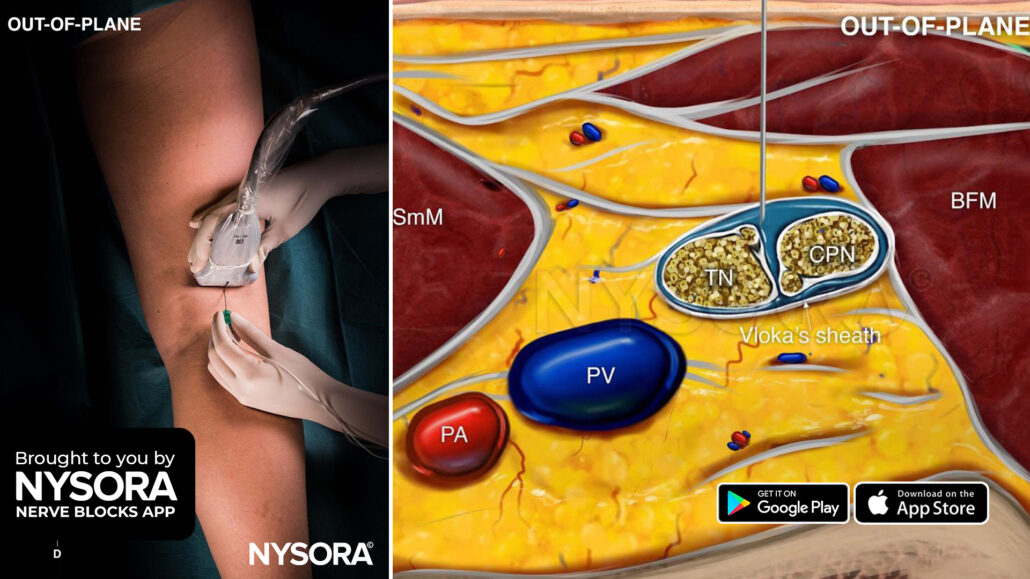
Popliteal Block: Intertendinous Approach

Overview
  • Indications: Ankle and foot surgery
  • Landmarks: Popliteal fossa crease, tendons of the semitendinosus and semimembranosus muscles
  • Nerve stimulation: Twitch of the foot or toes at 0.2-0.5mA current
  • Local anesthetic: 35-45 mL
  • Complexity level: Intermediate
General considerations
Image

The popliteal block is a block of the sciatic nerve at the level of the popliteal fossa. The popliteal block is one of the most commonly used regional anesthesia techniques in our practice. Some common indications include corrective foot surgery, foot debridement, and Achilles tendon repair. Sound knowledge of the principles of nerve stimulation and anatomic characteristics of the sciatic nerve in the popliteal fossa are essential for its successful implementation.

Regional anesthesia anatomy
Image

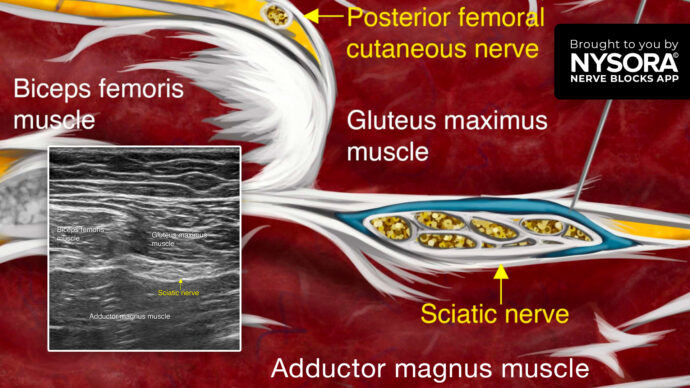
The sciatic nerve is a nerve bundle consisting of two separate nerve trunks, the tibial and common peroneal nerves. A common epineural sheath envelops these two nerves at their outset in pelvis. As the sciatic nerve descends toward the knee, the two components eventually diverge in the popliteal fossa, giving rise to tibial and common peroneal nerves. This division of the sciatic nerve occurs usually between 50 and 120 mm proximal to the popliteal fossa crease. From its divergence from the sciatic nerve, the common peroneal nerve continues its path downward and descends along the head and neck of the fibula. Its major branches in this region are branches to the knee joint and cutaneous branches that form the sural nerve. Its terminal branches are superficial and deep peroneal nerves. The tibial nerve is the larger of the two divisions of the sciatic nerve. The tibial nerve continues its path vertically through the popliteal fossa. Its terminal branches are the medial and lateral plantar nerves. Its collateral branches give rise to the cutaneous sural nerves, muscular branches to the muscles to the calf, and articular branches to the ankle joint. It is important to note that in contrast to the common assumption, the sciatic nerve in the popliteal fossa is lateral and superficial to the popliteal artery and vein and it is not enveloped by the same tissue sheath (neurovascular sheath). This anatomic characteristic is important to understand why systemic toxicity and vascular punctures are so rare after popliteal blockade.

Distribution of anesthesia
Image

Popliteal blockade results in anesthesia of the entire distal two thirds of the lower extremity, with the exception of the medial aspect of the leg. Cutaneous innervation of the medial leg below the knee is provided by the saphenous nerve, a superficial terminal extension of the femoral nerve. Depending on the level of surgery, the addition of a saphenous nerve block may be required for surgery. Popliteal block alone is typically sufficient as anesthesia for the tourniquet pain, because this pain is the result of the pressure and ischemia of the deep muscle beds.

Patient positioning
The patient is in the prone position. The foot on the side to be blocked should be positioned so that even the slightest movements of the foot or toes can be easily observed. This is best achieved by allowing the foot to protrude off the operating room bed. Image
Equipment
A standard regional anesthesia tray is prepared with the following equipment:
  • Sterile towels and 4"x4" gauze packs
  • Three 20-mL syringes with local anesthetic
  • Sterile gloves, marking pen, and surface electrode
  • One 1½" 25-gauge needle for skin infiltration
  • A 5-cm long, short bevel, insulated stimulating needle
  • Peripheral nerve stimulator
Image
Landmarks

Surface Landmarks

The following surface anatomy landmarks are used to deter-mine the insertion point for the needle.
  1. Popliteal fossa crease
  2. Tendon of biceps femoris (laterally)
  3. Tendons of semitendinosus and semimembranosus muscles (medially)
Image

Anatomic Landmarks

Landmarks for the intertendious approach to popliteal block are easily recognizable even in obese patients. All three landmarks should be outlined by a marking pen:
  1. Popliteal fossa crease
  2. Tendon of biceps femoris (laterally)
  3. Tendons of semitendinosus and semimembranosus (medially)
Image
TIPS:
  • Relying on tendons rather than on subjective interpretation of the popliteal fossa triangle gives a much more precise and consistent localization of the popliteal nerve.
  • tendons of semitendinosus and semimembranosus muscles are palpated using a two-finger technique. A corresponding anatomic image accentuates the structures palpated.
Image

The needle insertion point is marked at 7 above the popliteal fossa crease at the midpoint between the tendons.

TIPS:

  • It should be noted that these landmarks differ from those in the "popliteal fossa triangle" approach in that they are based on easily palpable anatomic structures, rather than on the imaginary lines of the "triangle".
  • Relying on the tendons of the biceps femoris and semitendinosus as landmarks makes this approach easily applicable, even in the obese patients.
  • In obese patients, it is easier to start tracing the tendons from their attachment at the knee cephalad.
Image

Maneuvers to accentuate the landmarks

When not immediately apparent visually, these landmarks can be accentuated by asking the patient to flex the leg in the knee joint. This maneuver tightens the hamstring muscles and allows an easy and accurate palpation of the tendons.

Image
Technique
Image

After a thorough cleaning with an antiseptic solution, local anesthetic is infiltrated subcutaneously. The anesthesiologist is standing on the side of the patient with the palpating hand on the biceps femoris muscle. The needle is introduced at the midpoint between the tendons. This position allows the anesthesiologist both to observe the responses to nerve stimulation and to monitor the patient. The nerve stimulator should be initially set to deliver 1.5 mA current (2 Hz, 100µsec) because this higher current allows detection of the inadvertent needle placement into the hamstrings muscles and stimulation of the sciatic nerve through the epineural sheath as the needle is approaching its target. When the needle is inserted in a correct plane, advancement of the needle should not result in any local muscular twitches; the first response to nerve stimulation is typically that of the sciatic nerve (foot twitch).

Image TIPS:
  • Keeping fingers of the palpating hand on the biceps muscle is important for early detection of twitches of the biceps or semitendinosus muscles underneath the fingers.
  • These local twitches are the result of direct muscle stimulation when the needle is placed too laterally or medially, respectively:
    • When local stimulation of the biceps muscle is felt under the fingers of the palpating hand, the needle should be redirected medially.
    • Local twitches of the semitendinosus muscle indicates a too medial needle insertion. The needle should be withdrawn to the skin level and reinserted laterally.

Failure to obtain sciatic nerve stimulation on the first needle pass

When insertion of the needle does not result in stimulation of the sciatic nerve (foot twitches), implement the following maneuvers:

  1. Keep the palpating hand in the same position (left figure).
  2. Withdraw the needle to the skin level, redirect 15o lateral, and reinsert (middle figure).
  3. When the maneuver #2 fails to result in sciatic nerve stimulation, withdraw the needle to the skin level, reinsert 1 cm lateral, and repeat the procedure (right figure).

These maneuvers should invariably result in localization of the sciatic nerve.

Image Image Image
Goal
Image

Visible or palpable twitches of the foot or toes at 0.2-0.5 mA current. There are two common types of twitches. Common peroneal nerve stimulation results in dorsiflexion and eversion. Stimulation of the tibial nerve results in: plantar flexion and inversion.

TIPS:

  • In some patients with longstanding diabetes mellitus, renal failure, or peripheral neuropathy, it is difficult to obtain stimulation with currents less than 0.7 mA. In these cases, stimulation of the tibial nerve (plantar flexion) proves to be more reliable.
  • Some authors recommend a double-stimulation/injection technique to increase the success rate of blockade of both divisions of the nerve. Succinctly, this involves, stimulating and injection of both divisions of the sciatic nerve (tibial and common peroneal). This can be important with techniques involving needle insertion at the level of the patella, it is not necessary with the approach described here.
  • Upon obtaining a response of either division of the sciatic nerve, injection of a large volume of local anesthetic will spread within the sheath to block both divisions of the nerve.
  • Isolated twitches of the calf muscles should not be accepted because they may be the result of stimulation of the sciatic nerve branches to the calf muscles outside the sciatic nerve sheath.
Choice of local anesthetic

Popliteal blockade requires a larger volume of local anesthetic (35-45 mL) to achieve anesthesia of both divisions of the nerve. The choice of the type, volume, and concentration of local anesthetic should be based on the patient's weight and general condition and whether the block is planned for surgical anesthesia or pain management.

The type and concentration of local anesthetics and the choice of additives to local anesthetic influence the onset and, particularly, the duration of the blockade.

Onset
(min)
Anesthesia (hrs) Analgesia (hrs)
3% 2-Chloroprocaine (+ HCO3) 10-15 1 2
3% 2-Chloroprocaine (+HCO3 + epinephrine) 10-15 1.5-2 2-3
1.5% Mepivacaine (+ HCO3) 15-20 2-3 3-5
1.5% Mepivacaine (+ HCO3 + epinephrine) 15-20 2-2 3-8
2% Lidocaine (+ HCO3 + epinephrine) 10-20 2-5 3-8
0.5% Ropivacaine 15-30 4-8 5-12
0.75% Ropivacaine 10-15 5-10 6-24
0.5 Bupivacaine (or l-bupivacaine) 15-30 5-15 6-30
Block Dynamics and Perioperative Management

This technique is associated with minimal patient discomfort, because the needle passes only through the fat of the popliteal fossa. Although adequate sedation and analgesia are always important to ensure a still and tranquil patient, midazolam 1-2 mg after the patient is posi-tioned and alfentantyl 250-500µg just before block performance suffices for most patients. A typical onset time for this block is 10-25 minutes, depending on the type, concentration, and volume of local anesthetic used. The first signs of the onset of blockade are usually reported by the patient. The foot "feels different" or an inability to wiggle toes is reported. Sensory anesthesia of the skin with this block is often the last to develop. Inadequate skin anesthesia despite the apparent timely onset of the blockade is common. It may take up to 30 minutes to develop. Thus, local infiltration at the site of the incision by the surgeon is often all that is needed to allow the surgery to proceed.

Complications and How to Avoid Them
Infection - Use a strict aseptic technique
Local anesthetic toxicity - Systemic toxicity after popliteal block is rare
- Absorption of the local anesthetic form the popliteal fossa is very slow due to the low vascularity of the adipose tissue in the fossa
Hematoma - Avoid advancement of the needle when the patient reports pain; this may indicate that the needle is inserted through the hamstrings muscles
- Increasing the current output of the nerve stimulator helps distinguish between the two
Vascular puncture - Avoid medial redirection of the needle, because the vascular sheath is positioned medially and deeper as compared to the sciatic nerve
Nerve injury - Exceedingly rare; use nerve stimulation and slow needle advancement; do not inject when the patient complains of pain or high pressures on injection are met; do not inject when stimulation is obtained at < 0.2 mA current (100µsec)
- Avoid a combination of epinephrine in local anesthetic and application of tourniquet over the injection site to decrease the risk of prolonged ischemia of the nerve
Other - Instruct the patient on the care of the insensate extremity
Bibliography
  • Benzon HT, Kim C, Benzon HP, et al: Correlation between evoked motor response of the sciatic nerve and sensory blockade. Anesthesiology 1997; 87:548-52
  • Gouverneur JM: Sciatic nerve block in the popliteal fossa with atraumatic needles and nerve stimulation. Acta Anaesthesiol Belg 1985; 36:391-9
  • Hadzic A, Vloka JD: A comparison of the posterior versus lateral approaches to the block of the sciatic nerve in the popliteal fossa. Anesthesiology 1998; 88:1480-6
  • Hadzic A, Vloka JD, Singson R, Santos AC, Thys DM: A comparison of intertendinous and classical approaches to popliteal nerve block using magnetic resonance imaging simulation. Anesth Analg 2002; 94:1321-4
  • Kilpatrick AW, Coventry DM, Todd JG: A comparison of two approaches to sciatic nerve block. Anaesthesia 1992; 47:155-7
  • Rorie DK, Byer DE, Nelson DO, et al: Assessment of block of the sciatic nerve in the popliteal fossa. Anesth Analg 1980; 59:371-6
  • Sunderland S: The sciatic nerve and its tibial and common peroneal divisions. Anatomical features. Nerves and Nerve Injuries. Edinburgh and London, E. & S. Livingstone LTD, 1968, pp 1012-95
  • Vloka JD, Hadzic A, Koorn R, Thys D: Supine approach to the sciatic nerve in the popliteal fossa. Can J Anaesth 1996; 43:964-7
  • Vloka JD, Hadzic A, Mulcare R, Lesser JB, Koorn R, Thys DM: Combined blocks of the sciatic nerve at the popliteal fossa and posterior cutaneous nerve of the thigh for short saphenous vein stripping in outpatients: An alternative to spinal anesthesia. J Clin Anesth 1997; 9:618-22
  • Vloka JD, Hadzic A, Lesser JB, Kitain E, Geatz H, April EW, Thys DM: A Common Epineural Sheath for the Nerves in the Popliteal Fossa and Its Possible Implications for Sciatic Nerve Block. Anesth Analg 1997; 84:387-90
  • Vloka JD, Hadzic A, April EW, Geatz H, Thys DM: Division of the sciatic nerve in the popliteal fossa and its possible implications in the popliteal nerve blockade. Anesth Analg 2001; 92:215-7

GO TO TOP


Site map

Acknowledgments


Valid XHTML 1.0!


COPYRIGHT © 1996, 2006 NYSORA.COM
No part of this web page may be reproduced without the permission of the authors.

DISCLAIMER: The material presented on this Web page has not been peer-reviewed. The indications, techniques and dosages on this Web page have been recommended in the medical literature and/or conform to OUR clinical practice. The medications and equipment have not necessarily been approved by the Food and Drug Administration (FDA) for use in the techniques and dosages for which they are recommended. The package insert for each drug and/or equipment should be consulted for use and dosage as recommended by the FDA. Because standards, practices and recommendations change, it is advisable to keep abreast of revised recommendations, particularly those concerning new drugs and techniques. While the techniques and dosages described are successfully used in our practice, they should be followed with a discretion since their complications may be dependent on the operator, patient and/or other accompanying clinical circumstances. The development and maintenance of this web page has not been supported by any pharmaceutical or medical manufacturing industry. The medications and/or equipment discussed in the web page is shown solely for teaching purposes. Similar equipment or medications from other manufacturers may produce similar clinical results to ours.