An ankle block is essentially a block of four branches of the sciatic nerve (deep and superficial peroneal, tibial and sural nerves) and one cutaneous branch of the femoral nerve (saphenous nerve).
Three superficial nerves: superficial peroneal, sural, saphenous
Never use an epinephrine-containing local anesthetic
Local anesthetic: 6 mL per nerve
Complexity level: Basic
General considerations
An ankle block is essentially a block of four branches of the sciatic nerve (deep and superficial peroneal, tibial and sural nerves) and one cutaneous branch of the femoral nerve (saphe-nous nerve). An ankle block is a basic, peripheral nerve block technique. It is simple to perform, essentially devoid of systemic complications, and highly effective for a wide variety of procedures on the foot and toes. As such, this technique should be in the armamentarium of every anesthesiologist. In our institution, an ankle block is most commonly used in podiatry surgery and foot and toe debridement or amputation.
Regional anesthesia anatomy
With exception of the saphenous nerve (sensory branch of the femoral nerve), an ankle block is essentially a block of the terminal branches of the sciatic nerve. It is useful to think of the ankle block as the block of two deep nerves (posterior tibial and deep peroneal nerves) and three superficial nerves (saphenous, sural and superficial peroneal). This concept is crucial for the success of the block, because the two deep nerves are anesthetized by injecting local anesthetic underneath the superficial fascia, whereas the three superficial nerves are anesthetized by a simple subcutaneous injection of local anesthetic.
Common peroneal nerve
The common peroneal (lateral popliteal) nerve separates from the tibial nerve (L4-5 and S1-2) and descends along the tendon of the biceps femoris muscle and around the neck of the fibula. Just below the head of the fibula, the common peroneal nerve divides into its terminal branches: the deep peroneal and superficial peroneal nerves. The peroneus longus muscle covers both nerves.
Deep peroneal nerve
The deep peroneal nerve runs downward below the layers of the peroneus longus, extensor digitorum longus, and extensor hallucis longus muscles to the front of the leg. (Figure 2) At the ankle level, the nerve lies anterior to the tibia and the interoseeous membrane and close to the anterior tibial artery. It is usually "sandwiched" between the tendons of the anterior tibial and extensor digitorum longus muscles. At this point, the nerve divides into two terminal branches for the foot: the medial and the lateral branches. The medial branch passes over the dorsum of the foot, along the medial side of the dorsalis pedis artery, to the first interosseous space, where it divides into two dorsal digital branches for the nerve supply to the first web space between the big toe and the second toe. The lateral branch of the deep peroneal nerve is directed anterolaterally, penetrates and innervates the extensor digitorum brevis muscle, and terminates as the second, third, and fourth dorsal interosseous nerves. These branches provide the nerve supply to the tarsometatarsal, metatarsophalangeal, and interphalageal joints of the lesser toes.
Superficial peroneal nerve
The superficial peroneal nerve (also called the musculocutanous nerve of the leg) is a branch of the common peroneal nerve. The superficial peroneal nerve gives muscular branches to the peroneus longus and brevis muscles. After piercing the deep fascia covering the muscles, the nerve eventually emerges from the anterolateral compartment of the lower part of the leg and surfaces from beneath the fascia 5-10 cm above the lateral malleolus. At this point, the nerve divides into terminal cutaneous branches: the medial and lateral dorsal cutaneous nerves. These branches carry sensory innervation to the dorsum of the foot and communicate with the saphenous nerve medially, with deep peroneal nerve in the first web space and sural nerve on the lateral aspect of the foot.
Tibial nerve
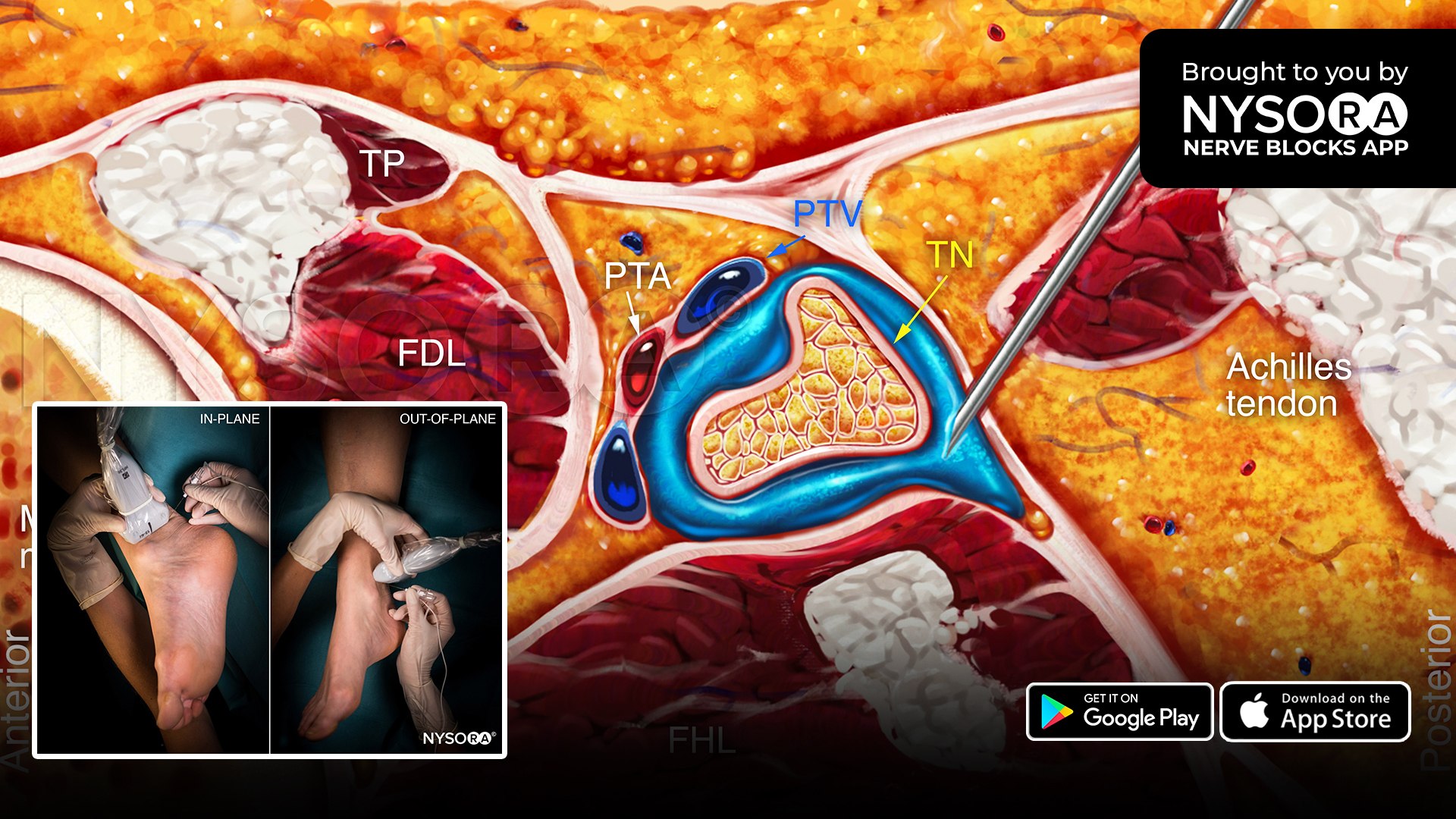
The tibial nerve (medial popliteal or posterior tibial nerve) separates from the common popliteal nerve at various distances from the popliteal fossa crease and joins the tibial artery behind the knee joint. The nerve runs distally in the thick neurovascular fascia and emerges at the inferior third of the leg, from beneath the soleus and gastrocnemius muscles on the medial border of the Achilles tendon. At the level of the medial malleolus, the tibial nerve is covered by the superficial and deep fasciae of the leg. It is positioned laterally and posteriorly to the posterior tibial artery, and midway between the posterior aspect of the medial malleolus and posterior aspect of the Achilles tendon. Just beneath the malleolus, the nerve divides into lateral and medial plantar nerves. The posterior tibial nerve provides cutaneous, articular, and vascular branches to the ankle joint, medial malleolus, inner aspect of the heel, and Achilles tendon. It also carries the branches to the skin, subcutanous tissue, muscles, and bones of the sole.
Sural nerve
The sural nerve is a sensory nerve formed by the union of the medial sural nerve - a branch of the tibial nerve - and lateral sural nerve, a branch of the common peroneal nerve. The sural nerve courses between the heads of the gastrocnemius muscle and after piercing the fascia covering the muscles, emerges on the lateral aspect of the Achilles tendon, 10 to 15 cm above the lateral mallelus. After giving lateral calcaneal branches to the heel, the sural nerve descends 1-1.5 cm behind the lateral malleolus, anterolateral to the short saphenous vein and on the surface of the fascia covering the muscles and tendons. At this level, the nerve supplies the lateral malleolus, Achilles tendon, and the ankle joint. The sural nerve continues on the lateral aspect of the foot supplying innervation to the skin, subcutaneous tissue, fourth interosseous space, and sensory innervation of the fifth toe.
Saphenous nerve
The saphenous nerve is a terminal cutaneous branch (branches) of the femoral nerve. Its course is in the subcutaneous tissue of the skin on medial aspect of the ankle and foot.
TIP: All superficial (cutaneous) nerves of the foot should be thought of as a neuronal network, rather than single strings of nerves with a well-defined and consistent anatomic position.
Distribution of anesthesia
An ankle block results in anesthesia of the foot. The proximal extension of the blockade is to the level at which the blocks are performed. However, it should be noted that an ankle block does not result in anesthesia of the ankle itself. The more proximal branches of the tibial and peroneal nerves provide innervation to the deep structures of the ankle joint (see "Anatomy"). Cutaneous innervation of the foot is provided by three superficial nerves (saphenous, sural, superficial peroneal). The two deep nerves (tibial, deep peroneal) confer anesthesia to the deep structures, bones, and cutaneous coverage of the sole and web between the first and second toes.
Patient positioning
The patient is in the supine position with the foot resting on a foot stand.
TIPS
Position the foot on a footrest so that an access to all nerves to be blocked is maintained.
Walk from one side of the foot to the other while performing the block procedure instead of bending and leaning to reach the opposite side.
Equipment
A standard regional anesthesia tray is prepared with the following equipment:
Sterile towels and 4"x4" gauze packs
Three 10-mL syringes with local anesthetic
Sterile gloves, marking pen, and surface electrode
One 1½" 25-gauge needle
Landmarks
The deep peroneal nerve is located immediately lateral to the tendon of the extensor hallucis longus muscle (between extensor hallucis longus and extensor digitorum longus). The pulse of the anterior tibial artery (dorsalis pedis) can be felt at this location; the nerve is immediately lateral to the artery.
TIP: This landmark is easily palpated and can be accentuated by asking the patient to dorsiflex the foot or toes.
The posterior tibial nerve is located just behind and distal to the medial malleolus. The pulse of the posterior tibial artery can be felt at this location; the nerve is just posterior to the artery.
The superficial peroneal, sural, and saphenous nerves are located in the subcutaneous tissue alongside a circular line that stretches from the lateral aspect of the Achilles tendon across the lateral malleolus, anterior aspect of the foot, and medial malleolus to the medial aspect of the Achilles tendon.
TIP: These nerves branch out and anastomose extensively and do not have a single, consistently positioned nerve trunk that can be anesthetized by a single, precise injection, as is often depicted in various regional anesthesiology books.
Technique
The anesthesiologist needs to change his or her position from lateral to the medial side of the foot to accomplish blockade of all five nerves. A controlled or regular syringe can be used. It makes sense to begin this procedure with blocks of the two deep nerves because subcutaneous injections for the superficial blocks will inevitably deform the anatomy. Before beginning the procedure, the entire foot should be cleansed with a disinfectant.
Deep peroneal block
The finger of the palpating hand is positioned in the groove just lateral to the extensor hallucis longus. The needle is inserted under the skin and advanced until stopped by the bone. At this point, the needle is withdrawn back 1-2 mm and 2-3 mL of local anesthetic is injected.
TIPS
Deep peroneal block is a "blind" injection of local anesthetic. Instead of relying on a single injection, a "fan" technique is recommended to increase the success rate. The needle is withdrawn back to the skin, redirected 30o laterally, and advanced again to contact the bone. After puling back 1-2 mm off the bone, an additional 2 mL of local anesthetic is injected. A similar procedure is repeated with a medial redirection of the needle.
Mentally visualize the plane of the needle insertion for the deep peroneal and posterior tibial nerves. Do not move the palpating finger during the injection to ensure proper needle reinsertions (30o lateral/medial).
Posterior Tibial Block
Posterior tibial nerve is anesthetized by injecting local anesthetic just behind the medial malleolus. Similar to the deep peroneal nerve, its position is deep to the superficial fascia. With the anesthesiologist facing the medial aspect of the foot, the needle is introduced in the groove behind the medial malleolus and advanced until contact with the bone is felt. At this point, the needle is withdrawn back 1-2 mm and 2-3 mL of local anesthetic is injected.
TIP
Similar to the technique used for deep peroneal nerve, a "fan" technique should be used to increase the success rate. The needle is pulled back to the skin and two additional boluses of 2 mL of local anesthetic are injected after lateral and medial needle reinsertions.
Block of the Superficial Peroneal, Sural and Saphenous Nerves
These three nerves are superficial cutaneous extensions of the sciatic and femoral nerve. Since they are positioned superficial to the deep fascia, a simple injection of local anesthetic in the territory in which they descend to the distal foot is adequate to achieve their blockade. Blockade of all three nerves is accomplished using a simple circumferential injection of local anesthetic subcutaneously.
Superficial peroneal nerve is blocked by subcutaneous infiltration of local anesthetic over the lateral aspect of the foot.
The sural nerve is a sensory nerve formed by the union of the medial sural nerve - a branch of the tibial nerve - and lateral sural nerve a branch of the common peroneal nerve. The sural nerve courses between the heads of the gastrocnemius muscle and after piercing the fascia covering the muscles, emerges on the lateral aspect of the Achilles tendon, 10 to 15 cm above the lateral mallelus. After giving lateral calcaneal branches to the heel, the sural nerve descends 1-1.5 cm behind the lateral malleolus, anterolateral to the short saphenous vein and on the surface of the fascia covering the muscles and tendons. At this level the nerve supplies the lateral malleolus, Achilles tendon and the ankle joint. The sural nerve continues on the lateral aspect of the foot supplying the skin, subcutanous tissue, fourth interosseous space and sensory innervation of the fifth toe.
To block the saphenous nerve, a 25-gauge 1½" needle is inserted at the level of the medial malleous and a "ring" of local anesthetic is raised from the point of needle entry to the Achille's tendon and anteriorly to the tibial ridge. This can be usually accomplished through one or two needle insertions. Five mL of local anesthetic suffices.
TIP
Remember the subcutaneous position of the superficial nerves and think of their blockade like a "field block". A distinct subcutaneous "wheal" should be with injection into a proper plane to block the superficial nerves.
Saphenous nerve is blocked by subcutaneous infiltration of local anesthetic over the medial as pect of the foot.
Choice of local anesthetic
The choice of the type and concentration of local anesthetic for an ankle block is based on the desired duration of the blockade. Because it is almost always beneficial that the analgesia after an ankle block lasts some time after surgery, a long-acting local anesthetic is most commonly used. The following table provides onset times and duration for some commonly used local anesthetics mixtures.
Onset (min)
Anesthesia (hrs)
Analgesia (hrs)
1.5% Mepivacaine (+ HCO3)
15-20
2-3
3-5
2% Lidocaine (+ HCO3)
10-20
2-5
3-8
0.5% Ropivacaine
15-30
4-8
5-12
0.75% Ropivacaine
10-15
5-10
6-24
0.5 Bupivacaine (or I-bupivacaine)
15-30
5-15
6-30
Block Dynamics and Perioperative Management
Although the ankle block is considered a "superficial block" procedure, it is one of the most uncomfortable block procedures for the patients. The reason is that an ankle block involves five separate needle insertions; subcutaneous injections to block the cutaneous nerves result in pressure distension of the skin and nerve endings. Additionally, the foot is supplied by an abundance of nerve endings and it is exquisitely sensitive to needle injections. For that reason, this block requires significant sedation/analgesia to make it acceptable to patient. We routinely use combination of midazolam (2-4 mg IV) and a narcotic (500-750 µmg alfentanyl) to ensure the patient's comfort during the procedure. A typical onset time for this block is 10-25 minutes, depending primarily on the concentration of the local anesthetic used. Sensory anesthesia of the skin with this block develops faster than the motor block. Placement of an Esmarch or a tourniquet at the level of the ankle is well tolerated and typically does not require additional blockade.
Complications and How to Avoid Them
Complications after an ankle block are typically limited to residual paresthesias due to an inadvertent intraneuronal injection. Systemic toxicity is rare because of the distal location of the blockade.
Infection
Rare with the use of an aseptic technique
Hematoma
Avoid multiple needle insertions
Most superficial blocks can be acomplished through one or two needle insertions
Use 25-gauge needle and avoid puncturing superficial veins.
Vascular puncture
Avoid puncturing the greater saphenous vein at the medial malleolus
Intermittent aspiration should be performed to avoid an intravascular injection
Nerve injury
Do not inject when the patient complains of pain or high pressures are met on injection
Do not re-inject deep tibial and peroneal nerves
Other
Instruct the patient on the care of the insensate extremity
Bibliography
Delgado-Martinez AD, Marchal-Escalona JM: Supramalleolar ankle block anesthesia and ankle tourniquet for foot surgery. Foot Ankle Int 2001; 22:836-8
Hadzic A,Vloka JD, Kuroda MM: The use of peripheral nerve blocks in anesthesia practice. A national survey. Reg Anesth Pain Med 1998; 23:241-6
Mineo R, Sharrock NE: Venous levels of lidocaine and bupivacaine after midtarsal ankle block. Reg Anesth 1992; 17:47-9
Myerson MS, Ruland CM, Allon SM: Regional anesthesia for foot and ankle surgery. Foot Ankle 1992; 13:282-8
Needoff M, Radford P, Costigan P: Local anesthesia for postoperative pain relief after foot surgery: a prospective clinical trial. Foot Ankle Int 1999; 16:11-3
Noorpuri BS, Shahane SA, Getty CJ: Acute compartment syndrome following revisional arthroplasty of the forefoot: the dangers of ankle-block. Foot Ankle Int 2000; 21:680-2
Reilley TE, Gerhardt MA: Anesthesia for foot and ankle surgery: Clin Podiatr Med Surg 2002; 19:125-47
Schurman DJ: Ankle-block anesthesia for foot surgery. Anesthesiology 1976; 44:348-52
Sharrock NE, Waller JF, Fierro LE: Midtarsal block for surgery of the forefoot. Br J Anaesth 1986; 58:37-40