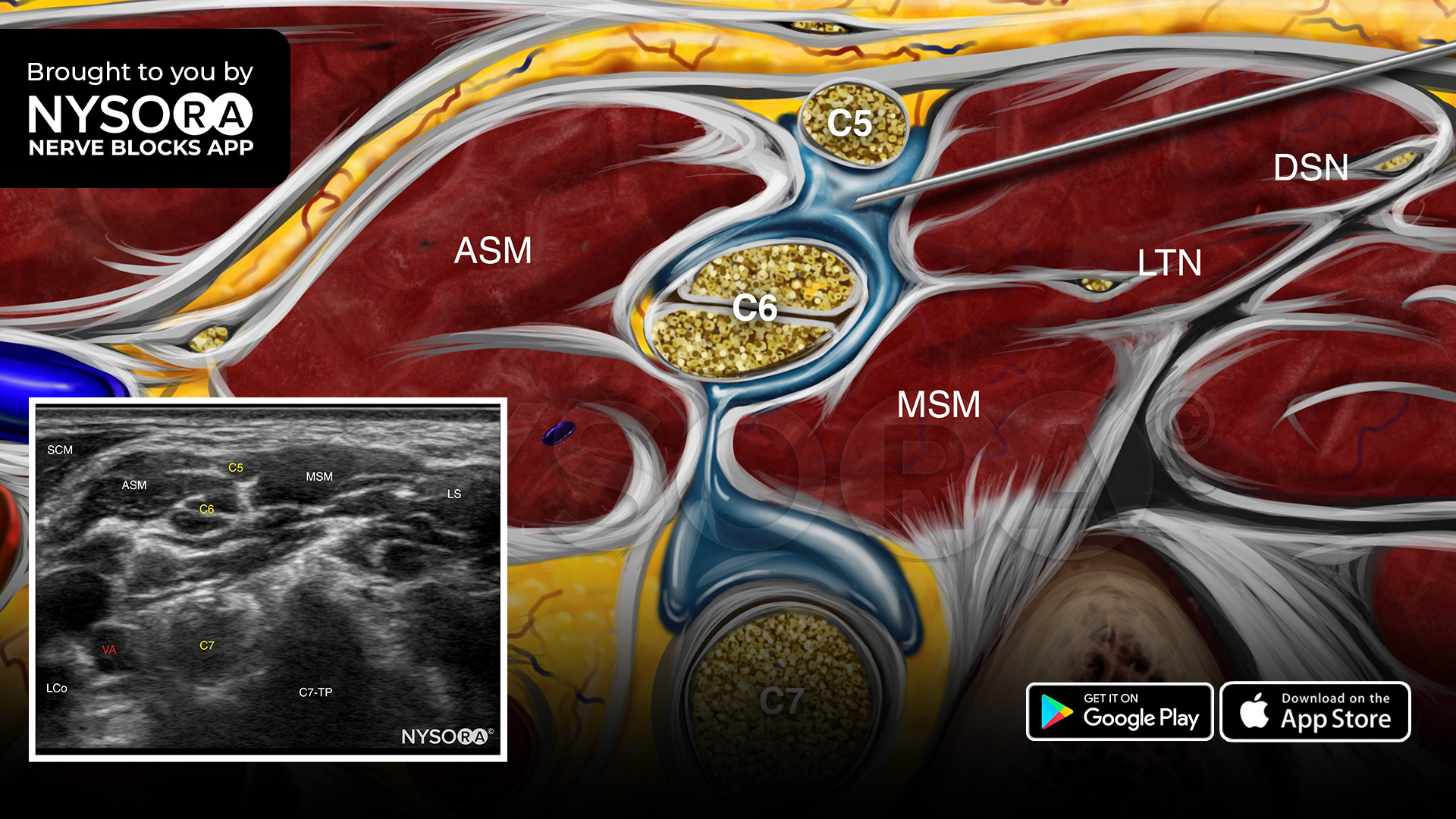
An interscalene brachial plexus block relies on dispersion of the larger volume of local anesthetic within the interscalene groove to accomplish blockade of the brachial plexus. In our practice, we approach this block closer to the clavicle, rather than a commonly described approach at the level of the cricoid cartilage.
An interscalene brachial plexus block relies on dispersion of the larger volume of local anesthetic within the interscalene groove to accomplish blockade of the brachial plexus. In our practice, we approach this block closer to the clavicle, rather than a commonly described approach at the level of the cricoid cartilage. At this lower level, the interscalene grove is shallower, easier to identify and the distribution of anesthesia is also adequate for elbow and forearm surgery. This block has a substantial clinical applicability and it well may be the most commonly used block in our practice. In addition, the needle insertion is much more lateral, which makes vascular puncture rare and the performance of the block much easier for trainees. We use this block routinely for shoulder, arm, and forearm surgery. The most common indications for this block in our practice are shoulder surgery and insertion of arteriovenous grafts for hemodyalisis.
Each trunk divides onto an anterior and a posterior division behind the clavicle, at the apex of the axilla. Within the axilla, the divisions combine to produce the three cords, which are named lateral, medial, and posterior, according to their relationships to the axillary artery. From there on, individual nerves are formed as these neuronal elements descend distally.
The interscalene approach to brachial plexus blockade results in consistent anesthesia of the shoulder, arm, and elbow. The interscalene block is not recommended for hand surgery; more distal approaches to the brachial plexus should be used instead (e.g., infraclavicular, axillary). Note that the labeled areas without a color shade are not anesthetized consistently with the interscalene brachial plexus block.
The patient is in the supine or semisitting position with the head facing away from the side to be blocked. The arm should be rested on the bed or on an arm board to allow for detection of responses to nerve stimulation. Removal of a cast prior to the block performance is beneficial for detecting twitches, but not essential as the responses to nerve stimulation are usually mixed (stimulation of the cords and trunks, rather than specific nerves).
The following surface anatomy landmarks are helpful for identifying the interscalene grove in patients undergoing interscalene brachial plexus block:
Sternal notch
Clavicle
Sternal head of the sternocleidomastoid muscle
Clavicular head of the sternocleidomastoid muscle
Mastoid process
TIP: Proportions of the shoulder girdle, size of the neck, prominence of the muscles and so forth, greatly vary among patients. For this reason, always perform a "reality check" when in doubt by estimating the three bony landmarks: sternal notch, clavicle, and mastoid process
Anatomic landmarks
When getting ready to perform the interscalene brachial plexus block, the following three landmarks should always be marked with a pen:
Clavicle
Posterior border of the clavicular head of the sternocleidomastoid muscle
External jugular vein
There are four maneuvers that can be used to accentuate the landmarks for this block:
Ask the patient to slightly face away from the side to be blocked. This maneuver tenses the sternocleidomastoid muscles and makes this landmark much more prominent.
Ask the patient to reach the ipsilateral knee on the side to be blocked or passively pull the wrist toward the knee. This maneuver flattens the skin of the neck and helps to identify both the scalene muscles and the external jugular vein.
Ask the patient to lift the head off the table while facing away. This maneuver tenses the sternocleidomastoid muscles and helps to identify the posterior border of the clavicular head of the sternocleidomastoid muscle.
Ask the patient to forcefully sniff while palpating the interscalene groove. The sniffing tenses the accessory respiratory muscles (scalene muscles) and the fingers of the palpating hand often fall into the scalene groove with this maneuver.
TIPS:
All anatomic landmarks outlined in the "surface landmarks section" are important in estimating the site for needle insertion. However, in patients with good anatomy the clavicle, clavicular head of the sternocleidomastoid muscle, and external jugular vein are all that is really important.
An argument can be made that the external jugular vein is not a consistent landmark and that it has a highly variable course. While this is certainly true, we find that the interscalene groove is almost always immediately in front or behind the external jugular vein.
In patients with difficult anatomy, the clavicle and external jugular vein often prove to be the most reliable landmarks.
After cleaning the skin with an antiseptic solution, local anesthetic is infiltrated subcutaneously at the determined needle insertion site. This is the most uncomfortable part of the entire block procedure (provided that low-intensity nerves stimulation is used to identify the brachial plexus).
TIPS:
Care should be taken to infiltrate local anesthetic in the subcutanous tissue plane only because the brachial plexus is very shallow at this location. Deeper needle insertion may easily result in injection into the brachial plexus sheath and a consequent difficulty in obtaining the twitch response.
Local anesthetic is best infiltrated tangentially rather at a single insertion point. This both ensures a superficial injection and allows for needle repositioning during block performance, if required.
Hand position
The fingers of the palpating hand should be gently, but firmly pressed between the anterior and middle scalene muscles to shorten the skin-brachial plexus distance. The skin over the neck is highly movable and care should be taken to stabilize the fingers as well as to distend the skin between the two fingers to assure accuracy in needle advancement and redirections. The palpating hand should not be moved during the entire block placement procedure to allow for precise redirections of the angle of the needle insertion when necessary.
TIPS:
To ensure proper position of the palpating hand, first feel the posterior border of the clavicular head of the sternocleidomastoid muscle. Asking the patient to lift the head up assures accurate palpating of this landmark. Then, slowly move the palpating fingers posteriorly until they fall in the interscalene groove muscles.
The most common mistake made when identifying the interscalene groove is too anterior needle insertion. Whenever the insertion site seems to be too anterior, the chances are it is! Go back to the posterior border of the clavicular head of the sternocledimoastoid muscle and reassess the anatomy.
Needle advancement
A needle connected to the nerve stimulator is inserted between the palpating fingers and advanced at an angle almost perpendicular to the skin plane. The needle must never be oriented cephalad. Slight caudal orientation of the needle is the single best measure to take to prevent inadvertent insertion of the needle toward the cervical spinal cord. The nerve stimulator should be initially set to deliver 0.8 mA (2 Hz, 100µsec). The needle is advanced slowly until stimulation of the brachial plexus is obtained. This typically occurs at a depth of 1-2 cm in almost all patients. Once appropriate twitches of the brachial plexus are elicited, 35-40 mL of local anesthetic is injected slowly with intermittent aspiration to rule out intravascular injection.
TIPS:
The needle should never be advanced beyond 2.5 cm to avoid the risk of complications (cervical cord injury, pneumothorax, carotid artery puncture).
Never inject when resistance (high pressure) on injection of local anesthetic is met. In this scenario, do not move the palpating hand from its position, simply flush the needle and repeat the procedure.
Stimulation of the brachial plexus with a current intensity of 0.2-0.4 mA. The following twitches all result in the same success rate:
Pectoralis muscle
Deltoid muscle
Triceps muscles
Biceps muscle
Any twitch of the hand or forearm
TIPS:
A controversy exists over whether nerve stimulation or a paresthesia technique is better, safer, and more precise in interscalene brachial plexus block. The truth is, due to the superficial position of the brachial plexus in the interscalene groove, either technique can be used. In our practice, however, we use only nerve stimulation technique. This allows for appropriate sedation and a much more pleasant experience for the patient.
Stimulation of the brachial plexus with a higher current (e.g., >1.0 mA) results in an exaggerated response and unnecessary discomfort for patient. In addition, an unpredictably strong response often causes dislodgement of the needle position and withdrawal reaction by the patient.
A controversy exists over the optimal motor response to nerve stimulation in the brachial plexus. In our large series, there is no difference in the success rate among various twitches as long as the stimulation is obtained using similar stimulating current intensity (0.2-0.4 mA).
Never inject local anesthetic when stimulation is obtained at a current intensity < 0.2 mA. Coupled with forceful injection of large volumes of local anesthetic, this carries a risk of injection under pressure within the epidural sleeve and the consequent spread of local anesthetic toward subarachnoid space (total spinal anesthesia).
Attention should be paid to avoid interpretation of the diaphragmatic and trapezius twitch as the stimulation of the brachial plexus. Misinterpretation of these twitches are among the most common causes of block failures.
Whenever in doubt, palpate the muscle that appears to be twitching to ensure the proper response.
Failure to obtain brachial plexus stimulation on the first needle pass
When insertion of the needle does not result in upper extremity muscle stimulation, the following maneuvers can be followed:
Keep the palpating hand in the same position and the skin between the fingers stretched.
Withdraw the needle to the skin level, redirect 15o posterior, and repeat the needle advancement.
Withdraw the needle to the skin, redirect 15o anterior, and repeat the needle insertion.
Never insert the needle beyond 2 cm in slim and 3 cm in obese patients; the brachial plexus is invariably superficial.
TIPS:
When these maneuvers fail to result in motor response, carefully and methodically reposition the palpating hand 1-cm posterior or anterior using an intuitive approach and repeat steps 1 through 3.
Failure to stimulate after the above steps should prompt needle withdrawal and a reassessment of the landmarks.
Keep in mind that failure to obtain brachial plexus stimulation is most commonly a result of a too anterior needle insertion.
Do not forget to ascertain that the nerve stimulator is functional and properly connected.
Increasing the current intensity >1.0 mA is more likely to result in patient discomfort then in helping to localize the brachial plexus
Interpreting Responses to Nerve Stimulation
Some common responses to nerve stimulation and the course of action to obtain the proper response are shown in table below:
Response Obtained
Interpretation
Problem
Action
Local twitch of the neck muscles
Direct stimulation of the anterior scalene or sternocleoidomastoid muscles
Needle pass is in the wrong plane; usually anterior and medial to the plexus
Withdraw the needle to the skin level and reinsert 15o posteriorly
Needle contacts bone at 1-2 cm depth; no twitches are seen
The needle is stopped by the transverse process
The needle is inserted too posteriorly; the needle is contacting the anterior tubercles of the transverse process
Withdraw the needle to the skin level and reinsert 15o anteriorly
Twitches of the diaphragm
This is the result of stimulation of the phrenic nerve
The needle is inserted too anteriorly
Withdraw the needle and reinsert 15o posteriorly
Arterial blood noticed in the tubing
Puncture of the carotid artery (most common)
The needle insertion and angulation is too anterior
Withdraw the needle and keep a steady pressure 2-3 minutes; reinsert 1-2 cm posteriorly
Pectoralis muscle twitch
Brachial plexus stimulation (C4-5)
Accept and inject local anesthetic
Twitch of the scapula
Twitch of the serratus anterior muscle; stimulation of the thoracodorsal nerve
Needle position is posterior/deep to the brachial plexus
Withdraw the needle to the skin level and reinsert the needle anteriorly
Trapezius muscle twitches
Accessory nerve stimulation
Needle posterior to the brachial plexus
Withdraw the needle and reinsert
Twitch of: pectoralis, deltoid, triceps, biceps, forearm, and hand muscles
The brachial plexus at the site of an interscalene block requires a relatively large volume of local anesthetic to achieve anesthesia of the entire plexus. The choice of the type and concentration of local anesthetic should be based on whether the block is planned for surgical anesthesia or pain management. Due to the highly vascular area and potential for inadvertent intravascular injection, the local anesthetic solution should be injected slowly with frequent aspiration.
Onset (min)
Anesthesia (hrs)
Analgesia (hrs)
3% 2-Chloroprocaine (+HCO3 + epinephrine)
5-10
1.5
2.0
1.5% Mepivacaine (+HCO3)
10-20
2-3
2-4
1.5% Mepivacaine (+HCO3 + epinephrine)
5-15
2.5-4
3-6
2% Lidocaine (+ HCO3)
10-20
2.5-3
2-5
2% Lidocaine (+ HCO3 + epinephrine)
5-15
3-6
5-8
0.5% Ropivacaine
15-20
6-8
8-12
0.75% Ropivacaine
5-15
8-10
12-18
0.5% Bupivacaine (+ epi)
20-30
8-10
16-18
TIPS:
Always assess the risk-benefit ratio of using large volumes and concentration of long-acting local anesthetic for lumbar plexus block.
Smaller volumes and concentrations can be used successfully for analgesia (e.g ,15-20 mL).
When low-intensity current nerve stimulation and slow needle advanced are used, interscalene brachial plexus block is associated with minimal patient discomfort. Thus, excessive sedation is not only unnecessary, but also disadvantageous with this technique because patient cooperation during landmark assessment and block performance is beneficial. Besides, administration of midazolam tends to decrease the tonus of the interscalene and sternocleidomastoid muscles, making palpation and identification of these landmarks difficult. We typically use small doses of midazolam (e.g., 1-2 mg) to achieve a comfortable and cooperative patient during nerve localization.
The onset time for this block is short. The first sign of the blockade is the loss of coordination of the shoulder and arm muscles. This sign is seen sooner than the onset of sensory blockade or temperature change and when present within 1-2 minutes after injection, it has a very high positive predictive value for a pending successful brachial plexus blockade. In fact, this is the single test that we perform before allowing the surgeons to proceed with the preparation for surgery. In patients undergoing shoulder arthroscopic procedures, it is important to note that the arthroscopic portals can be inserted outside the cutaneous distribution of the interscalene block. Local infiltration at the site of the incision by the surgeon is all that is needed as the entire shoulder joint and deep tissues are anesthetized with the interscalene block.
Many patients will developed a horse voice, mild ipsilateral ptosis (Horner's syndrome), and nasal congestion after interscalene block. Proper explanation and reassurance is all that is needed by patients.
An interscalene block inevitably results in ipsilateral diaphragmatic paralysis (phrenic nerve block). The significance of this is often debated and avoidance of this block is suggested in patients with chronic respiratory disease, such chronic obstructive lung disease and bronchial asthma. Although unilateral diaphragmatic paralysis should be kept in mind when choosing an interscalene blockade, we avoid the use of this block only in patients whose breathing involves the use of accessory respiratory muscles.
Appropriate intravenous sedation, communication with the patient, lifting drapes off patient's face, and shielding the ears from the noise are all necessary ingredients to success with interscalene block in patients undergoing shoulder surgery.
Avoid multiple needle insertions, particarly in anticoagulated patients
Keep a 5-minute steady pressure when carotid artery is inadvertenly punctured
Use a single-shot needle to localize the brachial plexus in patients with difficult anatomy
In the absence of spontaneous bleeding, the use of anticoagulant therapy should not be regarded as a contraindication for this block
Vascular puncture
Vascular puncture is not common with this technique
Steady pressure of 5 minutes duration should be maintained when the carotid artery is punctured (rare)
Local anesthetic toxicity
Systemic toxicity due to absorbtion of local anesthetic after intrascalene blockade is rare
Systemic toxicity most commonly occurs during or shortly after injection of local anesthetic; this is most commonly caused by an inadvertent intravascular injection or channeling or forcefully injected local anesthetic into small veins or lymphatic channels cut during needle manipulation
Large volumes of long-acting anesthetic should be reconsidered in older and frail patients
Careful and frequent aspiration should be performed during the injection
Avoid forceful, fast injection of local anesthetic
Nerve injury
Never inject local anesthetic when pressure on injection is encountered
Local anesthetic should never be injected when patient complains of severe pain or exhibits a withdrawal reaction on injection
Total spinal anesthesia
When stimulation is obtained with current intensity of <0.2mA, the needle should be pulled back to obtain the same response with the current >0.2mA before injecting local anesthetic to avoid injection into the dural sleeves and the consequent epidural or spinal spread
Never inject local anesthetic when pressure on injection is encountered
Horner's syndrome
Occurence of ipsilateral ptosis, hyperemia of the conjuctiva, and nasal congestion is common and it is dependent on the site of injection (less common with the low intrascalene approach) and total volume of local anesthetic injected; the patients should be instructed on the occurence of this syndrome and reassured about its benign nature
Diaphragmic paralysis
Invariably present; avoid interscalene blockade or the use of a large volume of local anesthetic in patients who have severe, chronic respiratory disease and use accessory respiratory muscles during breathing at rest
Agostoni M, Marchesi M, Fanelli G, Reineke R: Analgesic brachial plexus block for reduction of shoulder dislocation. Reg Anesth 1996; 21:373
Borgeat A, Ekatodramis G, Kalberer F, Benz C: Acute and nonacute complications associated with interscalene block and shoulder surgery: a prospective study. Anesthesiology 2001; 95:875-80
Brown DL, Bridenbaugh LD: The Upper Extremity: Somatic Block . In Cousins, M.J., and Bridenbaugh PO (eds): Neuronal Blockade in Clinical Anesthesia and Management of Pain. Philadelphia, J.B. Lippincott-Raven Publishers, 1988; pp 345-71
Chelly JE: Peripheral Nerve Blocks. A Color Atlas. Philadelphia, Lippincot, 1999
Coleman MM, Peng P: Pectorialis major in interscalene brachial plexus blockade. Reg Anesth Pain Med 1999; 24:190-1
Hadzic A, Vloka JD, Kuroda MM, Koorn R, Birnbach DJ: The practice of peripheral nerve blocks in the United States: a national survey. Reg Anesth Pain Med 1998; 23:241-6
Long TR, Wass CT, Burkle CM: Perioperative interscalene blockade: an overview of its history and current clinical use. J Clin Anesth 2002; 14:546-56
Raj PP: Textbook of Regional Anesthesia. London, Churchill Livingston, 2002
Silverstein WB, Saiyed MU, Brown AR: Interscalene block with a nerve stimulator: a deltoid motor response is a satisfactory endpoint for successful block. Reg Anesth Pain Med 2000; 25:356-9
White JL: Catastrophic complications of interscalene nerve block. Anesthesiology 2001 ; 95:1301
Wong GY, Brown DL, Miller GM, Cahill DR: Defining the cross-sectional anatomy important to interscalene brachial plexus block with magnetic resonance imaging. Reg Anesth Pain Med 1998; 23:77-80