Home | Nerve Blocks | Nerve Stimulator Techniques | Sciatic Nerve Block (Anterior Approach)

Sciatic Nerve Block (Anterior Approach)

image

The anterior approach to a sciatic block is an advanced nerve block technique. The block is well suited for surgery on the leg below the knee, particularly on the ankle and foot. It provides complete anesthesia of the leg below the knee with the exception of the medial strip of skin, which is innervated by the saphenous nerve.


Overview

  • Indications: Surgery on the knee, tibia, fibula, ankle, and foot
  • Landmarks: Femoral crease, femoral artery
  • Nerve stimulation: Twitch of the foot or toes at 0.2-0.5 mA current
  • Local anesthetic: 20 mL
  • Complexity level: Advanced
Image

Back to top


General considerations

The anterior approach to a sciatic block is an advanced nerve block technique. The block is well suited for surgery on the leg below the knee, particularly on the ankle and foot. It provides complete anesthesia of the leg below the knee with the exception of the medial strip of skin, which is innervated by the saphenous nerve. Combined with the femoral nerve block, anesthesia of the entire knee and the leg below the knee level is achieved. It should be noted that the anterior approach is less clinically applicable compared to the posterior approach. The sciatic nerve is blocked more distally and a higher level of skill is required to achieve reliable anesthesia. Consequently, we reserve the use of this block for patients that cannot be repositioned into the lateral position needed for the posterior approach. This technique is not suitable for catheter insertion because of the deep location and perpendicular angle of insertion required to reach the sciatic nerve.

Back to top


Regional anesthesia anatomy

Image

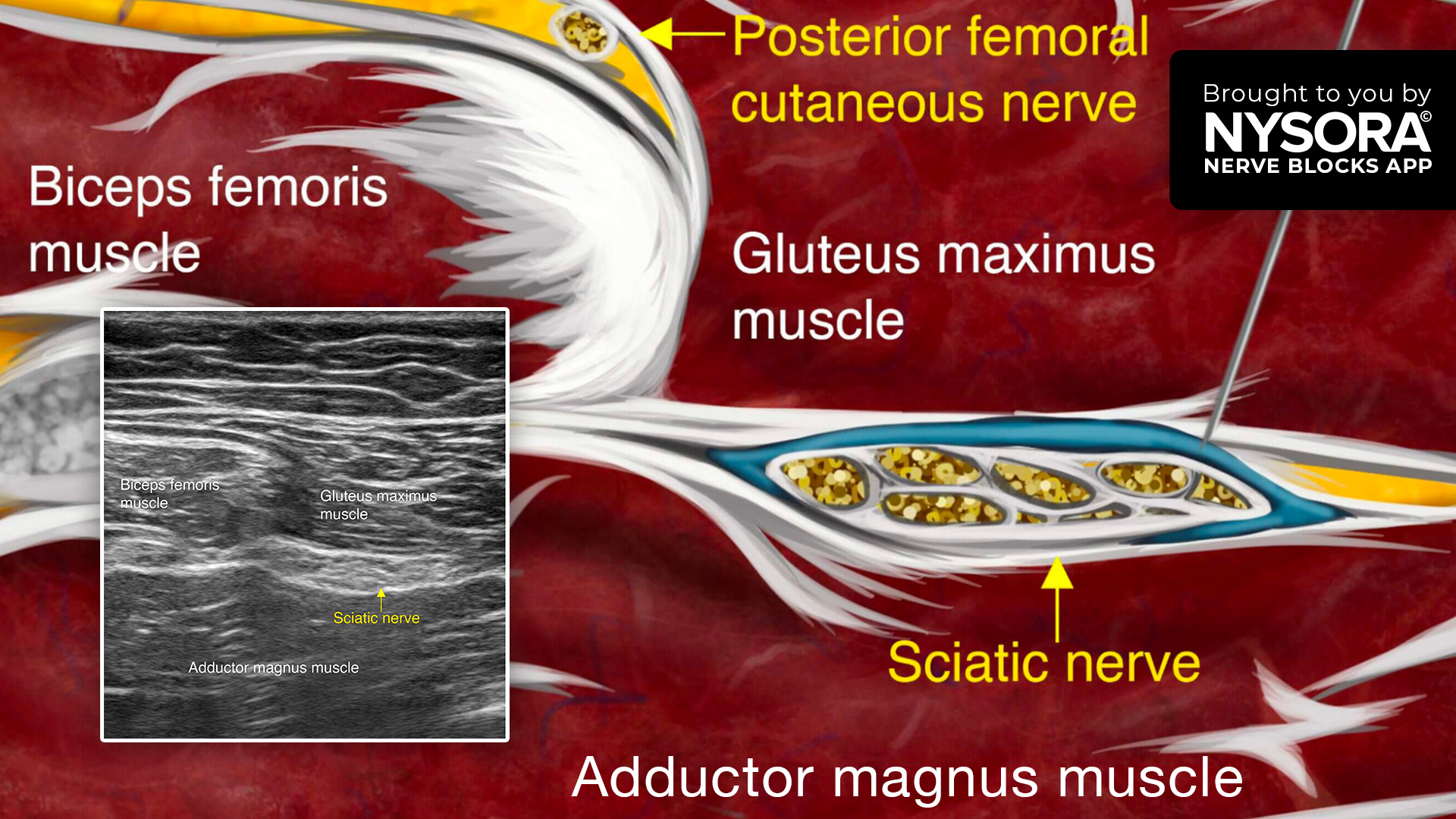
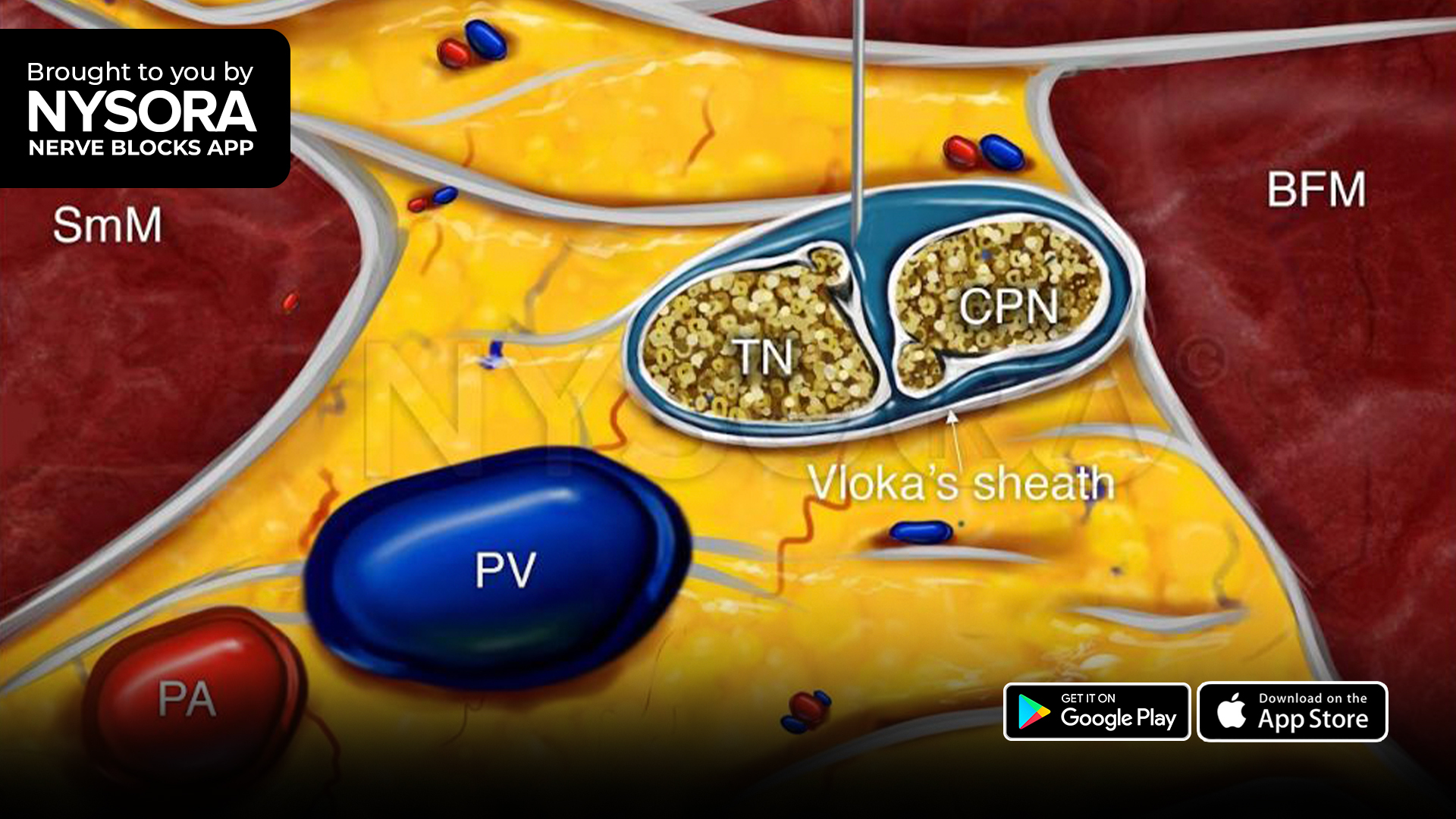
The sciatic nerve is formed from the L4 through S3 roots. The roots of the lumbosacral plexus form on the anterior surface of the sacrum and are assembled into the sciatic nerve on the anterior surface of the piriformis muscle. The course of the nerve can be estimated by drawing a line on the back of the thigh beginning from the apex of the popliteal fossa to the midpoint of the line joining the ischial tuberosity to the apex of the greater trochanter. The nerve exits the pelvis through the greater sciatic notch and gives off numerous articular (hip, knee) and muscular branches. Once in the upper thigh, the nerve continues its descent behind the lesser trochanter and becomes completely covered by the femur. The only part of the nerve that is accessible to blockade through an anterior approach is a short segment slightly above and below the lesser trochanter. The muscular branches of the sciatic nerve are distributed to the biceps femoris, semitendinosus, semimembranosus, and to the ischial head of the adductor magnus; the branches of the latter two arise by a common trunk. The nerve to the short head of the biceps femoris comes from the common peroneal division, the other muscular branches from the tibial division of the sciatic nerve. At the level of the blockade, the nerve is partly hidden by the femur (minor trochanter).

TIPS:

  • There are variations in the course of the sciatic nerve through the gluteal region. In some 15% of people, the piriformis muscle divides the nerve. The common peroneal component passes through the muscle or above it, and only the tibial component passes below the muscle.
  • The components of the sciatic nerve diverge at a variable distance from the knee joint; most sciatic nerves diverge at or above 7 cm from the popliteal fossa crease.

Back to top


Distribution of Anesthesia

Image

A sciatic nerve block through the anterior approach results in anesthesia of the hamstring muscles below the blockade and the entire leg below the knee (including ankle and foot), except a strip of skin over the medial aspect. The saphenous nerve, a superficial cutaneous branch of the femoral nerve, provides innervation to this area of skin. The posterior cutaneous nerve of the thigh and articular branches to the hip are not anesthetized with this technique. Therefore, the anterior approach to a sciatic block can be chosen for selected patients for knee or below knee surgery. A proximal thigh tourniquet should be avoided with this technique because of the risk of prolonged ischemia of the sciatic nerve.

The shaded areas indicate the cutaneous distribution of anesthesia with the anterior approach to the block of the sciatic nerve. In addition, two distal thirds of the hamstring muscles are also anesthetized with this technique (not shown in the illustration).

Back to top


Patient Positioning

The patient is in the supine position with both legs fully extended.

TIP: Placing a pillow underneath the patient's hips can be beneficial to optimize access to the groin and landmarks for the block.

Image

Back to top


Equipment

Image

A standard regional anesthesia tray is prepared with the following equipment:

  • Sterile towels and 4"x4" gauze packs
  • 20-mL syringes with local anesthetic
  • Sterile gloves, marking pen, and surface electrode
  • One 1½" 25-gauge needle for skin infiltration
  • A 15-cm long, short bevel, insulated stimulating needle
  • Peripheral nerve stimulator

TIP: Although it may appear that a 150-mm needle is too long, such as in a slim adult, more often than not, shorter needles (e.g., 100 mm) will be unable to reach the sciatic nerve and may lead to unnecessary unsuccessful attempts.

Back to top


Landmarks

Image

The only surface anatomy landmark that is important in determining the insertion point for the needle is the femoral crease (white arrows).

TIP: Note that the technique described differs from common descriptions of the anterior approach to sciatic block. This technique does not rely on identification of the inguinal ligament, which can be difficult to estimate in obese patients. Instead, this much simplified technique relies on the femoral crease, which is easily recognizable even without palpation in all patients.

The following landmarks should routinely be outlined using a marking pen:
  1. Femoral crease
  2. Femoral artery pulse
  3. Needle insertion point marked 4-5 cm distally on the line passing through the pulse of the femoral artery and perpendicular to the femoral crease.

ImageTIPS:

  • Avoid pushing the soft tissues laterally or medially during palpation of the femoral artery. The skin and subcutaneous tissue in this area are highly movable and lateral or medial displacement of the tissues may skew the femoral artery landmark.
  • The femoral crease is easily identifiable in all patients. Retraction of the adipose tissue of the lower abdomen is very useful for exposing the femoral crease, facilitating palpation of the femoral artery, and block placement in obese patients.

Back to top


Technique

Image

Local anesthetic skin infiltration

After cleaning the area with an antiseptic solution, local anesthetic is infiltrated subcutaneously at the determined needle insertion site. The anesthesiologist performing the block should stand on the side of the patient to be able to monitor the patient and his or her responses to nerve stimulation.

Needle insertion and advancement

Image

The fingers of the palpating hand should be firmly pressed against the quadriceps muscle to decrease the skin-nerve distance. The needle is introduced at a perpendicular angle to the skin plane. The nerve stimulator should be initially set to deliver 1.5 mA current (2 Hz, 100µsec). Stimulation typically occurs at a depth of 10-12 cm. After negative aspiration for blood, 20 mL of local anesthetic is slowly injected. Any resistance to injection of local anesthetic should prompt cessation of the attempts to inject and needle withdrawal by 1mm. The injection is then reattempted. Persistent resistance to injections should prompt complete needle withdrawal and flushing before reintroduction of the needle.

TIP: Because the needle transverses muscle planes, occasionally it gets obstructed by the muscle fibers. When resistance to injection is met, it is never correct to assume that the needle is obstructed. The correct action is to withdraw the needle, check its patency by flushing, and reinsert.

Back to top


Goal

Visible or palpable twitches of the calf muscles or foot or toes at 0.2-0.5 mA current.

TIPS:

  • Image
    Local twitches of the quadriceps muscle are often elicited during needle advancement. The needle should be advanced past these twitches.
  • Although there is a concern of femoral nerve injury with further needle advancement, this concern is theoretical. At this level, the femoral nerve is divided into smaller terminal branches that are movable and unlikely to be penetrated by a slowly advancing, blunt tipped needle.
  • Resting the heel on the bed surface may prevent the foot from twitching even when the sciatic nerve is stimulated. This can be prevented by placing the ankle on a footrest or by having an assistant continuously palpate the calf or Achilles tendon.
  • Because branches to the hamstrings muscle may depart the main trunk of the sciatic nerve at the level of needle insertion, twitches of the hamstrings should not be accepted as a reliable sign of sciatic nerve localization.
Image
Image
Image


TIPS: Needle advancement

Bone contact is frequently encountered during needle advancement. This indicates that the needle has contacted the femur (usually lesser trochanter).

When the needle is stopped by the bone, the algorithm below is followed:

  1. The needle is withdrawn 2-3 cm.
  2. The foot is rotated inward (internal rotation).
  3. The needle is advanced to pass by the trochanter minor.


  1. The internal rotation of the leg swings the lesser trochanter downward and away from the path of the needle and often allows passage of the needle toward the sciatic nerve.
  2. When the described algorithm fails to facilitate passage of the needle, the needle is withdrawn back to the skin and reinserted at a slight medial angulation and the steps 1 through 3 can be repeated.


Failure to pass the needle or achieve nerve stimulation should prompt withdrawal of the needle and the following actions are taken:

  1. Assure that the nerve stimulator is functional, properly connected to the patient and to the needle, and that it is set to deliver a current of desired intensity.
  2. Reassess the landmarks.
  3. Insert the needle 1-cm medial to the original insertion site.


Some common responses to nerve stimulation and the course of action to take to obtain the proper response:

Troubleshooting

Response Obtained Interpretation Problem Action
Twitch of the quadriceps muscle (patella twitch) Common; stimulation of the branches of the femoral nerve Too shallow (superficial) placement of the needle Continue advancing the needle
Local twitch at the femoral crease area Direct stimulation of the iliopsoas or pectineus muscles Too superior insertion of the needle Stop the procedure and reassess the landmarks
Hamstring twitch The needle may be stimulating branch(es) of the sciatic nerve to the hamstring muscle; direct stimulation of the hamstrings with higher current is also possible Unreliable-difficult to determine whether the needle is in the proximity of the sciatic nerve Withdraw the needle and redirect slightly medially or laterally (5-10o)
The needle is placed deep (12-15 cm) but twitches were not elicited and bone is not contacted The needle is not in the proper position The needle is likely too medial Withdraw and redirect slightly laterally
Twitches of the calf, foot or toes Stimulation of the sciatic nerve None Accept and inject local anesthetic

Back to top


Choice of Local Anesthetic

Sciatic blockade requires a relatively low volume of local anesthetic to achieve anesthesia of the entire trunk of the nerve. The choice of the type and concentration of local anesthetic should be based on whether the block is planned for surgical anesthesia or pain management. Since the duration of sciatic blockade lasts longer than any other peripheral nerve block, we tend to use shorter acting local anesthetic more commonly. However, when prolonged pain relief is sought, longer acting local anesthetic may be more appropriate.

  Onset
(min)
Anesthesia (hrs) Analgesia (hrs)
3% 2Chlotoprocaine (+ HCO3) 10-15 2 2.5
1.5% Mepivacaine (+ HCO3) 10-15 4-5 5-8
2% Lidocaine (+ HCO3) 10-20 5-6 5-8
0.5% Ropivacaine 15-20 6-12 6-24
0.75% Ropivacaine 10-15 8-12 8-24
0.5 Bupivacaine (or I-bupivacaine) 15-30 8-16 10-48

TIP: We suggest avoiding the use of epinephrine for the anterior approach to sciatic nerve block because of the risk of nerve ischemia due to the combined effects of the vasoconstrictive action of epinephrine, nerve stretching, and application of a tourniquet.

Back to top


Block Dynamics and Perioperative Management

An anterior approach to a sciatic block can be associated with significant patient discomfort because the needle must transverse multiple muscle planes on its way to the sciatic nerve. We routinely use 2-6 mg of midazolam IV and narcotic (500 to 1000 µg of alfentanil) to make the patient comfortable and cooperative during this procedure. The need for this premedication is further exemplified by the fact that most of our indications for this block are in patients with lower extremity trauma, making patient positioning and leg manipulation even more uncomfortable. A typical onset time for this block is 10-25 minutes, depending on the type, concentration, and volume of local anesthetic used. Usually, the first sign of blockade onset is reported by the patient in the form of the foot feeling "different" or an inability to wiggle the toes.

TIP: Inadequate skin anesthesia despite an apparent timely onset of the blockade can occur. With some blocks, it can take up to 30 minutes for full sensory-motor anesthesia to develop. Local infiltration at the site of the incision by the surgeon is often all that is needed to allow the surgery to proceed.

Back to top


Complications and How to Avoid Them

Infection
  • A strict aseptic technique should always be used
Hematoma
  • Avoid multiple needle insertions
  • This technique should not be performed in anticoagulated patients
Vascular puncture
  • Vascular puncture is not common with this technique; when it occurs, it is usually because of too medial a placement of the needle (femoral artery and vein)
Local anesthetic toxicity
  • Systemic toxicity after sciatic blockade is not common; however, it is important to avoid injecting large volumes and doses of local anesthetic because of the proximity of the muscle beds and the potential for rapid absorption
Nerve injury
  • A sciatic block is uniquely sensitive to mechanical and pressure injury
  • Nerve stimulation and slow needle advancement should be employed
  • Local anesthetic should never be injected when a patient complains of pain
  • Never forcefully inject local anesthetic when an abnormally high pressure of injection is noted
  • It is never correct to assume that the needle is obstructed with tissue debris when resistance to injection is met; the needle should be taken out and checked for patency (flush) before reinsertion and another attempt is made to inject
  • When stimulation is obtained with current intensity of <0.2 mA, the needle should be pulled back to obtain the same response with a current intensity if 0.2-0.5mA before injecting local anesthetic
Tourniquet
  • Avoid the use of a tourniquet when possible; injection of the local anesthetic within the sciatic nerve sheath; epinephrine, and a tourniquet over the site of injection can all combine to cause ischemia of the sciatic nerve.
Other
  • Instruct the patient and the nursing staff on the care of the insensate extremity
  • Explain to the patient that frequent body repositioning is needed to avoid stretching and prolonged ischemia (sitting) of the anesthetized sciatic nerve
  • Advise a heel padding during prolonged bet rest or sleep

Back to top


Bibliography

  • Chelly JE, Delaunay L: A new anterior approach to the sciatic nerve block. Anesthesiology 1999; 91:1655-60.
  • Magora F, Pessachovitch B, Shoham I.: Sciatic nerve block by the anterior approach for operations on the lower extremity. Br J Anaesth 1974; 46:121-3.
  • Mansour NY: Anterior approach revisited and another new sciatic nerve block in the supine position. Reg Anesth 1993; 18:265-6.
  • McNicol LR: Anterior approach to sciatic nerve block in children: loss of resistance or nerve stimulator for identifying the neurovascular compartment. Anesth Analg 1987; 66:1199-200.
  • McNicol LR: Sciatic nerve block for children. Sciatic nerve block by the anterior approach for postoperative pain relief. Anaesthesia 1985; 40:410-4.
  • Van Elstraete AC, Poey C, Lebrun T, Pastureau F: New landmarks for the anterior approach to the sciatic nerve block: imaging and clinical study. Anesth Analg 2002; 95:214-8.
  • Vloka JD, Hadzic A, April E, Thys DM: Anterior approach to the sciatic nerve block: the effects of leg rotation. Anesth Analg 2001; 92:460-2.

Back to top

  • email Email to a friend
  • print Print version
  • Plain text Plain text
Image gallery
3.25